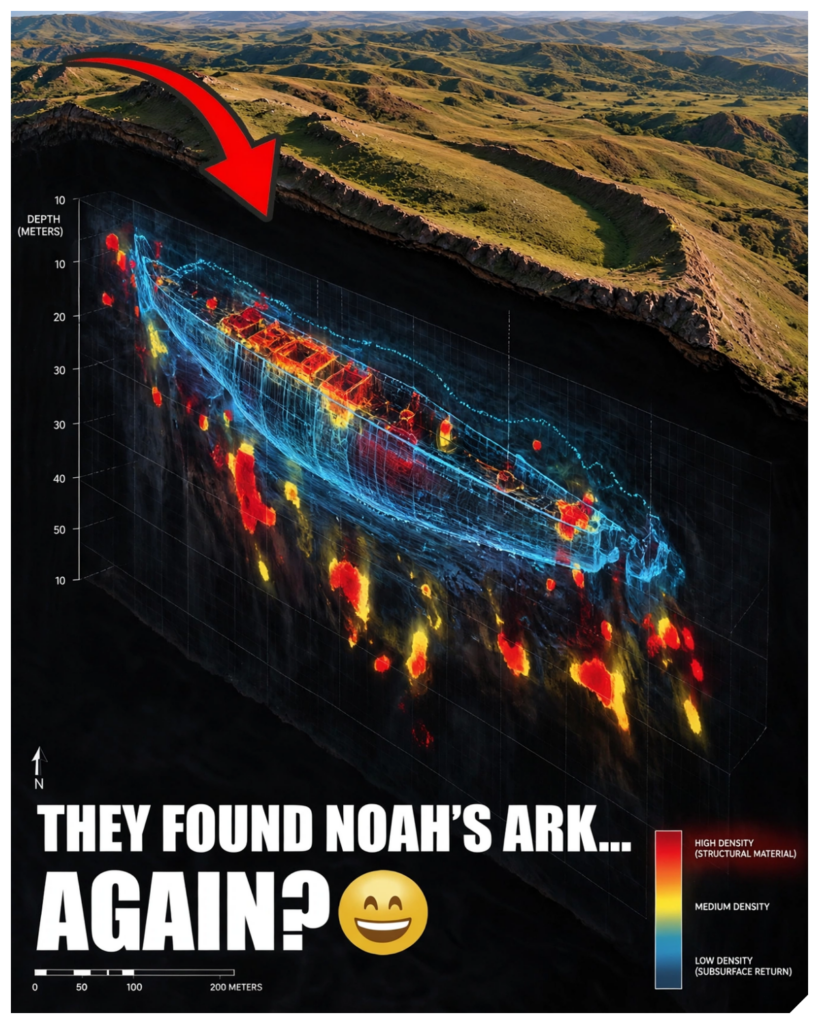
In the autumn of 2026, on a hillside 18 miles south of Mount Ararat, a drill bit broke.
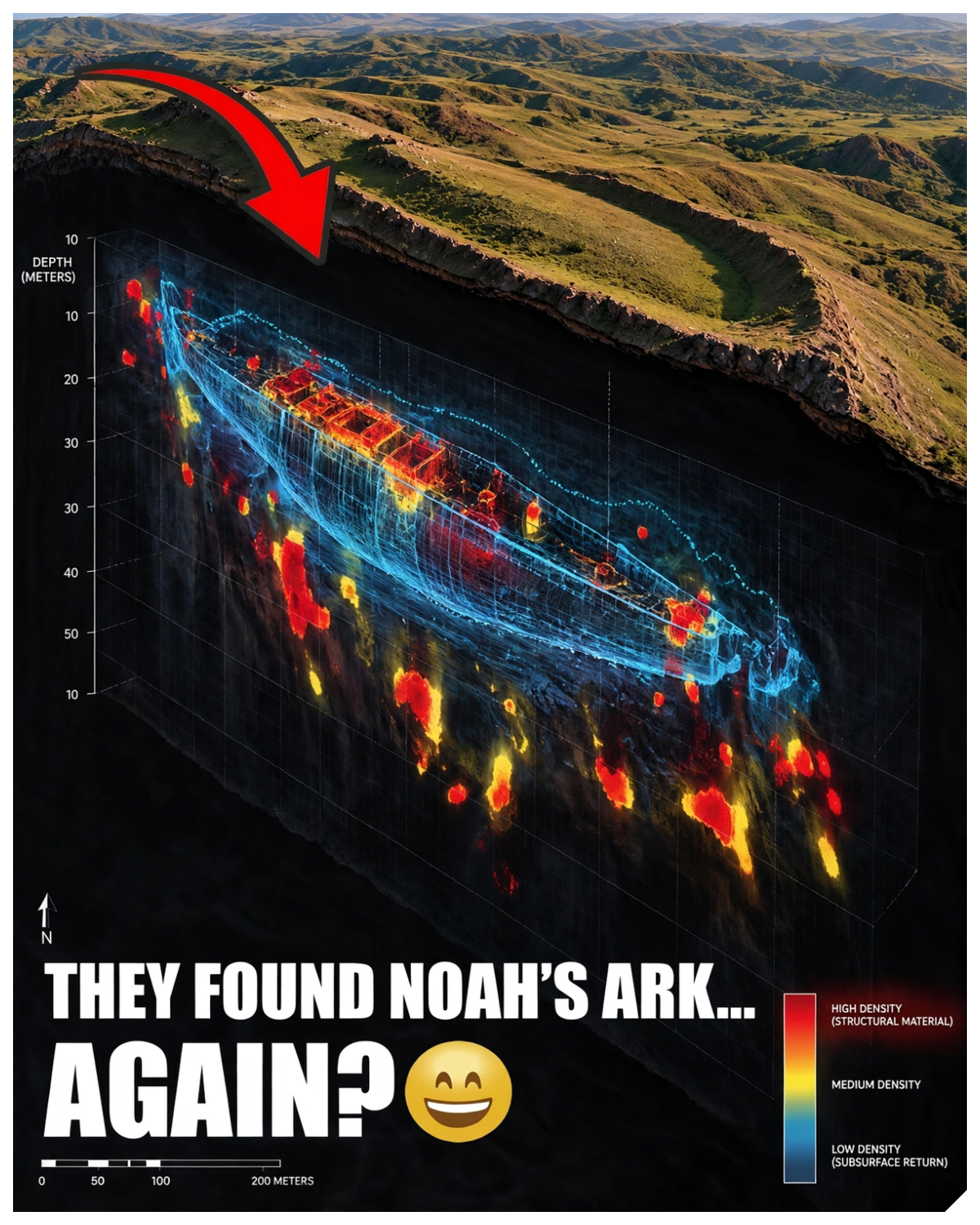
It hit something hard 13 to 16 ft down.
The team says it might be petrified wood.
It might be an ordinary block of stone.
They don’t know yet.
Days earlier, a British newspaper had run the story as an exclusive.
The hill, it said, was 100% confirmed as a man-made object.
The headlines left something out.
The same hill has been called Noah’s Ark before.
In 1987, in 2021, in 2023, in 2025, closer every time, they say.
Whether the ark exists is between you and your faith.
What I want to know is smaller and stranger.
Why does this one hill keep getting found?
So, every announcement goes on a ladder, one rung per claim, and every rung gets one plain question.
And the wood, the way the story is usually told, it begins in May 1948.
Rain and earthquakes strip the mud off a slope near the village of Uzangali, and a long shape rises out of the ground.
In 1959, a Turkish army captain named Ilhan Durupunar spotted it in aerial photographs, an outline shaped like a hole.
In 1960, a team went up with one stated goal to confirm it was the ark.
A television evangelist co-led it and Captain Durupunar went with them.
This was not a team of skeptics.
Life magazine covered the trip on September 5, 1960.
The surveys it reported revealed no sign that the object was man-made.
The team came home and called it natural.
Rung one certainty 0%.
That should have been the end of it.
In the late ‘7s, an amateur archaeologist named Ron Wyatt read that article and went to see for himself.
He said his scans showed walls and decks, that he’d found petrified wood and iron brackets, and that large stones nearby once hung from the ship.
In 1987, the Turkish government declared a national park around the site.
Wyatt convinced a salvage expert named David Fosold, who made nine trips to the hill and published a book in 1988 calling it the Ark.
Then Fossil did something rare.
He changed his mind in print.
In 1996, he and geologist Lawrence Collins wrote in a geocience journal that under the microscope, every material presented as man-made was natural.
It cannot have been Noah’s ark, they concluded, nor even a man-made model.
They added that a shape like this pulls people in, and the hunger to be the one who found it can beat caution.
Rung two.
The man who climbed highest walked back down.
The official version deserves a fair hearing.
Most geologists call this a natural formation.
One of them, Marat Ai, describes a block of limestone that slid down in a landslide and was shaped by an earth flow.
The compartments follow natural fractures.
The anchor stones are local volcanic rock.
The petrified wood was ordinary rock.
The iron brackets weathered volcanic material.
And the right angles on today’s radar, natural folding and erosion, they say.
Even answers in Genesis, the ministry behind the life-size arc replica in Kentucky, has said this site sits in a valley, not on a mountain.
Regular viewers know why that word flow makes me set up.
Even the official story here is mud on the move.
It explains the shape.
It doesn’t explain why the hill keeps getting found.
The hill hasn’t changed.
2010, a different team, a different spot, 13,000 ft up Mount Ararat itself.
A group from Hong Kong said it had gone inside a wooden structure, carbon dated, its website said, to 4,800 years.
One researcher put it at 99.9%.
At the time, they hadn’t revealed a location or let outside archaeologists check it.
2021, back to the same hill.
A team led by Andrew Jones, who first walked this formation in 1997, said radar suggested a man-made object underground.
One report called them near certain.
And the wood, not yet.
2023.
A team from three Turkish and American universities reported marine material from between 5,500 and 3000 BC and said it was close to confirming the site.
2025 more organic matter and potassium inside the outline than outside, the team said and old radar reread as hallways and rooms.
Plus one detail they reported that I can’t let go of.
The grass on the hill turns yellow earlier than the grass around it.
Closer every time they say.
[snorts] 2026 about 20 researchers from five countries led by archaeologist Sanker Atila of Civas Jimuria University with Jones’s group Noah’s Arc Scans in support.
Their radar was built on technology first developed for the US Air Force.
They reported right angles, a hallway around 250 ft long, a buried layer in three parts they compared to decks, and 40% more carbon inside the outline than outside.
Then the headline, 100%.
Then the drilling and the bit that broke on that hard layer.
Then a camera robot lowered into the bore holes named Gopher after the gopher wood of Genesis.
Its wheels reportedly struggled in the loose sediment.
Then Jones told Newsweek that nothing had yet been identified as ancient wood and no age had been established and the wood not yet.
Before the last stretch, thank you to everyone who keeps coming back.
I’m working from published reports, not a lab in Anchora, and some of this may already be out of date.
If you’ve stood on that hill or seen a result I missed, put it in the comments and tell me which wrong you’d have stepped off this ladder or if you’re still climbing.
Now, the oldest sources because they say something the headlines skip.
Genesis doesn’t name a peak.
It says the ark came to rest on the mountains of Ararat, plural.
The peak we call Mount Ararat has carried that name since the Middle Ages and some argue the word once meant the whole region.
The Quran names Aljudi and even its exact location is unsettled.
The dominant view in Islamic tradition points to Mount Kudi near Turkeykey’s border with Iraq, a different mountain entirely.
In 2023, Turkish researchers decided to study both Ararat and Kudi side by side.
So, the old books aren’t the problem.
Read on their own terms, they never pointed at this one hill.
We did.
Back to my question, then.
Why does this hill keep getting found?
I won’t accuse anyone.
I don’t need to.
Much of it is printed in the open.
The drilling news went out in a fundraising letter from the American Group’s director of marketing and fundraising.
It promised that university courses would need rewriting and that Darwinism will be dismantled.
The university called the project one of the most remarkable in the history of archaeology.
A Turkish news channel headed part of its coverage with a question, Noah’s Arc or propaganda?
None of that makes anyone a liar.
A person can believe with their whole heart and still need money to dig.
To be fair, Sankoratila pumped the brakes himself.
He said the 100% posts didn’t fully reflect the results and that headlines claiming a definite discovery were misleading, though he called the data astonishing.
Carbon tests are still to come with lab results due this winter.
It has been 78 years since that rain in 1948, and the certainty around this hill has climbed from 0% to 100%.
The hill hasn’t changed.
This winter, a lab will hand it one more number.
Maybe the believers are right and the ground is about to speak.
Or maybe the geologists are right and this is what longing looks like when you measure it.
Or is there something else in this pattern?
