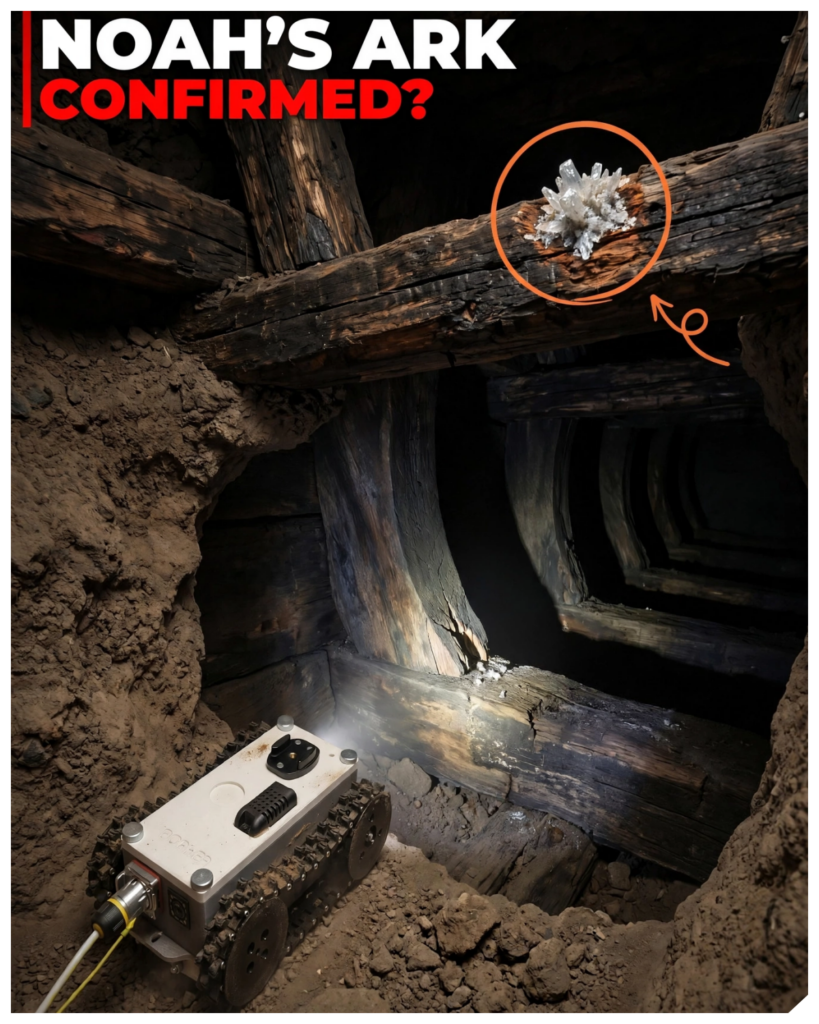
This is the view researchers released after sending Gopher beneath the alleged Noah’s Ark site.
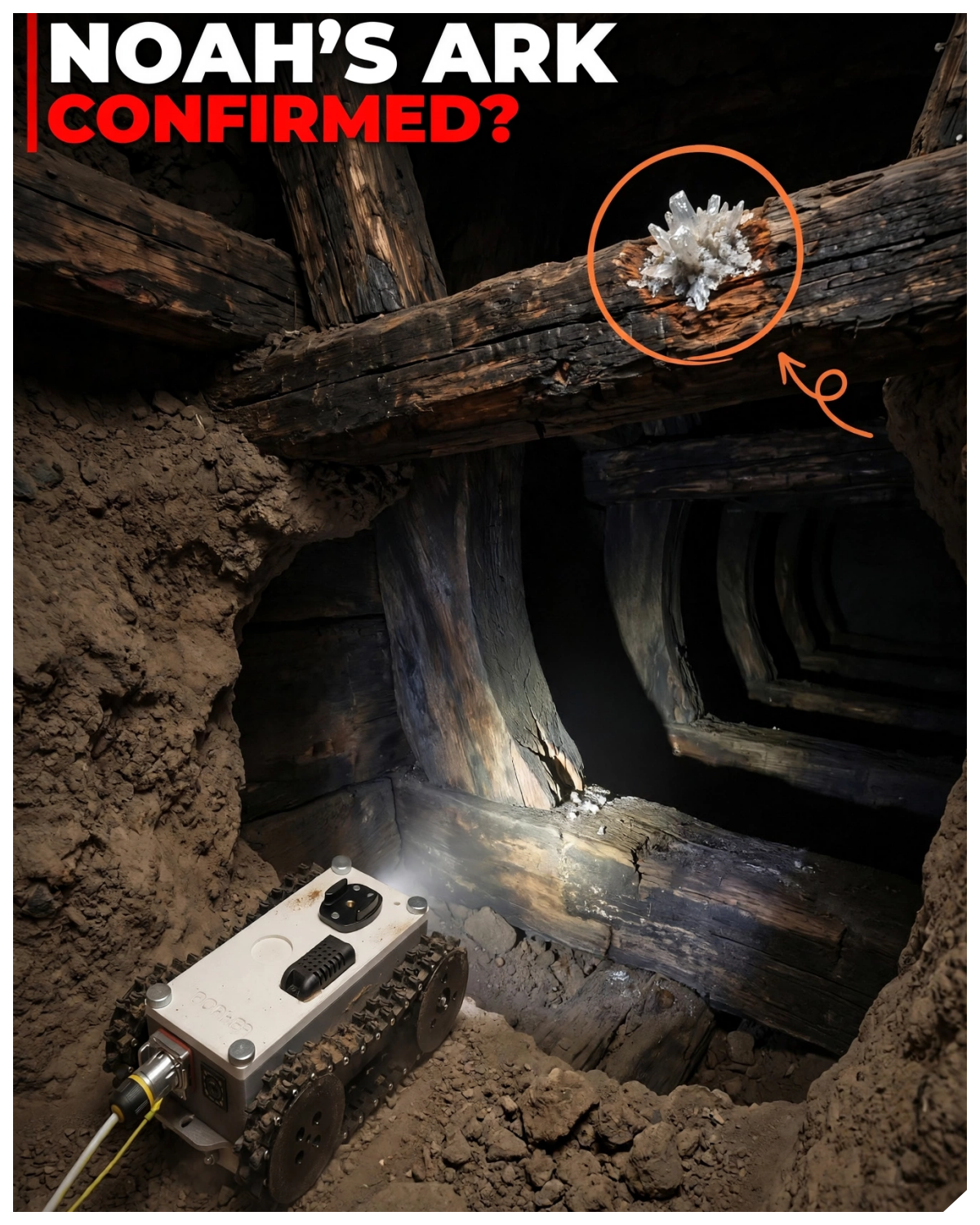
The small tracked robot was meant to investigate underground features suggested by the team’s scans, but reaching the ground below and exploring what lies there are two different challenges.
What did its camera actually reveal?
Durupinar is a boat-shaped geological formation located in the Dogubi district of eastern Turkay.
It sits near Mount Ararat, but not on its high summit, lying roughly 29 km souths southwest of the peak.
The physical structure spans 157 m in length, rising 12 m above the surrounding mountain terrain.
Because its limestone ridges naturally taper into a pointed bow and stern, some observers associate the formation with Noah’s ark.
However, scientific consensus classifies the feature as a sinclennal fold, a natural limestone ridge shaped over millions of years by tectonic pressure and gradual erosion.
While this striking silhouette has captured global interest for decades, visual resemblance alone does not prove the existence of a constructed vessel.
The outline explains why people looked here.
The next question was underground to peer beneath the soil surface.
The expedition deployed ground penetrating radar and electrical resistivity tomography across the length of the formation.
The team interpreted these raw geoysical scans as showing distinct right angled anomalies roughly 4 to 7 m down.
In their official reports, the researchers highlighted these patterns as potential underground voids or roomlike spaces.
However, radar reflections differ from photographs.
These geometric anomalies do not confirm open chambers as natural fractures in limestone or mineral-rich veins produce identical signals.
Ground penetrating radar simply measures wave boundaries, leaving the actual physical reality of these spaces unverified.
No scan could answer what was truly down there or what a camera would actually record in the deep darkness.
The scan supplied a target.
Now the team needed to see it.
In September 2026, the expedition prepared to cross the boundary between scan images and physical space.
They brought a compact tracked camera robot named Gopher, a machine designed to crawl through spaces too tight for a human.
Equipped with highdefinition visual sensors and powered by a long tether, this device offered a direct way to inspect the dark interior of the formation.
The team planned to lower the robot through newly drilled 12-in steel casings that cut deep into the limestone.
These drilling access holes were the only entry points to the suspected voids.
But lowering a camera into a narrow vertical shaft is not a guarantee of success.
A clear entrance does not establish a safe path, and the team had no way to know if the machine could navigate the unexplored environment below.
The released video feed begins in total darkness before the onboard LED ring lights illuminate the narrow passage.
What the camera shows is a sequence of layered sediment-filled surfaces marked by alternating light and dark bands of stratified geological deposits.
As the tracked machine advances, a small recess appears briefly on the left side of the frame, showing a shallow cavity with rough, uneven walls.
The recording shows only natural features without timber, metal brackets, or engineered joinery.
The parallel walls of the channel narrow gradually, presenting natural rock textures and loose powdery silt that cascades across the lens.
There are no constructed surfaces or ship fittings visible in the entire 12 m descent.
The camera captures a natural geological environment, leaving the structural claims unverified by visual evidence.
How much of the intended target could this view inspect?
According to the expedition, one stable loose sediment inside the bore hole quickly stalled the machine.
To combat the slipping tracks, the team reported making on-site adjustments, altering the track width, and modifying the tension on the power cable.
These mechanical struggles expose a fundamental limitation of the physical search.
Gopher can only record what its lens can directly reach and illuminate, leaving any features further down completely unverified.
A blocked path does not reveal what lies past the obstruction, nor does it confirm the scan interpretations.
What would you need to see before calling this a buried vessel?
For archaeologists, a visual of a dark cavity is only the beginning.
The expedition’s September 23rd release reports that the core drilling team successfully recovered physical geological samples at depths reaching 18 m.
This extended operational limit belongs strictly to the rotary hammer drilling rig, completely separate from the shorter restricted paths navigated by the tracked robot camera.
While drilling a second hole, the crew reported striking a highly resistant solid layer at approximately four to 5 m below the surface.
The sudden impact with this dense layer fractured a heavy steel drill bit, halting further downward progress in that specific vertical shaft.
Based on the force required to damage the gear, the researchers hypothesized that the subterranean obstruction might be petrified wood.
This remains an unconfirmed hypothesis as extreme hardness alone is insufficient to identify organic material.
Sandstones, volcanic intrusions, and cemented toughs common to this Anatolian region can easily produce identical physical resistance and damage heavy drilling equipment.
Independent laboratory testing is still required to analyze the mineral composition of the retrieved core fragments and determine if any cellular wood tissue actually exists.
The damage bit showed resistance.
Identifying the material required another kind of evidence.
For archaeologists, identifying an ancient ship requires satisfying three distinct scientific standards.
First, researchers must establish exactly what the material is.
A dark fibrous texture might look like ancient timber, but visual similarity is not scientific proof.
Natural rock formations, mineralized volcanic deposits, and fossilized organic matter can easily mimic the grain of wood.
Second, even if laboratory tests confirm organic timber, the material must show clear signs of human shaping.
In a hypothetical site, this would appear as clear tool marks, plain surfaces, or engineered joints like a mortise and tenon connection.
No such features have been found or claimed at this formation.
Third, any verified material must exist within a secure, undisturbed archaeological context.
Isolated fragments of wood or metal do not establish the presence of a vessel.
A structure of this scale requires a continuous recognizable hull outline preserved within a single contemporaneous layer of sediment.
Without these three elements, any underground feature remains classified as a geological formation rather than a historical vessel.
In 1996, researchers Lawrence Collins and David Fold analyzed previous claims of recovered structural materials from the Durupanar formation to determine if ancient timber was present.
Prior expeditions had identified dark fibrous specimens from the site as fossilized wood.
Under microscopic and petrographic examination, however, Collins and Facult found that the material was actually metamorphosed peridotite.
This natural ignous rock, which is common to the local volcanic geology of eastern Turkey, can naturally weather into parallel sheetlike structures that closely mimic organic wood grain.
Those findings concerned earlier samples.
The current campaign’s material [music] needs its own examination.
To examine the duropanar formation systematically, researchers must synthesize three separate streams of evidence.
The geoysical scans, the camera footage, [music] and the physical core samples.
The ground penetrating radar scans provided the initial search coordinates revealing geometric anomalies beneath the surface.
Yet these patterns only indicate where physical properties change, not what materials exist there.
They show a target to investigate rather than structural walls or engineered compartments.
The visual feed from the gopher robot offered a direct look inside those targets.
[music] Yet the 12 meters of released footage documented only natural stratified [music] sediment, a small geological cavity, and loose silt.
No preserved ship decks, timber beams, or metal joints appeared on the camera feed.
The core drilling samples yielded physical material from the deeper layers, including the dense stratum that broke the drill bit at 5 m.
While the field team hypothesized this could be petrified wood, the claim remains a tentative hypothesis until independent laboratories publish mineral and organic analyses.
Extreme hardness and dark fibrous textures also characterize common local volcanic rocks and sandstones.
Individually, each stream of evidence represents an isolated observation.
Collectively, they remain disconnected.
To prove the existence of an ancient constructed vessel, a discovery requires all three streams to converge, physical samples of human work timber, visual evidence of engineered joinery, and a continuous stratographic context showing a preserved hull.
The September 2026 campaign delivered new data, but no released evidence links these three streams into proof of a constructed ship.
The search has mapped geological features and retrieved samples for study, but the physical reality of the site remains unverified.
Subscribe to impossible archives for the machines, missions, and evidence behind extraordinary discoveries.
Today, the Durupinar Formation remains a canvas for our deepest historical hopes.
But the true test of discovery is not what we wish to find, but our willingness to accept what the physical data actually reveals.
Until independent laboratories verify these samples, the boundary between geological reality and ancient legend remains uncrossed.

