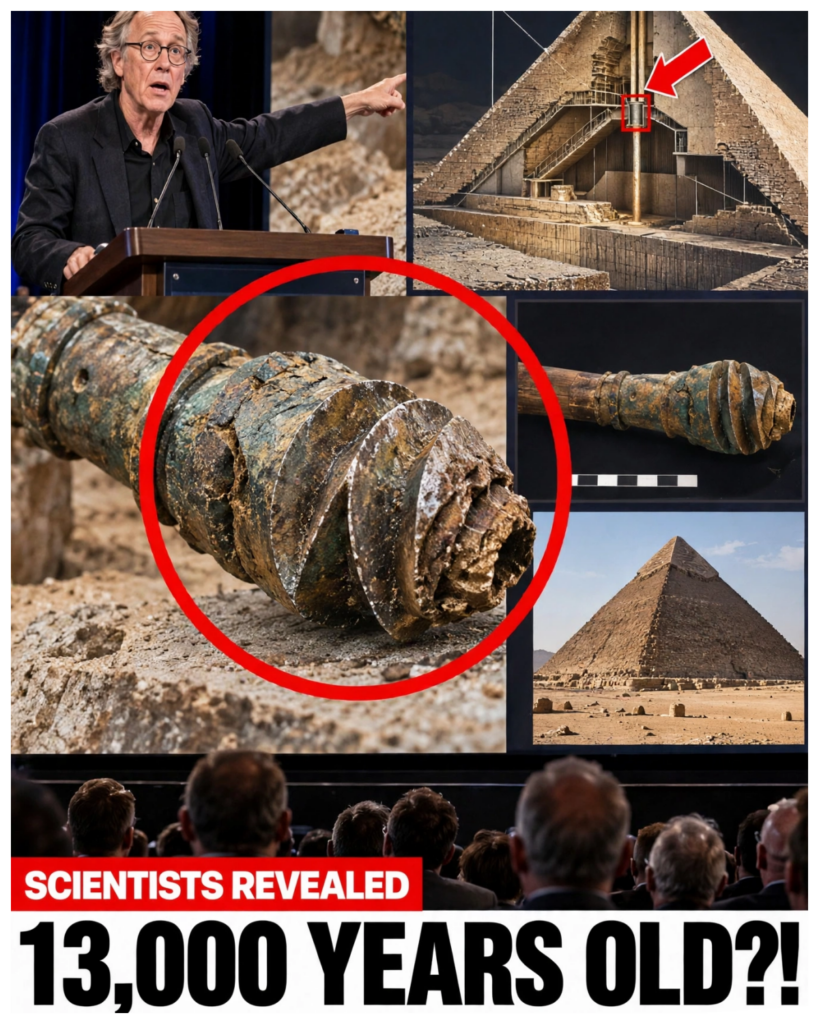
Deep inside the dark, untouched masonry of the Great Pyramid of Giza, sealed within a narrow shaft for thousands of years, lies an extraordinary secret.
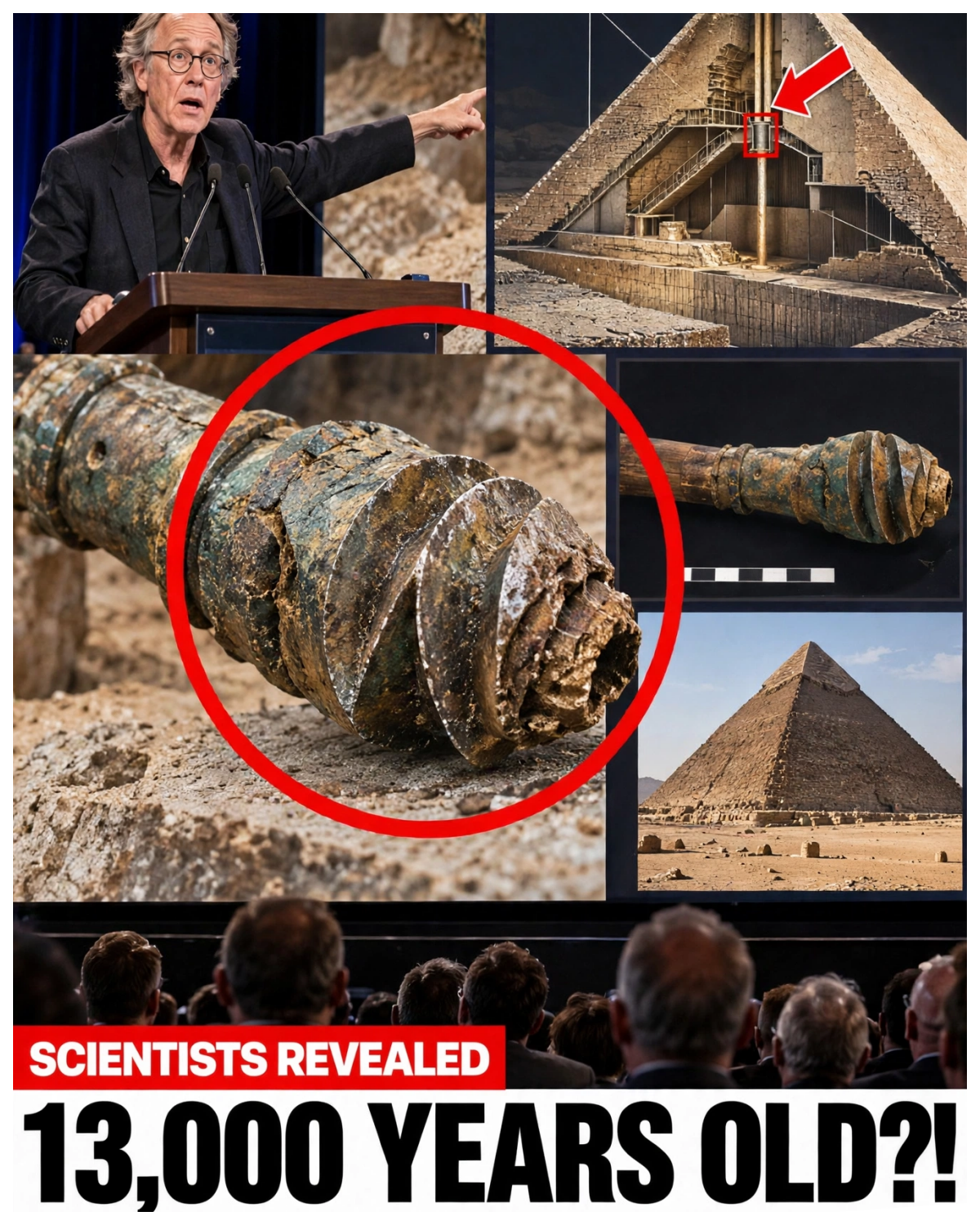
In 1872, explorers recovered a forgotten wooden relic left behind by the builders.
But when modern scientists finally subjected this physical artifact to carbon testing, the results sent shockwaves through archaeology.
The tool was not made during Pharaoh Khufu’s reign, it was centuries older than the pyramid itself.
How did it get there?
The Artifact Hidden in the Dark For over four thousand years, the interior of the Great Pyramid of Giza kept its secrets tightly locked behind millions of tons of limestone and granite.
While generations of plunderers, scholars, and travelers marvelled at the sheer scale of the exterior, the inner stone veins held silence.
But in 1872, an English engineer named Waynman Dixon, working alongside his colleague Dr.
James Grant, made a discovery that would fundamentally alter our physical connection to the individuals who erected the monument.
Dixon had been exploring the Queen’s Chamber, a quiet stone room positioned lower in the pyramid’s core than the iconic King’s Chamber.
As he carefully scrutinized the walls of this stark room, he noticed faint, hairline fractures along the smooth surface of the south and north masonry.
Curious as to whether these cracks were merely stress fractures or hidden openings, Dixon took a chisel and began tapping gently against the stone.
To his amazement, the chisel broke through into hollow space.
Behind a thin crust of limestone, he uncovered two narrow, rectangular shafts measuring roughly eight inches wide by eight inches high.
These dark tunnels angled upward into the heart of the structure, entirely invisible from the room itself until Dixon chiselled away the stone covering.
The shafts had been deliberately sealed off at the chamber wall, never intended to open into the room during normal operations.
Poking long wires and rods up these pitch-black conduits, Dixon felt something unexpected snagging against his tools.
When he worked carefully to retrieve whatever was lodged deep inside the narrow passage, he pulled out three distinct objects that had sat undisturbed in complete darkness since the Old Kingdom.
These three items would come to be known worldwide as the “Dixon Relics.”
The first was a small, heavy bronze sphere, possibly used as a plumb bob or balancing counterweight.
The second was a bone or ivory hook, often interpreted as part of a sacred tool or ritual device.
But the third object was perhaps the most intriguing: a small, splintered piece of cedar wood, roughly five inches long, featuring notched edges and precise craft marks.
It was a fragment of a measuring rod or a wooden wedge used by the ancient stonemasons to align the heavy casing stones during construction.
What made this discovery electrifying was its sheer context.
Up until 1872, virtually every single artifact associated with the Great Pyramid had been looted in antiquity.
Grave robbers had stripped away gold, grave goods, and ritual tools centuries before modern science emerged.
The Dixon Relics represented something virtually unheard of: genuine, operational builder’s tools left inside the original, undisturbed fabric of the monument.
They were not glorious treasures intended for a king’s afterlife; they were working artifacts touched by the dusty hands of the builders themselves.
As Dixon gathered these three objects, he documented their retrieval, but the technology of the 19th century was simply not equipped to unlock their deepest secrets.
The small piece of cedar wood was packed away, transported back to Britain, and eventual ownership shifted through private collections and institutional donations over the decades.
Yet the question remained hanging over the archaeological world: why would the builders seal a set of specific tools inside a shaft that was closed off from the rest of the pyramid, and what precise moment in human history did that wood actually represent?
How did an object sealed deep within the stone heart of the pyramid predating Pharaoh Khufu come to rest inside an untouched tomb?
The Lost Fragment and the Aberdeen Revelation For nearly a century, the three Dixon Relics led vastly different lives.
While the small bronze sphere and the enigmatic bone hook eventually found a permanent home in the prestigious collection of the British Museum, the third and arguably most vital artifact, the ancient fragment of cedar wood, seemed to vanish entirely into thin air.
By the mid-20th century, researchers attempting to locate the wooden tool encountered dead end after dead end.
Curators cross-referenced acquisition records, searched basement vaults, and tracked private estate auctions, but the piece of cedar was declared officially lost.
Many historians feared that one of the only organic artifacts ever recovered from the core of the Great Pyramid had been accidentally discarded, ruined by humidity, or destroyed during the chaos of world wars.
It was not until late 2019 that an extraordinary turn of events resurrected the lost artifact.
Curatorial assistant Abeer Eladany was conducting a routine audit of the Asian and Middle Eastern collections at the University of Aberdeen Museum in Scotland.
Deep inside the museum’s reserve storage, she opened an unassuming, yellowed cigar box that had sat forgotten on a back shelf for decades.
Lying inside, broken into a few small splinters but remarkably well-preserved, was the missing Dixon cedar fragment.
It had been donated to the university back in 1946 by the daughter of Dr.
James Grant, Dixon’s close associate, but because it was never properly cross-referenced in the digital catalog, it had sat undisturbed in a Scottish storage room for over seventy years.
The timing of its rediscovery could not have been more fortuitous.
Unlike nineteenth-century engineers, twenty-first-century scientists possessed advanced non-destructive carbon-dating technology capable of analyzing miniscule organic samples with incredible accuracy.
Because the wooden fragment was made of cedar, an organic material that absorbed atmospheric carbon while the tree was alive, it offered an unprecedented opportunity to obtain an absolute scientific date from inside the Great Pyramid’s sealed interior.
Researchers immediately submitted a tiny sample of the cedar splinters to the Oxford Radiocarbon Accelerator Unit for rigorous AMS radiocarbon analysis.
The scientific consensus had long placed the reign of Pharaoh Khufu and the construction of the Great Pyramid around 2580 to 2560 BC, during Egypt’s Fourth Dynasty.
However, when the Oxford laboratory finalized the carbon-dating results, the data yielded a startling revelation.
The timber used to craft the wooden tool did not date to Khufu’s reign at all.
Instead, the testing placed the origin of the wood somewhere between 3341 and 3094 BC.
This meant that the piece of cedar was roughly 500 years older than the monument in which it was sealed.
The news reverberated through the global archaeological community.
Here was a physical object, extracted directly from an untouched internal shaft, that predated the Pharaoh himself by five centuries.
Speculation immediately flared across media channels, with some wondering if the pyramid itself was far older than mainstream history suggested.
Yet, serious Egyptologists recognized a far more grounded, fascinating reality behind the numbers.
The ancient Egyptians did not live in a world of limitless timber; wood, especially imported Lebanese cedar, was exceptionally scarce, valuable, and carefully preserved.
The discovery was not evidence of a time-warped civilization, but a breathtaking glimpse into ancient supply chains, heirloom tool preservation, and the immense longevity of precious resources in the ancient Near East.
With a physical object dating centuries prior to the official timeline in hand, we are forced to ask: what does this tell us about the engineers who used it?
The Mystery of the Air Shafts and Robotic Probes Unlike any other ancient Egyptian tomb, the Great Pyramid of Giza contains four narrow, diagonal conduits branching out from its main interior rooms.
Two extend upward from the King’s Chamber, while two originate from the lower Queen’s Chamber.
Measuring a mere eight inches wide by eight inches high, these narrow stone tunnels were once casually dismissed as simple ventilation ducts meant to circulate fresh air for ancient workmen.
However, modern engineering surveys quickly discarded this early theory.
The Queen’s Chamber shafts were completely encased in solid masonry at both ends, entirely sealed off from the open air and hidden from human sight until Waynman Dixon breached their stone walls in 1872.
The true nature of these internal shafts took on an entirely new dimension in 1993, when German robotics engineer Rudolf Gantenbrink partnered with the Egyptian Antiquities Organization to explore the tight passages.
Gantenbrink deployed a custom-built, treaded robotic rover named Upuaut 2, named after the ancient Egyptian deity whose name translates to “The Opener of the Ways.”
Equipped with bright halogen lights and a miniaturized video camera, the tiny rover crawled up the steep forty-five-degree incline of the Queen’s Chamber’s southern shaft.
After traveling roughly two hundred feet into the pitch-black stone incline, the robot’s video feed suddenly broadcast a sight that astonished archaeologists worldwide.
The shaft was completely blocked by a meticulously polished slab of limestone fitted with two tarnished copper loops or handles embedded directly into the stone surface.
For nearly two decades, the nature of this “secret door” generated fierce debate.
Was it a barrier protecting a hidden treasure vault, or simply a structural plug?
In 2011, an international team led by the University of Leeds launched the Djedi Project, utilizing a flexible, serpentine crawler designed to drill a tiny, microscopic hole through the first blocking stone without causing damage.
When the probe’s micro-camera snaked through the newly drilled opening, it revealed a tiny, undisturbed space hidden behind the door for four and a half millennia.
The camera captured images of delicate, hand-painted red ochre symbols and mason’s marks brushed onto the stone floor, along with a clear view of the back side of the copper fittings, revealing them to be decorative, rounded loop pins rather than functional weight-bearing handles.
These high-tech discoveries fundamentally reframed our understanding of why the ancient builders crafted such intricate features.
The shafts were never meant for physical human passage, nor were they simple air vents.
Instead, they were cosmic highways, meticulously engineered conduit channels designed to direct the departing spirit of the Pharaoh upward toward the circumpolar stars.
The copper-fitted stones served as symbolic gateways for the royal soul to navigate as it journeyed into the night sky.
The fact that workers left measuring tools like the Dixon cedar fragment inside these sacred, star-aligned pathways reveals that every stage of construction was deeply imbued with ritual significance, where the boundary between practical engineering and cosmic theology simply did not exist.
Understanding why an ancient tool was left inside these astronomical shafts requires understanding the monumental leap in human capability that made Giza possible.
The Old Wood Anomaly The discovery of a 5,300-year-old wooden tool sealed inside a 4,500-year-old monument brings researchers face-to-face with a famous archaeological conundrum known as the “Old Wood Problem.”
To modern minds accustomed to abundant lumber and disposable manufacturing, an artifact dating half a millennium earlier than the stone structure housing it feels like a glaring historical paradox.
However, in the hyper-arid geography of Bronze Age Egypt, timber was not a cheap commodity to be used once and tossed aside; it was among the most prized, heavily guarded resources in the entire ancient Mediterranean world.
Native Egyptian trees like the date palm, sycamore, and desert acacia were soft, crooked, and completely unsuitable for precision carpentry, heavy structural framing, or fashioning long, rigid alignment rods.
To acquire high-grade, straight-grained timber capable of withstanding heavy construction forces, Old Kingdom pharaohs had to organize and finance massive maritime trading fleets.
These expeditions sailed across the Mediterranean Sea to the dense pine and cedar forests of ancient Byblos, located in modern-day Lebanon.
Importing massive cedar trunks required immense royal capital, naval protection, and sophisticated international trade networks.
Once those precious logs reached the Nile Delta, every board was treated with extreme care and recorded in royal inventories.
Wood was never casually discarded.
Scribes logged timber allocations, and master carpenters spent lifetimes maintaining, shaving down, and repurposing old planks.
Damaged structural beams were recut into sledges, worn furniture legs were turned into wedges, and ancient measuring sticks were carefully preserved across generations.
A finely crafted cedar tool like the Dixon fragment would have been a prized, highly accurate instrument, a heirloom piece of master-craft equipment passed directly down from master builder to apprentice across decades or even centuries.
Crucially, radiocarbon dating measures the exact year that a tree ring stopped absorbing carbon from the surrounding atmosphere.
In massive, slow-growing species like Lebanese cedar—trees that can live for over a thousand years, the heartwood situated near the center of a thick trunk ceases carbon exchange centuries before the tree is ever felled by loggers.
If a Fourth Dynasty craftsman carved a measuring rod out of timber harvested from the ancient inner core of an old-growth tree, or carved it from a centuries-old piece of stockpiled timber, modern AMS radiocarbon testing will naturally register the ancient age of that internal wood rather than the moment the carpenter shaped it.
When combined with the documented Egyptian practice of hoarding and recycling royal timber reserves, the timeline aligns perfectly with the realities of ancient engineering logistics.
Far from proving an impossible chronological contradiction, the Dixon cedar relic offers an intimate glimpse into the frugality, deep resourcefulness, and material reverence that allowed ancient Egyptian society to execute projects on a scale the world had never seen.
Yet timber supply was only one small piece of a vast, continent-spanning logistical machine.
High Engineering and Stone Machining Capabilities The structure contains roughly 2.3 million stone blocks, averaging two and a half tons each, laid with such tight precision that a thin razor blade cannot fit between the casing joints.
For generations, casual observers assumed such feats required mystical technology or lost super-weapons.
Yet when modern engineers, experimental archaeologists, and materials scientists analyze the physical evidence left on the stone blocks themselves, they discover a system of rigorous empirical engineering that relied on sheer human ingenuity, limitless labor, and an exhaustive mastery of natural materials.
The primary metals available during the Old Kingdom were copper and arsenical bronze.
While softer than iron or modern steel, copper was transformed into an aggressive stone-cutting agent through the clever application of abrasives.
Workers used long, two-man copper saws without teeth, pumping slurry mixtures of sharp quartz sand and water into the cut grooves.
As the soft copper blade slid back and forth across limestone or hard granite, the suspended quartz grains embedded themselves into the copper edge, turning the metal into a continuous grinding plate.
Modern replication experiments have proved that this method slices through dense granite block by block, leaving distinct linear saw marks and microscopic copper traces that match the physical cut patterns found throughout the Giza plateau.
Similarly, the ancient masons executed deep cylinder cuts to carve out massive stone sarcophagi and internal chamber corners.
They used hollow copper tubes rotated under heavy downward pressure while fed with quartz abrasive dust, effectively inventing the world’s earliest core drills.
When the tubular drill sank deep into the stone, workers snapped out the central core with chiseled wedges, leaving cylindrical holes with spiral feeding grooves that remain visible today in the unfinished stone quarries of Aswan.
For surface leveling, builders relied on simple yet incredibly precise optical and mechanical methods.
They stretched taut, pigment-soaked strings across stone faces to check for high spots, and utilized triangular wooden A-frames equipped with plumb bobs to establish perfect horizontal levels across massive distances.
The foundational base of the Great Pyramid covers over thirteen acres, yet its perimeter is level to within less than seven-eighths of an inch across the entire footprint.
This extreme levelness was likely achieved by cutting a grid of narrow water channels directly into the limestone bedrock, marking the water line along the trench walls, and dressing the surrounding rock down to match that perfectly flat water baseline.
Combined with standard wooden measuring rods, much like the Dixon cedar relic, these straightforward mechanical tools enabled the architects to maintain structural alignment and tight mathematical tolerances across a monument that rose nearly four hundred and eighty feet into the sky.
Behind this extraordinary mastery over stone lay a society structured around a grand, unified vision.
The Society, Workforce, and Spiritual Mindset For centuries, popular culture pictured the construction of the Great Pyramid as a grim spectacle of cruelty, millions of enslaved workers dragged across desert sands under the lashes of ruthless overseers.
However, modern archaeological discoveries at Giza have completely dismantled this persistent myth.
Excavations led by Dr.
Zahi Hawass and Dr.
Mark Lehner at the “Lost City of the Pyramids” (Heit el-Ghurab) revealed that the workforce was composed not of miserable slaves, but of a highly organized, well-nourished national labor force of free citizens, skilled artisans, and seasonal conscripts fulfilling their civic duty to the state.
The worker village located just southeast of the plateau was a bustling urban center capable of housing thousands of laborers at a time.
Analysis of animal bones unearthed in dump sites shows that workers consumed massive quantities of high-grade beef, sheep, goat, and fish, alongside vast daily rations of freshly baked bread and draft beer.
This high-protein diet was essential for supporting the heavy physical demands of stone hauling and masonry.
Furthermore, skeletal remains of the workers show clear evidence of advanced medical care for the era.
Forensic anthropologists found healed bone fractures with splints, successful amputations, and even signs of brain surgery, proving that injured laborers received top-tier medical treatment and were given ample time to recover rather than being worked to death.
These workers were organized into competing administrative units called phyles, which were further subdivided into smaller crews or “gangs” of roughly twenty men.
These teams took immense pride in their labor, often painting playful, competitive slogans onto the hidden undersides of granite ceiling beams, names like “Friends of Khufu” or “Drunkards of Menkaure.”
Rather than working out of fear, laborers were motivated by a combination of material compensation, institutional pride, and a profound national faith.
Participating in the construction of the Pharaoh’s monument was viewed as a sacred obligation that helped maintain Ma’at, the divine order, balance, and harmony of the universe.
In ancient Egyptian theology, the Pharaoh was not merely a political ruler; he was the earthly living embodiment of Horus, responsible for maintaining cosmic stability.
Upon his death, his spirit needed to safely ascend to the celestial realm to join the eternal stars as Osiris.
By building a monumental mountain of stone that served as a resurrection machine, every citizen who hauled a block or turned a wooden drill bit was actively participating in the eternal survival of their kingdom.
A single tool left behind inside a shaft, like the Dixon cedar relic, was not just a forgotten piece of construction gear, but a quiet testament to the lived hands of dedicated craftsmen who poured their lives into linking earth with the cosmos.
Comparative Engineering Across Ancient Civilizations Across the ancient world, early civilizations were bound by the same fundamental constraints: a reliance on copper or early bronze metallurgy, manual leverage, and locally sourced natural building supplies.
Yet each major culture developed a distinct technological identity based on its unique environment, raw materials, and administrative priorities.
In the alluvial plains of Ancient Mesopotamia, where timber was scarce and stone virtually non-existent, the Sumerians, Akkadians, and Babylonians mastered the art of mud-brick architectural engineering.
Lacking the vast quarries of limestone available in Egypt, Mesopotamian builders focused their technological energy on monumental earthworks and structural ziggurats.
Because native trees were sparse, wood was treated as a rare structural commodity, largely reserved for heavy door frames, palace roofing beams, and specialized river barges.
To compensate for the softness of copper tools, Mesopotamian craftsmen became pioneers in lost-wax metal casting, creating refined socketed axes, chisels, and saws that allowed them to join heavy timber planks with intricate mortise-and-tenon joinery.
Farther east along the Indus River basin, the urban planners of Mohenjo-daro and Harappa developed a radically different technological focus centered on standardized industrial output and hydraulics.
While the Egyptians directed their stone-machining capabilities toward sacred royal monuments, the Indus Valley civilization deployed copper-alloy saws, drills, and fine measuring scales to build synchronized, grid-based cities.
Their carpenters and stone-cutters achieved remarkable dimensional uniformity, producing baked bricks with precise dimensional ratios (1:2:4) and crafting complex wooden sluice gates and underground urban drainage systems.
Their metallurgical tools were engineered primarily for utility, trade, and infrastructure rather than colossal monumentality.
Meanwhile, in the Mediterranean basin, the Bronze Age Minoans of Crete approached woodworking and architecture with a fluid, nature-focused aesthetic.
Blessed with abundant forests, Minoan builders pioneered advanced timber-laced masonry.
They engineered flexible wooden frameworks embedded directly inside stone walls, creating anti-seismic architectural designs capable of surviving major earthquakes.
Their craftsmen utilized heavy double-bladed copper axes (labrys) and fine-toothed bronze saws to frame sprawling palace complexes featuring multi-story wooden columns, light wells, and complex drainage channels.
When placed alongside these global contemporaries, the Dixon cedar relic and the Great Pyramid reveal both shared ancient practices and an unmatched scale of execution.
Every Bronze Age civilization learned to stretch soft metals, precious timber, and simple physical mechanics to their absolute limit.
But while others applied these early tools to construct urban sewer networks, brick ziggurats, or earthquake-resistant palaces, the engineers at Giza leveraged their precious cedar instruments to coordinate millions of tons of precision stone, aligning human ingenuity directly with the stars.
The Cosmic Alignment While comparing global engineering methods underscores how ancient societies solved practical challenges, the internal geometry of the Great Pyramid reveals a dimension of engineering that transcends simple mechanics.
The four narrow shafts extending from the King’s and Queen’s Chambers were not merely structural air vents or arbitrary tunnels; they were precision-calculated optical sightlines aimed directly at the heavens.
In the field of archaeoastronomy, these conduits represent one of the most sophisticated integrations of stellar observation and stone architecture in human history, designed to anchor the monument into the eternal rhythm of the cosmos.
When astronomers and engineers mapped the precise angle of these eight-inch-wide shafts, inclining at angles ranging from 32 to 45 degrees, they calculated where these stone tunnels pointed in the night sky during the mid-third millennium BC.
Due to the slow wobble of the Earth’s axis, known as precession, the stars visible in the night sky shift over thousands of years.
Reconstructing the northern and southern skies above Giza around 2500 BC revealed an astounding pattern: each of the four shafts targeted a specific celestial body of supreme religious significance to the ancient Egyptians.
The southern shaft of the King’s Chamber pointed directly toward the star Alnitak, the brightest star in the belt of the constellation Orion.
In ancient Egyptian cosmology, Orion was personified as Osiris, the lord of the underworld, rebirth, and eternal resurrection.
The northern shaft of the same chamber targeted Thuban, the pole star in the constellation Draco, around which the entire night sky appeared to revolve.
These unmoving circumpolar stars were revered as the “Imperishables”, celestial bodies that never set below the horizon, making them the ultimate destination for a departing pharaoh seeking immortality.
Meanwhile, the southern shaft of the Queen’s Chamber pointed toward Sirius, the brightest star in the sky, associated with the goddess Isis, the divine consort of Osiris and the symbol of fertility and renewal.
The northern shaft of the Queen’s Chamber targeted Kochab, a prominent star in the Little Dipper associated with cosmic endurance and transformation.
These alignments demonstrate that before a single block of limestone was laid, the royal astronomers had calculated the movement of the heavens with astounding mathematical precision, translating star charts directly into stone blueprints.
Building four diagonal channels that sliced upward through millions of tons of solid rock required extraordinary surveying capabilities.
Masonry crews had to maintain precise angles over hundreds of feet while simultaneously raising surrounding stone layers.
A single degree of error would cause a shaft to miss its target star completely or drift off course.
This is precisely where small measuring instruments like the Dixon cedar fragment played an essential role.
Plumb bobs, sighting rods, and wooden alignment jigs were continually used by teams working in pitch-black corridors to check slope gradients and shaft orientations.
When the builders sealed the Dixon Relics inside the Queen’s Chamber shaft, they were leaving behind the very calibration tools used to align the monument with the stars.
These shafts were not designed for human eyes to gaze through, nor were they open channels for physical travel.
They were cosmic pathways, meticulously engineered conduit tubes crafted to channel the spirit of the deceased pharaoh straight into the heart of the constellation where his divine ancestors awaited.
Which leaves us with the ultimate question: what legacy did these builders intend to project across thousands of years?
The Great Eternal Pyramid As the centuries rolled past and the golden casing stones that once crowned the Great Pyramid were stripped away by time and human hands, the monument never lost its ability to captivate the human imagination.
Today, the Giza plateau stands as an enduring monument not to lost extraterrestrial magic or forgotten hyper-advanced civilizations, but to the absolute peak of human ingenuity, social organization, and physical determination.
The Great Pyramid remains a physical bridge across five millennia, a testament to what a unified society can achieve when it marshals its resources, intellect, and faith toward a single, immortal objective.
When we strip away modern myths and sensationalized claims, the true story that emerges from Giza is far more inspiring.
The discovery of the Dixon cedar fragment inside a sealed astronomical shaft offers an extraordinarily intimate, human touchpoint within a mountain of millions of tons of stone.
It reminds us that behind the staggering mathematical precision, the starry alignments, and the massive granite blocks lay individual, dusty-handed human beings.
A carpenter painstakingly turned a piece of precious imported cedar into a calibration tool; a mason checked the gradient of a cosmic shaft; a team of workers left their marks and humor on the hidden undersides of ceiling beams.
The 5,300-year-old piece of cedar does not break history, it grounds it.
It tells a story of ancient maritime trade routes spanning the Mediterranean, of generations of craftsmen cherishing and preserving precious timber, and of an ancient civilization capable of harmonizing practical mechanics with profound cosmic theology.
That tiny wooden relic, sitting forgotten in a museum box before coming back into the light of modern science, bridges the gap between our modern world and the minds of those who raised the Last Wonder of the Ancient World.
As mini-robots continue to explore the dark, silent conduits of Giza and advanced non-invasive scanners probe the stone core for undiscovered cavities, the Great Pyramid continues to yield its secrets slowly, methodically, and on its own terms.
It stands as a timeless mirror reflecting humanity’s endless drive to master the earth, measure the heavens, and leave a trace of its existence that can withstand the weight of thousands of years.
If this dive into the real mysteries of ancient engineering captivated you, hit subscribe to join us on our next journey through history.


