That the stones used in building the Great Pyramid came from Torah and Torah is a 25 miles to the east.
In 1971, the story goes, an excavation team broke through the floor of a sealed chamber beneath Sakara, the vast necropolis south of Cairo, and lifted out a carved limestone block that nobody has been able to explain in more than 50 years.
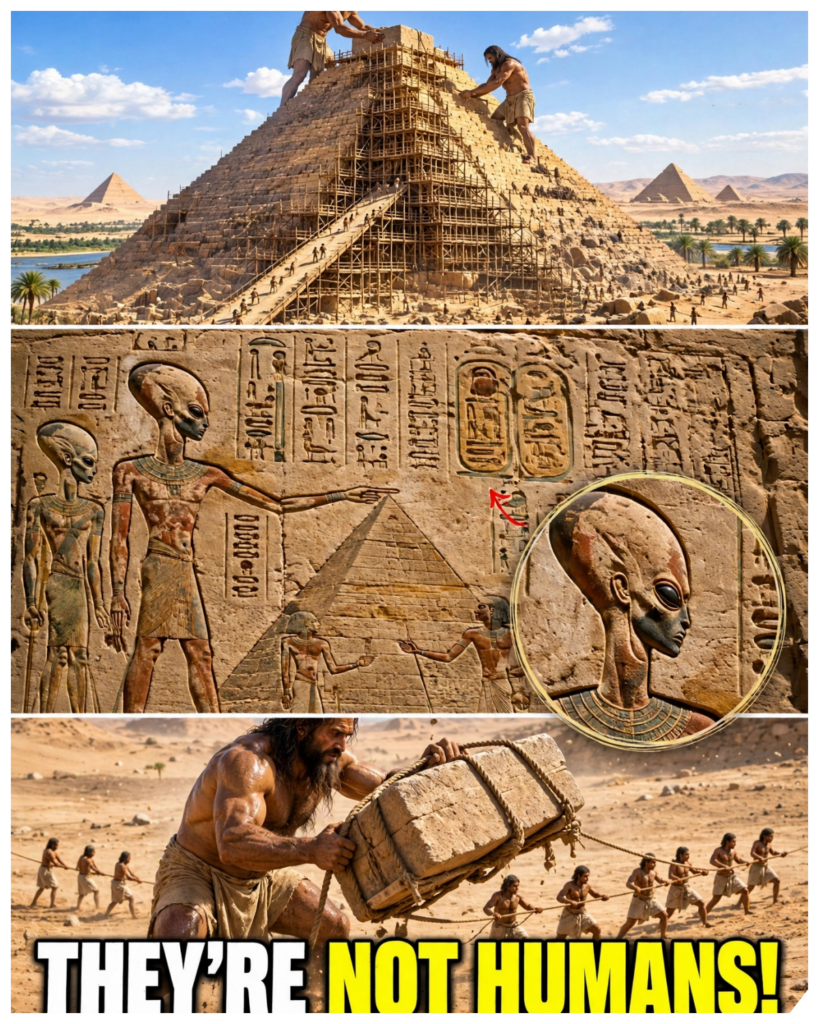
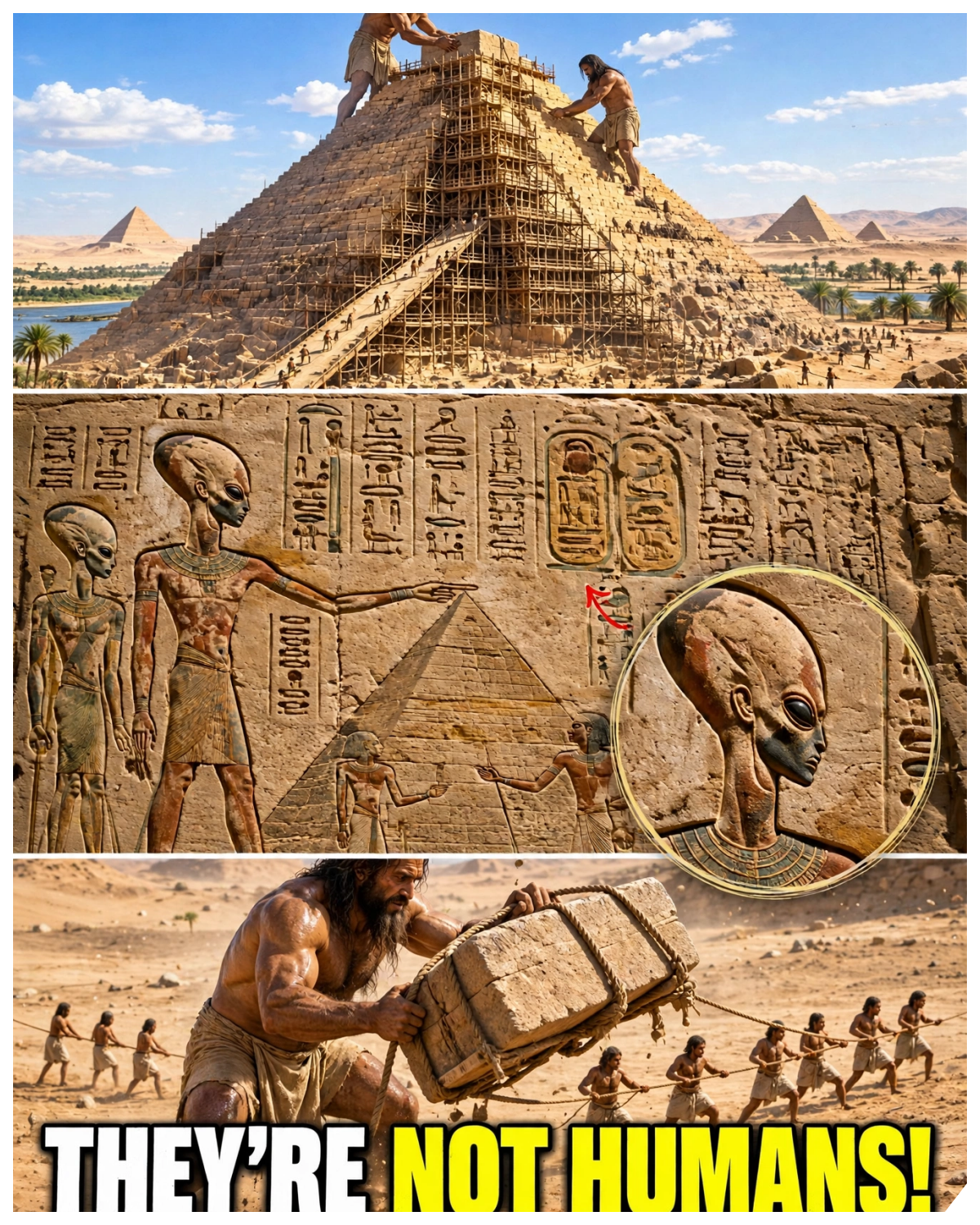
The figures on it were humanoid, but wrong.
The inscription beside them supposedly named them those who came before the counting of years.
The block was cataloged in 1974 with a deliberately vague description and has allegedly sat in basement storage ever since.
Beneath the same chamber, a genetics team supposedly found four burials carrying a Y chromosome lineage that fits nowhere on the human family tree.
And modern radar, we’re told, has detected three sealed rooms that no one is permitted to open.
It’s a story built to make your pulse quicken.
And parts of it stand on real ground.
Sakara is real.
The archaeologist at its center is real.
The Turkish temple site it leans on is real, and it is astonishing.
The DNA studies are real, too.
What makes this particular story so effective and so worth examining carefully is that it works precisely because it drapes invented claims over a genuine foundation.
The best misinformation always does.
But when I went looking for the block, the catalog number, the scholars quote, the anomalous genetic table, and the withheld radar data, I couldn’t find them.
Not in museum records, not in published papers, not in any reporting I could locate.
That doesn’t prove nothing lies beneath Sakara.
It means the most dramatic details of this story arrive with no paper trail at all.
So, we’re going to do something different from the videos that made you curious.
We’ll follow every thread, the stone, the beings, the tool, the bodies, and the sealed rooms.
And at each step, we’ll separate what is documented from what is only claimed.
You may discover that the real mystery under Sakura is stranger than the invented one.
The beings who came before the counting of years start with the block itself.
According to the story, it carries the registration number J9289 and the museum’s official description reads pre-denastic ceremonial relief, provenence uncertain.
It was supposedly pulled from a chamber older than the step pyramid complex above it and older than the first pharaohs who are conventionally dated to around 3100 BCE.
Here is what can be checked.
Cairo’s Egyptian Museum has traditionally registered its objects under J numbers short for Jonal Dantree, its entry ledger.
A system in continuous use since the museum’s founding in 1858 under French Egyptologist August Marriott.
J9289 matches neither that convention nor any cross reference I could locate in published acquisition records.
I found no catalog entry matching the number in this story and no published excavation report describing a pre-dynastic chamber beneath the step pyramid complex.
That doesn’t make it impossible.
Museum basement are notoriously underdocumented.
A problem the Egyptian Museum itself has acknowledged publicly given that its collection of over 120,000 objects was for decades cataloged by hand in aging ledgers.
But a discovery that overturned the start of Egyptian history would have left more than a rumor.
The man said to have led the dig, Jean Phipe Lau is very real, though he was French, not Egyptian.
Born in Paris in 1902, he arrived in Egypt in 1926 as an architect, assisting the English archaeologist Cecil FTH at Joser’s step pyramid.
He never really left.
Lauer spent roughly 75 years at Sakara restoring, excavating, and reconstructing the complex and died in 2001 at the age of 99.
He is regarded as one of the foremost authorities on how pyramids were built and his published output was prolific including major works like la pyramid ades his multiolume architectural study of the step pyramid complex which makes the silence around this supposed find all the stranger a discovery like this by lower would have appeared in his own voluminous publications I found no mention of it anywhere in his documented body of work.
The story also leans on a quote from UCLA Egyptologist Caracuni and on a note in the Oriental Institute’s archive at the University of Chicago, an institute renamed the Institute for the Study of Ancient Cultures in 2023.
Cooney is a genuine scholar known for her work on hatchepsuit and on power in ancient Egypt, including her 2018 book, The Woman Who Would Be King.
But I found no such statement from her.
Pinning an unsourced claim on a real named expert is the oldest trick in the genre because it borrows credibility the speaker never earned.
The story also gets one thing quietly wrong.
It calls Sakara the site of the world’s oldest largecale stone monument.
It isn’t.
The temple enclosures at Gobeci in Turkey are thousands of years older.
What Joser’s step pyramid built around 2670 B.CE by the architect Imoteep, the first named architect in recorded history actually represents is the first largescale cutstone building in Egyptian history.
A genuine turning point and one that didn’t need any outside help to explain.
But hold on to the phrase itself, those who came before the counting of years, because it echoes something real.
And what the figures were supposedly doing is where the story reaches for its most unsettling detail.
The construction scene and the impossible tool.
The carving, we are told, doesn’t show worship or ritual.
It shows construction.
Strange beings directing the placement of massive blocks holding a long rod that ends in a fork tilted at a precise downward angle.
Then the story crosses the map.
At Gobecepe in southeastern Turkey, it says, “Carvings show the same forked object at the same angle, 33°.”
The claim is credited to geologist Robert Shaw in 2017 and it’s offered as proof of a shared design across two unconnected sites.
First, Gbecley itself because it deserves better than being a prop.
The hilltop near Shaurfa was noticed in a 1960s survey and dismissed as a medieval cemetery.
Then in 1994, German archaeologist Klaus Schmidt began digging and found something that rewrote the timeline of human ambition.
Circular enclosures ringed with T-shaped limestone pillars, some weighing around 10 tons carved with foxes, boores, snakes, vultures, and scorpions built by people who had not yet adopted farming.
The earliest enclosures date to roughly 9,600 B.CEE, making Goeclete the oldest known monumental architecture on Earth, predating Stonehenge by more than 6,000 years and the Egyptian pyramids by nearly 7,000.
Its builders later buried it on purpose around 8,000 B.CE.
For reasons that still puzzle researchers.
It became a UNESCO World Heritage site in 2018.
Schmidt died in 2014 and the German Archaeological Institutees Lee Clare has directed the work since.
Since Schmidt’s death, the team has expanded excavation into adjacent areas now called Karahantepe and Tash Tempellar, finding related sites across southeastern Turkey that suggest the phenomenon was far more widespread than a single hilltop.
Pillar 43, the so-called vulture stone, is the site’s most famous carving.
Vultures with outstretched wings, a scorpion, a disc, and a small headless human figure.
Archaeologists connect that headless figure to the skull cults of the Neolithic Near East, a practice documented at Chhatalhyuk and other sites where human skulls were sometimes plastered and preserved.
Others have proposed astronomical readings, including a comet impact interpretation.
And that idea has drawn direct rebuttals from the excavating team’s own scholars.
What I did not find is any archaeologist or any publication documenting a forked implement at 33 degrees.
Choke is a real geologist at Boston University with a Yale doctorate.
Best known for arguing that erosion on the Sphinx enclosure points to an older origin, a position most Egyptologists reject, partly because no corroborating evidence of an earlier civilization capable of building it has been found.
I found no paper containing this measurement, and a number like 33° carries a false aura of precision.
The natural questions are who measured it, on which carving, with what method, and in which publication it appeared.
Then there’s the distance.
The story says 2,000 km in a straight line.
Gbeci Tusakura is roughly a thousand.
That matters because the claim of no possible contact collapses on real history.
The Neolithic package of wheat, barley, sheep, and goats reached Egypt from southwest Asia thousands of years before the pharaohs, traveling along exactly the roots this story claims were impassible.
And in 2025, researchers sequenced the first whole genome from an ancient Egyptian, a man buried near Nuerat around 285 to 2570 B.CE.
And found roughly a fifth of his ancestry traced to Mesopotamia.
Egypt and the Near East were talking to each other, trading and intermaring long before the step pyramid rose.
Contact across that geography wasn’t a mystery.
It was a routine feature of ancient life.
As for the fork, a forked stick is among the oldest and simplest tools humans have ever made.
Digging sticks, tongs, props, and spears all share that shape.
The convergent invention of basic tools across separated cultures is something anthropologists have documented repeatedly.
It’s one of the foundational observations of comparative archaeology.
When something is that basic, two peoples inventing it independently isn’t a mystery.
It’s a prediction.
So, the tool doesn’t hold up.
But the story had one more layer, and it went below the floor.
The bodies beneath the chamber.
Directly beneath that chamber, the story says, lay a pre-dynastic burial layer.
And in 2019, a Copenhagen team led by Esa Willers supposedly published the largest ancient DNA study of Egyptians ever attempted, covering 166 individuals.
Buried in supplementary table S74.
Sakura individuals carried a Y chromosome variant that could not be placed on the human tree.
The authors flagged it as low confidence possible sequencing artifact and no one followed up.
Here’s the real record.
Willers Lev is a real celebrated geneticist currently based at the Lunbeck Foundation Geogenetics Center at the University of Copenhagen and a world leader in ancient DNA research with major contributions to the genomics of early Americans and European prehistory.
But the landmark study of ancient Egyptian DNA was published in 2017 in nature communications by Verena Schwinaman and colleagues at the University of Tubingan and the Maxplank Institute for the Science of Human History.
A different institution, a different team, and a different year entirely.
It examined 151 mummies from Abusir Elmelik, a site in Middle Egypt, spanning the New Kingdom through the Roman era, about 1,300 years.
The paper used 166 samples from those 151 people, which is a curious echo of the number in our story.
Its results were mitochondrial genomes from 90 individuals and genomewide data from just three.
It found strong genetic continuity across that span.
Ancestry closest to the ancient near east and in modern Egyptians about 8% more subsaharan African ancestry than in the ancient mummies.
Nothing in it concerns pre-dynastic sakara.
And nothing in it concerns an unplaceable Y chromosome.
Why so little Egyptian DNA until so recently?
Because Egypt is brutal on genetic material.
Heat, humidity, and the chemicals used in mummification, natron salts, resins, aromatic oils, all degrade DNA aggressively, sometimes destroying it entirely.
It took until 2025 for a team led by Adeline Morz Jacobs with Pontis Scogund and Lionus Girdland Flink to publish the first whole genome from an ancient Egyptian in nature.
That man had been buried inside a ceramic pot in a rock cut tomb, a lucky preservation detail that likely shielded his DNA from both humidity and chemical exposure.
His skeleton showed evidence of a life of heavy labor with joint stress consistent with agricultural or construction work.
A genomewide data set from four predynastic Sakura burials would have been headline news around the world.
It wasn’t because no such data set exists.
Now suppose a lab really did flag a Y Haplo group as unresolvable.
What would that mean?
The scientific caution is real.
With degraded DNA and very few sequence reads, Haplo group assignments can drift into nonsense and organized looking patterns can emerge from damage and contamination.
Ancient DNA researchers routinely filter out low confidence Hapla group calls precisely because degraded samples mimic exotic lineages.
And even a truly odd lineage wouldn’t mean what the story wants it to.
In 2013, geneticists reported a Y chromosome lineage called AO found in a South Carolina man and in men from an embo community in Cameroon.
So divergent that it pushed back the estimated root of the human Y tree by well over a 100,000 years.
It rewrote the family tree and it was entirely human carried by living people today.
A branch that fits poorly on the tree is a puzzle for geneticists.
It is not a species.
It certainly doesn’t imply prehuman beings directing construction projects beneath Egyptian pyramids.
The story wants unplaceable to mean unknown.
In genetics, it more often means unlucky sample, which leaves the question underneath everything.
If the evidence for a lost people is this thin, why does the idea persist?
And what does the record say about who was really living in Egypt before the pharaohs?
The explanation and the theory it leaves behind.
The story’s conclusion is a theory and it deserves a fair hearing.
It proposes that a distinct people occupied the Nile Valley before the first dynasty, built sacred sites like Sakura, and were later remembered as gods.
They became mythology because memory turns things too large to hold into legend.
Some of that instinct is right.
But the pre-dynastic period is not the blank the story describes.
We know a great deal about Egypt before 3100 B.CE.
The Bedarian culture farmed and buried its dead around 4,400 B.CE CE, leaving behind fine pottery that remains among the thinnest walled ceramics ever produced in the ancient world.
Evidence of extraordinary skill long before any pyramid was imagined.
The Nata cultures followed and when Flender’s Petri dug their cemeteries in the 1890s, he built the very system sequence dating that archaeologists still use to order pre-dynastic pottery across the near east.
At Hacco, excavators found breweries capable of producing hundreds of liters of beer at a time, temples and elite tombs with murals predating those of the dynastic period.
At Abidos, a tomb known as UJ dated to about 3,300 B.CE held some of the earliest writing ever found in Egypt.
Small ivory and bone tags inscribed with protohieroglyphs recording commodities and estate names.
Far out in the Nubian desert at Nabta Pla, cattle herders arranged stone circles and alignments roughly 7,000 years ago in configurations that researchers believe tracked solstice sunrise.
These were sophisticated people.
They were also Egyptians, ancestors of the pharaohs in a continuous documented wel excavated line.
Sakara doesn’t need a lost race to be sacred either.
Tradition places the founding of Memphis, Egypt’s first capital, around 3,100 B.CEE under the semi-leendary ruler Nar, and Sakara was its necropolis from the very beginning.
English archaeologist Walter Brian Emory excavated early dynastic tombs there from the 1930s through the 1950s, including S3357, associated with a king of the first dynasty.
The site was already the burial ground for the elite of the earliest Egyptian state.
A status it held not because mysterious predecessors consecrated it, but because it overlooked the capital from the desert escarment to the west, in line with Egyptian beliefs about the western horizon as the realm of the dead.
And the memory of earlier ages is real, too, just not the way the story imagines.
The Tin King list, a papyrus from the reign of Rammeses II, opens with gods, then semi- divine spirits, then the followers of Horus before it reaches human kings.
Temple texts at Edfu, written far later, look back on a primeval first time when divine sages called the Sheptu founded the sacred places on a primordial mound.
The Polarmo stone from the Old Kingdom records rulers who predate the first dynasty.
The Egyptians themselves believed in a distant age of predecessors.
That’s a documented tradition going back millennia.
It doesn’t need a hidden people to explain it because it was never meant to be read as a geological or archaeological claim.
It was a theological one.
To be fair to the skeptics of the skeptics, there really are gaps.
The Nile Delta, where Egypt’s earliest urban centers would most plausibly have grown, has buried its own past under meters of silt, and delta settlements from the earliest periods are poorly preserved and under excavated.
Some of the record is genuinely missing.
But missing evidence isn’t evidence of a missing civilization.
If a people had cut 10 ton pillars or moved massive blocks, they would leave workshops, settlements, quarry sites, tools, waste, and burials.
The surviving footprint of pre-dynastic Egypt is enormous, and it’s Egyptian all the way down.
There’s also a broader pattern worth naming.
Ideas of a lost, more advanced ancestor culture promoted by writers like Graham Hancock and Robert Boval, whose books like Fingerprints of the Gods and The Message of the Sphinx have sold millions of copies, are as old as archaeology itself.
19th century scholars attributed Stonehenge to the Druids.
20th century writers gave the pyramids to Atlantis.
The emotional appeal is consistent.
They suggest that official history is hiding something, that the truth is more spectacular than what experts admit.
The most reliable sign of that pull is the coverup frame.
The notion that the proof exists but is being kept from you.
Notice how effectively that frame works.
It makes the absence of evidence into further evidence of suppression.
Which brings us to the last claim.
The one that makes the whole story feel urgent.
Before we go back underground, there’s one more thing this story does that nobody talks about.
It takes something away.
Every version of the lost beings theory has the same quiet assumption underneath.
Egyptians couldn’t have done this.
Someone else must have.
And in that one move, the real builders disappear.
So, who were they?
In 2013, French archaeologist Pierre Talle was digging at Wadi Aljarf, an ancient port on the Red Sea, when his team found something no one expected.
Papi, rolls of them, dating to around 2560 B.CE, the reign of Kufu.
They are the oldest inscribed papiri ever discovered.
They weren’t prayers or royal decrees.
They were a log book.
It belonged to an official named Marer, an inspector who led a crew of about 40 men.
His job was to ferry limestone by boat from the quaries at Turra across the Nile to Giza, where it would be set into Kufu’s pyramid.
He recorded the days, the trips, the stops for food and rest.
It reads like a shipping ledger.
It is the closest thing we have to a diary from the men who moved the stone.
The evidence doesn’t stop there.
In the 1990s, archaeologists uncovered the cemeteries where the pyramid workers were buried in the shadow of the monument itself.
These were not slaves in unmarked pits.
The men were buried in proper tombs with bread and beer left beside them for the afterlife.
Their skeletons show healed fractures and even amputations that had been set and treated.
Evidence that someone cared for them when they were hurt.
Think about that.
They were paid, fed, and housed.
And when they died, they were honored near the thing they built.
They took pride in the work and left their crew names scrolled on the stones.
Now, compare that to the story we started with.
Strange beings directing construction from a carving no one can find.
In that version, Mirror isn’t a person.
The crews at Turra aren’t people.
The men with the set bones and the beer jars beside their graves are simply gone.
That is the real cost of the invented mystery.
It isn’t only that the evidence is missing.
It’s that the story trades documented human beings with names, jobs, and injuries for anonymous figures.
Nobody ever met.
And here is the irony.
The real story is harder to believe than the invented one.
Ordinary people with copper tools, ropes, boats, and organization did this.
No outside help, just an enormous number of humans working together for a king they believed would become a god.
That is the mystery worth sitting with.
And it brings us back to what’s still sealed.
In 2018, the story says French and Japanese teams ran ground penetrating radar beneath Sakara’s oldest sections and found at least three sealed chambers, inconsistent with any known architecture.
Permits were denied, the scans were withheld, and 7 years later, no one has gone inside.
Let’s look at what actually exists.
Sakara has been scanned repeatedly and the results have been published.
A Polish Egyptian team ran ground penetrating radar in 2012 and [music] traced the dry moat, a rock cut ditch about 40 m wide surrounding Joser’s complex previously known from surface evidence but now mapped in three dimensions.
In 2018, Gabala, Grass, Muek, and Sato published a fullresolution 3D radar study of the early donastic foundations of the necropolis.
I found nothing in it matching three unexplained sealed rooms whose permits were denied.
The published conclusions were discussed openly in the archaeological literature.
Denied permits and withheld data leave documentary footprints, [music] correspondence, institutional statements, researcher complaints.
None of that appears here.
What the real research does reveal is arguably more astonishing than anything the story invented.
A 2024 paper in plus one combined radar and 3D modeling of the substructure beneath Joser’s pyramid and estimated that its tunnels and rooms total about 6.8 km carved by removing more than 30,000 tons of limestone.
The central shaft alone drops roughly 28 m.
Twin shafts are joined by a tunnel about 200 m long.
The authors even proposed an unconventional hypothesis that hydraulic force helped lift stones during construction, a contested but peer-reviewed and publicly available argument.
The hidden Sakura is not a rumor.
It’s a labyrinth so large that its purpose is still actively debated among professional Egyptologists and sealed spaces do get found through legitimate science.
In 2017, the scan pyramids project, a collaboration between Cairo University, Paris’s HIPP institute, Nagoya University, and Laval University, used cosmic ray muon detectors to reveal a large void over 30 m long above the Grand Gallery of Kufu’s pyramid at Giza.
The technique works by measuring the absorption of naturally occurring cosmic muons which pass more easily through empty space than solid rock, revealing hidden voids without any drilling or excavation.
The result was published in Nature.
The data was discussed openly in press conferences and no one has entered the void.
A far more sensational claim in 2025 that radar had revealed a vast city beneath Giza was rebutted almost immediately by Zahi Hawas, Egypt’s most prominent archaeologist, who stated that the methods used couldn’t have resolved such features at that depth.
Notice the difference in how the public record treats each case.
Published methodology, peer review, open data, immediate expert engagement.
That is what real discovery looks like.
Why do chambers stay closed?
Usually for dull human reasons.
Limestone bedrock is fragile.
It shrinks and expands with temperature and humidity cycles and introduced moisture from breathing visitors can accelerate deterioration dramatically.
Lowour spent decades stabilizing the step pyramid complex precisely because uncontrolled access was damaging it.
The pyramid’s interior reopened in 2020, only after a restoration that ran well over a decade and involved installing a climate control system.
Permits require conservation plans, environmental impact assessments, and Egyptian government approval.
Funding is finite.
The Supreme Council of Antiquities manages thousands of known sites with a budget stretched across everything from delta sites drowning under rising groundwater to tombs in the Valley of the Kings where tourist humidity is visibly damaging murals painted 3,300 years ago.
An unopened door isn’t proof of a cover up.
It’s the ordinary condition of archaeology everywhere.
So where does that leave the mystery beneath Sakura?
The block is unlocatable.
The tool comparison is unpublished.
The DNA anomaly has no paper.
The radar chambers don’t appear in the record.
Every dramatic piece of the story arrives without a source that can be checked, cited, or contacted.
But what’s real is remarkable.
A necropolis with kilometers of underground passages we don’t fully understand.
A temple site in Turkey built by hunter gatherers that shattered everything we believed about what complexity requires.
A genome from a man in a clay pot who carried Mesopotamia in his blood and a pre-dynastic Egypt still emerging from the silt after more than a century of excavation.
Still producing surprises.
The recent discovery of a 4,300year-olderary complex at Sakara in 2020, [music] complete with wellpreserved painted burial shafts, was announced not by conspiracy theorists, but by the Egyptian Ministry of Tourism and Antiquities, published openly, shared with the world.
The truth doesn’t need an invented stone.
It has plenty of real ones.
If this story pulled you in, tell me in the comments which detail you’d most want a real answer to.
And if you want investigations that show you the paper trail or the honest absence of one, subscribe.
There’s a lot more buried in the record than anyone is telling you.