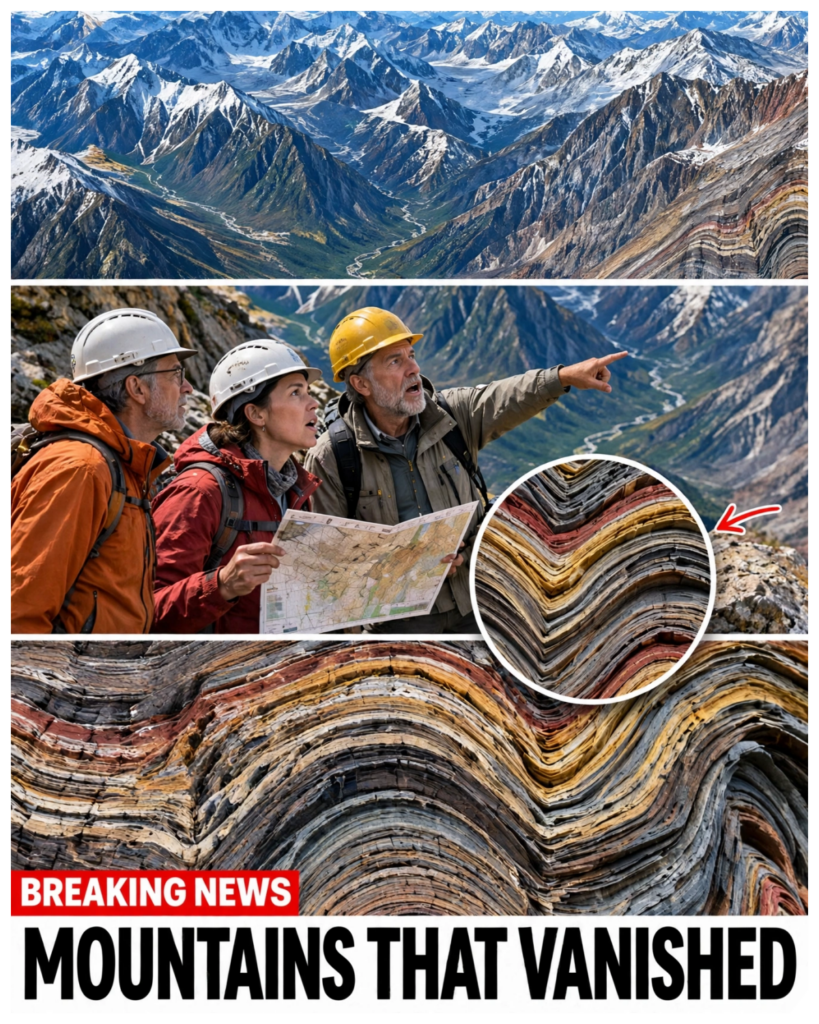
We were taught that life depends on factors like water and sunlight to survive, but what if it were all lies and the only thing that kept us alive was deep in the mountains?
For billions of years.
Before humans, before dinosaurs, even before animals looked anything like they do today, Earth was shaped by mountain ranges on a scale we can barely imagine.
Now, scientists are patching up clues that could change how we understand the story of life itself.
And the strangest part?
Some of the evidence may still be buried beneath Antarctica’s ice.
The Continental Puzzle Some of the world’s tallest mountains began rising hundreds of millions of years ago, and scientists have found a way to trace their history using crystals buried in ordinary sand.
One of those crystals is zircon, a tiny mineral made of zirconium, silicon, and oxygen.
It forms as magma cools, trapping uranium inside its structure while largely keeping lead out.
Over time, that uranium slowly decays into lead at a predictable rate, giving scientists a way to estimate the crystal’s age.
And hidden in those tiny grains may be clues to ancient mountain ranges that once towered over the landscape.
In 2006, geologists studying sand from coastlines thousands of kilometers apart uncovered a surprising pattern.
They discovered that the zircon grains from South America, Africa, India, Australia, and Antarctica showed remarkably similar age patterns.
These continents were separated by vast oceans, yet the crystals seemed to share the same geological history.
How could mountain ranges on different continents leave such similar traces?
The results raised a question scientists couldn’t easily ignore.
After a series of tests, it turned out that the sand spread across five continents may have come from one enormous source, carried by ancient rivers long before today’s coastlines existed.
And if that much sediment came from a single region, it meant that a mountain so big had worn out due to erosion until its remains became part of the ground beneath our feet.
The question on everyone’s mind is how one mountain range was able to produce so much sand and what could have created something so enormous.
Well, we can only get the answer journeying back hundreds of millions of years to a world that looked nothing like the one we know today.
When people think of ancient supercontinents, Pangaea usually comes to mind.
But long before Pangaea formed, an even older landmass may have covered much of the planet.
Known as Greater Gondwana, it may have brought together huge sections of what are now separate continents.
To piece together its history, geologists traced buried fragments of ancient crust from India and Southeast Asia through China and as far north as Kazakhstan.
Those scattered pieces could help reveal just how enormous this lost world really was.
This ancient mountain-building event began when East and West Gondwana collided sometime between 650 and 550 million years ago.
As these huge landmasses pushed into each other, the continental rock resisted sinking deep into the mantle.
Instead, the collision compressed and thickened the crust, forcing parts of it upward.
Over millions of years, that pressure helped build a mountain range on a scale that is difficult to imagine today.
The collision gave rise to what scientists call the Transgondwanan Supermountain, an ancient range estimated to stretch more than 8,000 kilometers long and 1,000 kilometers wide.
That would make it vastly larger than any mountain range we know today.
The Himalayas, for comparison, stretch about 2,400 kilometers.
This lost mountain system may have towered across a huge part of the ancient world, and its eventual collapse would leave traces scattered across continents.
Even the most powerful tectonic forces have their limits.
As mountains grow taller, their weight puts more pressure on the crust underneath where heat and pressure can weaken the rock, making the thickened crust unstable.
Eventually, parts of the mountain system can spread outward and sink, causing the range to gradually collapse under its own weight.
The Transgondwanan range was enormous, but it wasn’t the only supermountain system Earth had ever seen.
Geologists believe an even older range existed hundreds of millions of years earlier, leaving behind clues that have taken decades to piece together.
The Nuna Supermountain In 2022, researchers at the Australian National University uncovered evidence of a much older mountain system known as the Nuna Supermountain.
It may have formed between two billion and one point eight billion years ago, long before the Transgondwanan range ever existed.
The discovery offered a glimpse into a period of Earth’s history that scientists are still working to piece together.
The Nuna Supermountain formed as an ancient supercontinent called Nuna, or Columbia, came together.
Tectonic plates collided across areas that are now Canada, northern Siberia, North China, and Central India, pushing these regions together.
Today, chemical clues preserved in ancient rocks have helped scientists connect these distant places to show how they were once part of the same massive collision zone.
Two billion years ago, Earth looked nothing like it does today.
There were no trees, grass, or land plants, just vast stretches of exposed rock battered by the elements.
Rising across this ancient landscape was the Nuna mountain range, believed to have stretched more than 8,000 kilometers.
Its roots extended deep into the crust, where extreme heat and pressure transformed the rock and pushed molten granite into surrounding layers.
The weight of this enormous range also pressed down on the Earth’s outer shell, creating deep depressions in the land around it.
As these mountains rose, heavy rains battered the bare rock.
With no trees or plants to hold the ground together, water flowed freely down the slopes, carrying huge amounts of broken rock and sediment with it.
Over millions of years, rivers washed these materials into the ancient oceans, along with chemicals released from the eroding mountains.
Those changes may have helped reshape the oceans and create conditions that would later influence the evolution of life.
Before the Australian team published its findings, the Nuna Supermountain had barely registered in the scientific picture of ancient Earth.
Researchers had overlooked the possibility that a mountain range on the scale of Transgondwana could have existed so early in the planet’s history.
Even with two distinct eras, separated by more than a billion years, there were no clues left behind, even after erosion wore them down.
So how did scientists uncover evidence of mountains that disappeared billions of years ago?
Sitting in the 71 spot of the periodic table is lutetium.
This heavy but rare earth element is the key to understanding what exactly happened below the surface for millions of years.
Thanks to this element, scientists have found a way to investigate the extreme pressures deep beneath ancient mountain ranges.
During those times, huge mountains needed deep roots to support their weight, much like an iceberg extending far beneath the water.
In some cases, those roots could even reach several times deeper than the mountains rise above the ground, leaving behind clues about the forces that once shaped them.
Beneath a supermountain stretching thousands of kilometers, the weight of the rock above creates enormous pressure deep in the crust.
Temperatures rise, and the pressure can reach anywhere around one to one point five gigapascals, changing how the surrounding rocks behave.
Under these conditions, the rocks undergo metamorphism and form minerals such as garnet.
As garnet grows, it tends to absorb lutetium from the surrounding rock.
Nearby, tiny zircon crystals are forming too, preserving clues to what was happening deep beneath the ancient mountains.
This difference gives scientists a way to identify ancient supermountains.
When zircon forms deep beneath a massive range, garnet absorbs much of the available lutetium, leaving the zircon with very little of it.
Smaller mountain ranges and volcanic island arcs usually have shallower roots, so less garnet forms deep underground to trap the element.
As a result, zircon crystals from these regions tend to contain more lutetium, giving researchers a way to tell the two geological settings apart.
This chemical signature gave geologists a way to investigate Earth’s distant past.
Researchers at the Australian National University studied lutetium-to-hafnium ratios in thousands of zircon grains, covering roughly 4.5 billion years of geological history.
When they compared the results across that vast timeline, two major peaks stood out.
Both lined up with periods when the Nuna and Transgondwanan supermountains are thought to have existed, giving scientists new evidence of these long-lost ranges.
It turns out there were clues that revealed something bigger than the mountains themselves.
Each time these giant ranges formed, erosion carried minerals into the oceans, changing their chemistry over millions of years.
Those changes may have played a major role in shaping the conditions that allowed life on Earth to evolve.
The Oxygen Revolution During both the Nuna and Transgondwanan periods, there were no trees, grass, or other land plants to hold the soil together.
With nothing to slow the flow of rainwater, exposed rock was vulnerable to erosion.
And with mountain ranges stretching across vast areas of the ancient continents, the effects on rainfall, weather patterns, and the surrounding landscape could have been enormous.
These mountain ranges stretched for thousands of kilometers across the ancient tropics, disrupting winds and changing how moisture moved through the atmosphere.
As warm, moisture-laden air hit the mountains, it was forced upward, where it cooled and released heavy rainfall.
This process, known as orographic precipitation, could have exposed the surrounding rock to millions of years of intense erosion.
The heavy rainfall wore down the exposed mountains through both physical erosion and chemical reactions.
Rainwater reacted with minerals in the rock, gradually breaking them down and releasing dissolved elements.
Rivers then carried huge amounts of sediment away from the mountains and into the oceans.
Over millions of years, this steady flow of rock and minerals helped reshape the landscape and changed the chemistry of the ancient seas.
The ancient crust held key elements such as phosphorus, iron, calcium, and strontium.
Before these giant mountains began to erode, many parts of the ancient ocean had limited supplies of essential nutrients.
Simple life already existed in the water, but its growth depended on the chemicals available.
As erosion released more of these elements and carried them out to sea, it may have helped create better conditions for life to spread and diversify.
The rise of these supermountains may have changed the oceans by sending fresh supplies of nutrients into the water.
As the rock broke down, rivers carried phosphorus and iron toward the coast, where they could fuel the growth of tiny marine organisms.
Phosphorus, in particular, is essential for life, and a greater supply could have helped these organisms multiply across the oceans.
Over time, that growth may have had far-reaching effects on the chemistry of the seas and the evolution of life.
The influx of nutrients may have done more than feed ancient marine life because as these organisms grew, they began changing ocean chemistry.
As they did, the consequences eventually reached the atmosphere and reshaped the future of life on Earth.
There’s no doubt that the erosion of the Nuna Supermountain may have played a role in one of the biggest changes in Earth’s history.
As rivers carried phosphorus and iron from the mountains into shallow coastal waters, these nutrients gave microscopic marine organisms more of what they needed to grow, potentially setting the stage for changes in the planet’s atmosphere.
Cyanobacteria, ancient organisms that make their own food through photosynthesis, thrived on these newly available nutrients.
As their populations grew, they spread through the oceans, taking in carbon dioxide and releasing oxygen.
Over time, some of that oxygen escaped from the water into the atmosphere, helping drive a major change in the air surrounding Earth.
This sudden change of nutrients may have helped support the rise in oxygen associated with the Great Oxidation Event, a major turning point in Earth’s history.
As oxygen levels gradually increased, the planet became more suitable for new forms of life.
Much later, eukaryotic cells emerged, with a more complex internal structure that would eventually give rise to plants, animals, and fungi.
For billions of years, life on Earth consisted mainly of simple cells called prokaryotes, including bacteria.
These cells had no nucleus or the complex internal structures found in more advanced cells.
Eukaryotes were different.
They had a nucleus to hold their DNA, specialized structures called organelles, and mitochondria that help produce energy.
That added complexity opened the door to the evolution of plants, animals, and countless other forms of life.
Eukaryotic cells are more complex than bacteria, and keeping their internal systems running takes energy.
Rising oxygen levels may have helped support their evolution, although scientists are still investigating exactly how that happened.
The timing is intriguing, especially as the evidence of the Nuna Supermountain overlaps with a period of major change in early life.
As the mountains eroded, they released nutrients into the oceans, potentially helping marine organisms thrive.
The connection is still being studied, but it raises a fascinating possibility about if the forces that built and wore down ancient mountains may have helped create conditions for the complex life we see today.
As Nuna supermountains may have helped create conditions for complex cells to emerge, Earth entered a long stretch of far less geological activity and surprisingly little change in life for nearly a billion years.
Scientists call this period the Boring Billion, and you’re about to find out why.
The Boring Billion The Boring Billion, which lasted from about 800 million to one point eight billion years ago, was an unusually quiet chapter in Earth’s history.
The continents changed far less than they had during earlier periods, and there was less evidence of the massive mountain-building events that had shaped the planet before.
With fewer major collisions creating new mountain ranges, Earth entered a long stretch that scientists are still trying to understand.
Researchers at the Australian National University found that zircon grains with low lutetium levels became far less common in the rocks dating to the Boring Billion.
This suggests that the kind of deep-rooted mountain building seen in earlier periods had slowed considerably.
With fewer giant ranges being worn down, less fresh rock was exposed to erosion, and the flow of nutrients such as phosphorus and iron into the oceans may have declined.
The result could have been a major change in the conditions supporting life in the ancient seas.
Without a steady supply of nutrients from eroding mountains, parts of the ancient ocean became warm, oxygen-poor, and rich in toxic sulfur compounds.
Some researchers describe these conditions as the Canfield Ocean.
The effects on marine life may have been significant, with limited nutrients making it harder for some organisms to thrive.
For hundreds of millions of years, life remained mostly microscopic, with simple organisms dominating the seas while the evolution of more complex life moved slowly.
The geological record may hold an important clue to the link between mountain building and life on Earth.
During the Boring Billion, major mountain-building events were less common, and life remained largely microscopic.
Then, around 650 million years ago, continents began colliding again, raising another enormous mountain range.
Its rise would bring fresh questions about how changes deep within the Earth affected life in the oceans.
The Transgondwanan Uprising That long period of relative calm eventually gave way to renewed continental movement.
Around 650 to 500 million years ago, tectonic plates shifted and collided, bringing together the landmasses that would form Gondwana.
These collisions helped raise the Transgondwanan Supermountain, an enormous range that may have stretched across much of the ancient supercontinent.
For millions of years, this towering wall of rock reshaped the landscape, setting the stage for another major chapter in Earth’s history.
Mapped onto today’s world, the Transgondwanan Supermountain would cross parts of Africa, the Arabian Peninsula, India, Antarctica, and Australia.
Researchers estimate that this ancient range stretched for more than 8,000 kilometers, linking regions that are now separated by vast oceans.
It would have been one of the largest mountain systems in Earth’s history, spanning an extraordinary distance across the supercontinent of Gondwana.
The amount of rock these mountains shed over time was enormous.
Rain and rivers steadily wore down the peaks, carrying broken stone and sand toward the surrounding coastlines.
Over millions of years, this sediment built up in thick layers, including deposits of quartz-rich sandstone that geologists can still study today.
These rocks preserve clues to the scale of the ancient range and how its erosion reshaped the landscapes around it.
Because the Transgondwanan Supermountain stretched across the tropics, heavy rainfall may have sped up the chemical breakdown of its exposed rocks.
As water reacted with silicate minerals, it released calcium and bicarbonate that rivers carried into the oceans.
Over time, this influx of dissolved material may have changed ocean chemistry, making some seawater more favorable for calcium carbonate to form and accumulate.
At the same time, nutrients released by the eroding mountains may have helped marine algae grow and spread, increasing the amount of oxygen produced through photosynthesis.
Over time, rising oxygen levels helped create conditions that could support larger, more energy-hungry animals, setting the stage for a major turning point in the evolution of life.
The conditions were finally in place.
Oxygen levels were rising, and the oceans were rich in dissolved minerals.
The Transgondwanan supermountain may have helped set the stage for one of the most important turning points in the history of life.
Between 541 and 520 million years ago, the fossil record began to reveal a dramatic change known as the Cambrian Explosion.
Before this period, Earth’s oceans were home to the Ediacaran biota, strange, mostly soft-bodied organisms with no hard shells or obvious signs of complex movement.
Many lived attached to the seafloor, in a world that looked very different from the one that followed.
One of the biggest changes came with biomineralization, the ability of animals to build hard structures from minerals in their environment.
Shells, teeth, claws, and skeletons all require chemical ingredients, including calcium and phosphorus.
If those minerals weren’t available in the surrounding water, early animals had far fewer options for building hard body parts that could protect them or help them survive.
One possible explanation lies in the Transgondwanan Supermountain.
As the enormous range eroded, it may have released minerals into nearby seas, giving early animals more of the raw materials needed to build shells and skeletons.
This could help explain why so many different animal groups appear in the Cambrian fossil record with hard body parts, seemingly within a relatively short period.
As minerals washed into the oceans, early animals had more of the materials needed to build hard body parts.
That may have helped fuel a new kind of competition.
Predators developed ways to capture their prey, while other animals evolved shells, better ways to detect danger, and faster ways to escape.
This growing struggle for survival helped drive the rapid diversification of animal life during the Cambrian Explosion.
Geologists have looked for clues in strontium isotopes preserved in ancient rocks and fossils.
These chemical signatures can help trace where sediments came from, including the weathering of continental crust.
While they may offer clues about mountain erosion during the Cambrian, they don’t prove that the Transgondwanan Supermountain directly supplied the materials animals used to build their shells and skeletons.
Scientists had found clues linking these ancient mountains to the rise of animal life.
Then, in 2026, researchers turned their attention to one of the most remote places on Earth, drilling deep beneath Antarctica’s ice to uncover more of the mountain chain’s history.
The 2026 Discovery Researchers from the GFZ Helmholtz Centre and The Australian National University turned to the waters around Antarctica, where layers of seafloor sediment preserve clues to the continent’s past.
Working in freezing conditions, they drilled into the ocean floor and collected sediment cores, hoping to uncover evidence of the ancient mountain chain buried beneath the region’s geological history.
The team recovered marine sediments and isolated 1,712 zircon crystals for chemical analysis.
But how do minerals from deep inland reach the ocean?
Antarctica’s glaciers provide one answer.
As these huge masses of ice move across the continent, they scrape against the bedrock below, grinding it into smaller fragments and carrying the debris toward the coast, where it can eventually reach the sea.
When the results came in, the Antarctic zircon crystals revealed something unexpected.
Their chemical signatures pointed to a mountain-building event involving immense pressure, offering new clues about the scale of the ancient range.
The findings also suggested that parts of the Transgondwanan Supermountain may have formed under conditions different from those recorded in rocks from Africa and Australia.
By piecing together ancient continental maps, geologists traced the mountain range across the landscape that existed hundreds of millions of years ago.
Between roughly 650 and 450 million years ago, parts of the Transgondwanan Supermountain may have stretched across what is now Antarctica.
If the range released large amounts of weathered rock and minerals, it could have helped change the chemistry of ancient oceans far beyond the continent itself.
The discovery raises a bigger question about what still lies beneath Antarctica’s ice.
Parts of the ancient mountain system may remain buried under the East Antarctic Ice Sheet, hidden beneath kilometers of ice.
These rocks could hold valuable clues about how the range formed, how it weathered over time, and whether it played a role in the changes that helped animal life diversify during the Cambrian Explosion.
These ancient mountains may be long gone from the surface, but their remains could still lie beneath Antarctica’s ice.
So if supermountains played such a major role in shaping Earth’s history, why don’t we see anything like them today?
Why Doesn’t Earth Have Supermountains Today?
Today, the Himalayas dominate the world’s mountain ranges, with Mount Everest rising higher than any other peak on Earth.
But even this giant falls short of the scale scientists associate with ancient supermountains.
These ranges stretched across vast regions, and their effects may have reached far beyond the land they occupied.
Compared with the ancient mountains of Nuna and Gondwana, the Himalayas are impressive, but they’re on a very different scale.
To understand why supermountains are so rare today, we need to look at how continents move over time.
Geologists call this the supercontinent cycle, a process in which landmasses gradually come together to form enormous supercontinents, then break apart again.
This cycle unfolds over hundreds of millions of years, repeatedly reshaping Earth’s surface and creating very different conditions for mountain building.
Today, Earth’s continents are spread across the globe, separated by vast oceans.
That makes the kind of continent-wide collision associated with supermountains much harder to achieve.
The Himalayas formed when the Indian plate moved north and collided with Eurasia, pushing the land upward over millions of years.
The result is an enormous mountain range stretching roughly 2,400 kilometers, yet it formed from a much more localized collision than the massive continental gatherings of the ancient past.
Building a supermountain stretching 8,000 kilometers would take a very different set of conditions.
Instead of two plates colliding in one region, several huge landmasses would need to converge across a much wider area, forcing vast stretches of continental crust together and raising mountain ranges that could span an entire supercontinent.
Earth is still in a long period of continental breakup that began when Pangaea started splitting apart around 200 million years ago.
With the continents spread across the globe, mountain building is happening in separate regions rather than along one enormous collision zone.
For now, the conditions that may have produced ancient supermountains are largely absent.
But as the continents continue to move, Earth’s geography will keep changing, setting the stage for another major chapter in the planet’s history.
Today, the continents are spread far apart, and the mountains they form are relatively localized.
But plate tectonics never stops.
As the continents continue to move, scientists are already exploring how Earth’s next supercontinent might take shape and where its mountain ranges could eventually rise.
The continents are still moving, and scientists are using those movements to explore what Earth might look like millions of years from now.
By tracking the speed and direction of tectonic plates, researchers can build computer models of future continental shifts.
Some of these models suggest that the continents could eventually join again to form a new supercontinent, with possible names including Amasia and Pangaea Ultima.
Some models point to the possible rise of a future supermountain range known as the Sumean Mountains, perhaps 200 to 250 million years from now.
The geography would look very different from today.
As Africa continues moving north, it could collide with Europe, gradually closing the Mediterranean Sea and pushing up a vast mountain belt stretching from Spain through Greece and into Asia.
Another possibility is the Aurica model, which imagines both the Pacific and Atlantic oceans eventually closing as the continents shift into new positions.
In this scenario, the Americas could collide with Asia, while Australia moves farther north and joins the growing landmass.
The exact outcome is uncertain, but some future supercontinent models suggest that these collisions could produce mountain belts thousands of kilometers long, on a scale that echoes the ancient ranges associated with Nuna and Gondwana.
These future mountain ranges could have major effects on Earth’s climate and oceans.
They would redirect winds, change rainfall patterns, and expose vast areas of fresh rock to erosion.
Rivers could then carry large amounts of mineral-rich sediment into nearby seas, changing ocean chemistry and potentially affecting marine life and the climate across the new supercontinent.
These future mountain-building events could also create new pressures on life, forcing species to adapt as climates and ecosystems change.
Over millions of years, that could lead to new forms of life evolving.
Earth’s mountains may seem permanent, but they rise and wear away over time, shaped by the same geological forces that keep changing the planet.
Supermountains may be a thing of Earth’s past, but their story isn’t over.
As the continents continue to move, the same forces that built those ancient ranges could one day create something similar again.
Time Perspective For decades, scientists have tried to explain how Earth went from a world dominated by simple life to one filled with complex animals.
The clues weren’t all in the fossils.
Some were hidden in the chemistry of ancient rocks.
Researchers have identified two major periods of supermountain formation, linked to the Nuna and Transgondwanan ranges.
As these mountains eroded, they may have released minerals into the oceans, helping create conditions that supported the rise and diversification of complex life.
Their story offers a striking reminder that some of the biggest changes in evolution may have started with the slow, relentless wearing down of stone.
Recent research is giving scientists a clearer picture of the ancient world, including what may lie beneath Antarctica’s ice.
By analyzing sediment from the seafloor, researchers have found clues that could help trace the history of the Transgondwanan Supermountain.
The results are more than enough proof that some of Earth’s most important geological evidence remains hidden beneath ice, rock, and layers of sediment, waiting to be uncovered.
It’s hard to grasp just how long the Earth has been changing.
Human civilization has existed for only a brief moment in the planet’s history, between ancient mountain-building events and those that may come millions of years from now.
Yet, by studying tiny mineral grains preserved in rocks and sediments, scientists can piece together the history of landscapes that disappeared billions of years ago.
Places we will never see again are leaving behind clues that researchers are only now learning to read.
Do you think life as we know it would have evolved without supermountains?
Share your thoughts in the comments below.
If you enjoyed this, please don’t forget to hit that like button and subscribe right now.
For more content like this, click the video on your screen.
Thank you for watching!