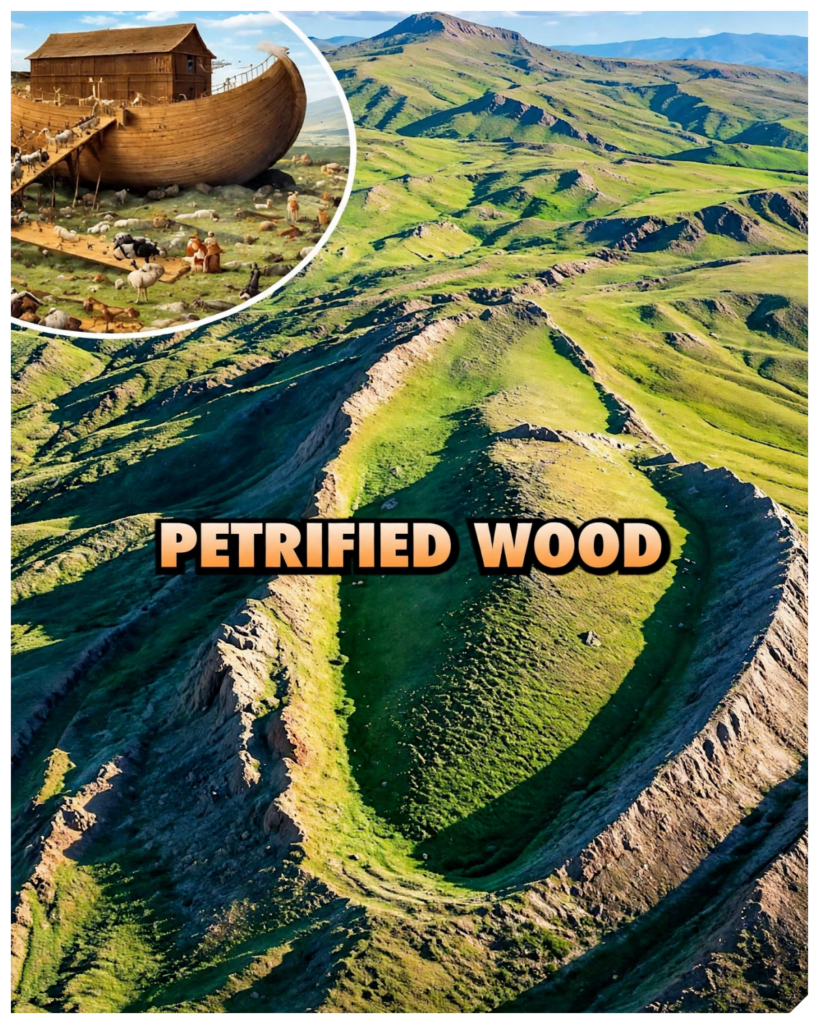
🚨 NOAH’S ARK LOCATION CONFIRMED?? A SHOCKING DISCOVERY IN TURKEY MAY FINALLY EXPLAIN THE 4,000-YEAR-OLD MYSTERY!
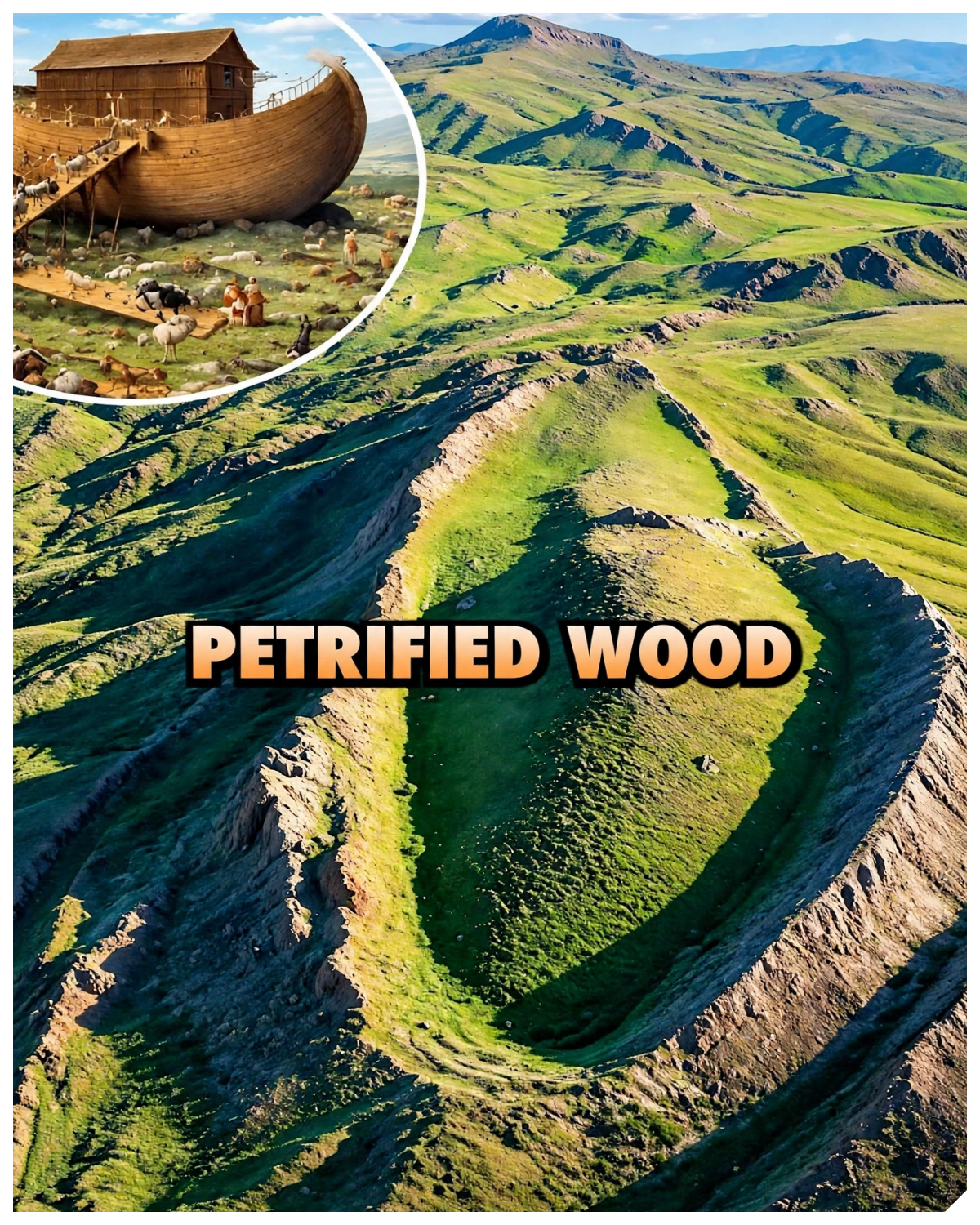
PART 1: THE MOUNTAIN THAT MAY HOLD THE GREATEST SECRET IN HISTORY
For thousands of years, one question has refused to disappear.
Where is Noah’s Ark?
According to the biblical account, Noah built an enormous vessel to save his family and representatives of the animal world from a devastating flood. When the waters finally receded, the Ark came to rest in the mountains of Ararat.
Generations have searched for it.
Explorers have climbed frozen slopes. Historians have examined ancient manuscripts. Researchers have studied unusual geological formations. Countless photographs have circulated, each accompanied by claims that the legendary vessel might finally have been found.
But no discovery has provided universally accepted scientific proof.
Until a mysterious investigation in eastern Turkey brought the debate roaring back.
And this time, the researchers were not simply looking at photographs.
They were examining a formation whose unusual outline had fascinated investigators for decades.
The story began near Mount Ararat, where the landscape seems almost untouched by time.
The mountain rises dramatically above the surrounding countryside. Its snow-covered summit disappears into the clouds, while deep valleys and rugged slopes conceal geological formations shaped over countless centuries.
It is a beautiful place.
But it is also a place surrounded by questions.
A research team led by a determined geologist named Daniel had traveled to the region to investigate a formation popularly associated with Noah’s Ark.
Daniel was not a man who believed every extraordinary story.
He had spent most of his career studying geological structures and understanding how natural forces shape the Earth’s surface.
He knew that mountains could create formations that looked remarkably artificial.
Still, he was fascinated by this particular location.
Its elongated, boat-like appearance had attracted attention from researchers and enthusiasts for years.
Some claimed that its dimensions resembled the measurements of Noah’s Ark recorded in Genesis.
Others argued that the formation was entirely natural.
Daniel wanted to know what the evidence actually showed.
His colleague Miriam, an archaeologist with a deep interest in ancient history, shared his determination.
Unlike Daniel, she had spent years studying the historical traditions surrounding ancient floods.
She understood how powerful the story of Noah had become across generations.
But she also knew that a biblical description and an archaeological identification were two different things.
On their first morning at the site, the team stood together overlooking the formation.
Miriam opened her notebook.
“Imagine,” she said quietly, “if something connected to that ancient story really survived here.”
Daniel looked across the landscape.
“Then we would need evidence strong enough to convince people who don’t already believe it.”
Miriam smiled.
“That’s why we’re here.”
The investigation began with careful measurements and geological surveys.
Researchers documented the formation’s outline, examined the surrounding rock, and compared the results with existing geological maps.
The first observations were intriguing.
Certain areas displayed unusual variations in material and surface texture.
But nothing could establish whether the formation had been shaped by human hands.
Daniel repeatedly reminded the team not to confuse resemblance with proof.
Then something unexpected happened.
A member of the survey team noticed a difference in the geological readings near the lower section of the formation.
At first, the team suspected a simple equipment error.
The measurements were repeated.
The variation remained.
Miriam approached the monitor.
“What does that mean?”
Peter, the technician, adjusted the display.
“It means the material beneath this section may be different from what we expected.”
“Different how?”
“We need more measurements before we can say.”
Daniel examined the results.
The feature could have been caused by changes in rock density, mineral deposits, or other natural geological processes.
But it was unusual enough to deserve further examination.
The team collected carefully documented samples and arranged for laboratory analysis.
For several days, they waited.
The researchers continued their work, unaware that the next development would change the direction of the investigation.
A laboratory technician named Elif contacted Daniel.
Her voice was unusually serious.
“We have completed the preliminary examination.”
Daniel immediately asked, “And?”
“There are some variations in the sample that deserve additional testing.”
“Are you suggesting human construction?”
“No. We cannot establish that. But I recommend examining the original material again.”
Daniel thanked her and ended the call.
Miriam had been listening.
“Could this be something important?”
“Possibly. But we have to be careful.”
The following morning, the team reviewed the laboratory observations.
The results showed variations in mineral composition and microscopic texture.
Some were consistent with the surrounding geological environment.
Others required additional investigation.
Nothing established the presence of ancient wood or a man-made vessel.
Still, the team decided to conduct another survey.
This time, they would focus on a section that had received relatively little attention.
The weather changed dramatically as they prepared.
Dark clouds gathered over the mountain.
Cold wind swept across the ground, carrying dust and small fragments of stone.
Daniel stood beside the equipment, looking toward the formation.
Miriam approached him.
“Do you ever think about what would happen if we actually found something?”
Daniel remained silent for a moment.
“People would want us to announce it immediately.”
“And?”
“And we would have to resist that pressure until the evidence was complete.”
Miriam nodded.
Then she looked toward the mountain.
“Some mysteries are bigger than the people investigating them.”
Daniel smiled.
“That’s why we have to be careful.”
The next survey began.
The equipment recorded several geological variations beneath the surface.
One feature appeared particularly interesting.
Peter repeated the measurement.
Then he called Daniel over.
“Look at this.”
Daniel examined the screen.
“Could it be a cavity?”
“Possibly, but we need to rule out natural explanations.”
Miriam joined them.
For several minutes, they examined the readings.
The feature appeared to extend beyond the immediate area.
The team decided to document it for additional investigation.
But before they could finish, Miriam received an unexpected message.
It came from Samuel, a historian who had been examining old expedition records associated with Mount Ararat.
The message contained an attachment.
The subject line read:
I THINK YOU NEED TO SEE THIS.
Miriam opened the file.
It was an old photograph of a handwritten document.
The text described an earlier expedition to the same general region.
One passage referred to an unusual formation and recommended examining the material beneath its lower section.
Miriam immediately called Daniel.
“Come here. You need to see this.”
Daniel entered the room.
“What happened?”
She pointed toward the photograph.
“Someone may have investigated this area decades ago.”
Daniel studied the document.
“Do we know whether it’s authentic?”
“Not yet. Samuel is checking its history.”
They continued examining the photograph.
Then Daniel noticed something.
The document contained a rough drawing.
Its outline looked remarkably similar to the formation they were currently investigating.
He leaned closer.
“Where did this come from?”
Miriam shook her head.
“We need to ask Samuel.”
Daniel picked up his phone.
Before he could make the call, another message arrived.
This time, it contained a scanned page from the same historical collection.
Miriam opened it.
The page was incomplete, and several lines were damaged.
But one sentence remained readable.
She read it aloud:
“Do not search only where the vessel appears to rest. The answer may lie beneath the place where the waters disappeared.”
Daniel stared at the screen.
“What does that mean?”
Neither researcher had an answer.
The sentence might have been metaphorical.
It might have referred to an entirely different location.
Or it might have been a clue that earlier explorers had misunderstood.
Then Miriam noticed something at the bottom of the page.
A handwritten name.
It belonged to a researcher who had reportedly led an earlier expedition near the mountain.
Daniel searched through the available records.
Suddenly, he stopped.
The researcher had a surviving family member who might possess additional documents.
And the final note in the historical file contained something even more surprising.
It mentioned a second location.
A place that was not on the modern team’s original investigation map.
Daniel looked at Miriam.
“Call Samuel. We need to know where this second location is.”
Miriam reached for her phone.
But before she could dial, Samuel sent one final message.
It contained a map.
And marked on that map was a location several kilometers away from the mysterious boat-shaped formation.
Daniel stared at the coordinates.
Then he whispered:
“That cannot be right.”
Because the old map appeared to point toward a place the team had never considered investigating.
And when Samuel finally explained why that second location had been marked, Daniel realized their entire search might have been focused on the wrong place.
👇 Want to know what the old map revealed? Check the comments for Part 2!
PART 2: THE LOCATION NOBODY HAD EXPECTED
And when Samuel finally explained why that second location had been marked, Daniel realized their entire search might have been focused on the wrong place.
Samuel joined the team by video call that evening.
He explained that the second location appeared in more than one historical document.
But there was something unusual about it.
The original expedition leader had apparently requested that it remain separate from the main investigation.
“Why?” Miriam asked.
Samuel took a deep breath.
“Because he believed the first formation might be a distraction.”
Daniel stared at the map.
“Then what did he believe was at the second location?”
Samuel opened another file.
“I found a photograph taken decades ago. And there’s something in it that I think you should see.”
He shared the image.
Miriam moved closer to the screen.
Her face went pale.
❤️ LIKE and comment ARARAT if you want Part 3!
PART 3: THE SECOND LOCATION — THE SECRET THAT COULD CHANGE EVERYTHING
Miriam moved closer to the screen.
Her face went pale.
For several seconds, she said nothing.
Daniel leaned toward the monitor.
“What are we looking at?”
Samuel enlarged the photograph.
The image was old and slightly damaged. Its edges were faded, and the contrast was poor.
It showed a remote section of mountainous terrain.
A narrow valley stretched between two rocky slopes.
In the foreground stood several people, apparently members of an earlier expedition.
But Daniel was not looking at them.
He was examining the ground behind them.
There was a long, irregular shape running across the landscape.
It was difficult to distinguish from the surrounding terrain.
Yet something about it seemed familiar.
“Is that another formation?” he asked.
Samuel nodded.
“That’s what I believe.”
Miriam studied the photograph.
“Why didn’t anyone mention this location before?”
“Because the historical account is incomplete. The original researcher seems to have treated this as a separate investigation.”
Daniel frowned.
“How separate?”
Samuel opened another document.
“The main expedition was focused on the formation everyone knows. But this second location appears in several private notes.”
“Did they investigate it?”
“That’s what I’m trying to establish.”
Daniel looked at the photograph again.
“Where was it taken?”
Samuel pointed toward the lower corner.
There was a handwritten description.
The location was identified by a nearby valley and a geographical landmark.
Miriam immediately opened the modern survey map.
She began comparing the descriptions.
The room became silent.
Finally, she looked up.
“I think I know where this is.”
Daniel moved beside her.
“Are you certain?”
“No. But the description matches an area east of our original survey.”
Samuel nodded.
“That’s consistent with my interpretation.”
Daniel looked at the old photograph.
For weeks, the team had been investigating the famous boat-shaped formation.
Now, an old document suggested that an earlier expedition might have been interested in somewhere else entirely.
He took a deep breath.
“Samuel, can you send us every document connected to that second location?”
“I can.”
“And I want the original photographs if possible.”
“I’ll contact the collection.”
The call ended.
Miriam closed her laptop.
“Do you think this is important?”
Daniel looked toward the window.
“I think it’s important enough to investigate.”
The story behind the map
The following morning, the team gathered around a large table.
Daniel displayed the photograph.
Miriam presented the historical descriptions.
Peter compared the old location notes with the available geographical information.
The first challenge was identifying the exact place.
The historical map was incomplete.
Some landmarks had changed.
Several place names had been translated differently over the decades.
And the original researcher had used descriptions that were difficult to interpret.
Still, there was one promising connection.
The notes repeatedly referred to a narrow valley near a natural rock formation.
The location was not the same as the famous Durupınar formation, which has long attracted attention because of its boat-like appearance.
Instead, the historical documents suggested a separate area that had not received the same level of public attention.
Miriam examined the photographs.
“Why would the original expedition leader keep returning to this place?”
Peter shrugged.
“Maybe he thought it was significant.”
Daniel looked at him.
“Or perhaps he was simply documenting an unusual geological feature.”
“Either way, we need to find out.”
Daniel nodded.
The team agreed to conduct a preliminary survey.
But before they could proceed, they needed to establish whether the old documents were authentic.
Samuel had been working on that question.
He contacted the historical collection and requested a specialist examination.
The results arrived two days later.
The documents appeared to belong to a genuine historical collection, but their exact dates and authorship still required further confirmation.
The photographs could not be treated as definitive archaeological evidence.
Nevertheless, the information was valuable.
The team now had a possible location to investigate.
And for Daniel, that was enough.
A difficult conversation
That evening, Daniel received a call from an old colleague named Professor Richard Hayes.
Richard was a respected geologist who had studied unusual mountain formations for decades.
He had followed the investigation and was concerned about the growing public attention.
“I hear you’ve found another possible Ark location,” Richard said.
Daniel sighed.
“That’s not how I’d describe it.”
“That’s exactly how the newspapers will describe it.”
“We have an old photograph and a historical reference.”
“And no archaeological proof.”
“Correct.”
Richard paused.
“Daniel, I know you’re careful. But you need to understand what you’re dealing with. The moment you use the words Noah’s Ark, people stop listening to the qualifications.”
Daniel leaned back.
“What would you suggest?”
“Investigate the geological feature. Don’t attach a conclusion to it before you have evidence.”
“That’s what we’re planning.”
“Good. And one more thing.”
“What?”
“Do not let the historical account become your geological explanation.”
Daniel smiled.
“You’re beginning to sound like me.”
Richard laughed.
“Someone has to keep you honest.”
After the call, Daniel sat quietly.
He understood the concern.
The team had already experienced the pressure of public expectations.
Now the investigation was expanding into another location.
If they were not careful, an interesting historical clue could quickly become an exaggerated claim.
He opened his notebook.
At the top of the page, he wrote:
THE LOCATION IS A QUESTION, NOT AN ANSWER.
Returning to the mountain
The following week, the team traveled toward the second location.
The journey was difficult.
The road wound through rugged terrain, passing small settlements and open valleys.
The mountain landscape seemed to change with every kilometer.
Snow-covered peaks gave way to rocky slopes.
The air grew colder.
By the time they reached the general area, the afternoon light was fading.
Miriam stepped out of the vehicle.
She looked across the valley.
“Is this where the photograph was taken?”
Peter checked the map.
“According to the old description, we’re close.”
Daniel approached the edge of the survey area.
The landscape was quiet.
There were no obvious structures.
No exposed wooden remains.
No dramatic evidence of an ancient vessel.
Just rocks, soil, and the enormous silence of the mountains.
Miriam looked disappointed.
“I expected something more obvious.”
Daniel smiled.
“That’s usually how fieldwork works.”
They established a temporary base and reviewed the coordinates.
The next morning, they began the survey.
The team examined the surrounding geological layers.
They photographed surface features and compared the landscape with the old images.
After several hours, Peter noticed something.
“Daniel, come and look at this.”
Daniel approached.
Peter pointed toward a low section of ground.
The surface displayed a long depression.
It was not perfectly symmetrical.
Its edges were irregular.
But it seemed to correspond with part of the shape visible in the historical photograph.
Miriam examined it.
“Could this be the feature?”
“Possibly,” Daniel replied.
“Does it look artificial?”
“Not enough to say.”
Peter crouched near the edge.
“There are changes in the material here.”
Daniel looked carefully.
“Record the location.”
The team documented the area.
They collected non-invasive survey data and identified several points that deserved further examination.
Nothing established the presence of an archaeological structure.
But the historical photograph had helped them identify a geological feature that might otherwise have remained overlooked.
The unexpected visitor
On the third morning, a local guide named Yusuf approached the research team.
He had heard that researchers were examining the valley.
He was curious about their work.
Daniel greeted him and explained that they were studying the geological features and comparing them with historical photographs.
Yusuf listened.
Then he pointed toward the distant slopes.
“People have asked about that area for a long time.”
Miriam looked up.
“What do they say?”
Yusuf shrugged.
“Some talk about the Ark. Some talk about old ruins. Others say the mountain simply creates strange shapes.”
Daniel smiled.
“That’s a reasonable range of possibilities.”
Yusuf looked toward the valley.
“My grandfather used to tell stories about people coming here with old maps.”
Miriam immediately became interested.
“Do you remember anything about those stories?”
“Only that one group came many years ago. They spent several days looking around. My grandfather said they were searching for something beneath the ground.”
Daniel exchanged a glance with Miriam.
“Did your grandfather know who they were?”
Yusuf shook his head.
“No. But he remembered that one of them carried a notebook.”
Miriam asked:
“Did he ever describe what they found?”
Yusuf thought for a moment.
“He said they left without announcing anything.”
Daniel nodded.
That was not unusual.
Many expeditions ended without a discovery.
But Yusuf’s next words caught their attention.
“He also said they returned several years later.”
Miriam looked at him.
“Why?”
“I don’t know. But they came back to the same valley.”
Daniel thanked him.
After Yusuf left, the team discussed the possibility that the historical expedition had returned for additional work.
Samuel would need to investigate that lead.
The missing notebook
Later that afternoon, Samuel contacted Miriam.
He had received information from the family of the earlier expedition leader.
They had located another notebook.
This one was different.
It appeared to contain personal observations rather than formal research notes.
Samuel sent several scanned pages.
Miriam opened the first image.
It described the journey toward the valley.
The second page contained a rough map.
The third included a list of geological observations.
Then she reached the fourth page.
A sentence had been underlined.
“Something about this place reminds me of the old account, but I cannot determine whether the resemblance is meaningful.”
Daniel read it over her shoulder.
“That’s cautious.”
Miriam nodded.
She continued.
Another passage mentioned that the expedition had collected several samples.
But there was no clear record of what happened to them.
“Could the samples still exist?” Daniel asked.
Samuel replied by telephone.
“That’s what we’re trying to establish.”
“Where were they stored?”
“Possibly in the original research collection.”
“Can you find it?”
“I’m working on that.”
Daniel looked at the notebook.
For the first time, the investigation had a historical trail that might lead to physical material.
But the trail was fragile.
The documents were incomplete.
The collection history was uncertain.
And nobody knew whether the samples had survived.
Still, the team agreed to continue.
The laboratory mystery
Several days later, Samuel located a box of archived geological material associated with the old expedition.
The contents had been stored for years.
Some labels were faded.
Others were difficult to read.
The collection contained ordinary rock samples, soil specimens, and several containers with incomplete location descriptions.
None could be confidently connected to the alleged second location without additional documentation.
Daniel refused to make assumptions.
“We cannot simply choose the sample that looks most interesting,” he said.
Miriam agreed.
They contacted the collection’s administrators and arranged for an independent review.
The samples were examined and compared with available geological information.
The results were largely ordinary.
Several specimens were consistent with the surrounding regional geology.
One contained an unusual mineral association.
But the material did not establish human construction.
Miriam looked disappointed.
“So we still have no answer.”
Daniel shook his head.
“We have a better understanding of what we don’t know.”
She laughed.
“That’s a very scientific way of saying we’re still searching.”
“Exactly.”
Then the laboratory specialist noticed something.
One container had a handwritten location code that did not match the main expedition map.
It appeared to refer to a different collection point.
Daniel leaned forward.
“Can we identify it?”
The specialist examined the label.
“Possibly. But we need the original field notes.”
Samuel immediately began searching.
Within hours, he found a page that appeared to contain the missing reference.
It included a small drawing.
A narrow valley.
A ridge.
And a marked point near a natural depression.
Miriam stared at the drawing.
“That’s here.”
Daniel looked at the modern map.
The marked point appeared to correspond with the area they had surveyed earlier.
But there was another detail.
The sample label contained a second number.
A number that did not appear anywhere in the main collection records.
“Could that be a depth measurement?” Peter asked.
“Possibly,” Daniel replied.
“Or a sample number.”
Nobody knew.
The team agreed that the label required further archival investigation.
The pressure grows
Meanwhile, the story began circulating online.
Headlines appeared claiming that researchers had confirmed Noah’s Ark’s location in Turkey.
Some posts used photographs of the famous boat-shaped formation.
Others displayed unrelated mountain images.
Several claimed that drilling had uncovered ancient wooden remains.
But none of those claims had been established by the research team.
Daniel was furious.
He called an emergency meeting.
“Someone is presenting our preliminary work as proof.”
Miriam showed him several posts.
“They’re saying we’ve confirmed the location.”
“We haven’t.”
“Some are claiming the laboratory found ancient timber.”
“We haven’t found verified timber.”
Daniel stood.
“We need to release a clarification.”
The team prepared a statement explaining the actual status of the investigation.
It said that researchers were examining geological features and historical records at two locations in eastern Turkey.
It also made clear that no evidence had established either location as Noah’s Ark.
The statement did not stop the speculation.
But it protected the integrity of the investigation.
Daniel knew that the team could not control what people believed.
They could only control what they reported.
The final historical clue
A week later, Samuel called again.
This time, he had located the person who had originally catalogued part of the old collection.
The man’s name was Michael.
He had retired many years earlier but remembered the expedition records.
Samuel arranged a meeting.
Daniel and Miriam joined the call.
Michael appeared on screen.
He was an elderly man with a calm voice.
He listened as Samuel explained the investigation.
Then he nodded.
“I remember those notebooks.”
Daniel asked:
“Do you remember any samples from the second location?”
Michael thought for a moment.
“Yes. There were several.”
“Do you remember what they contained?”
“Not specifically. But I remember that the expedition leader was interested in the difference between the surface material and the underlying deposits.”
Miriam leaned closer.
“Did he believe he had found something artificial?”
Michael shook his head.
“No. He was careful about that.”
“Did he ever claim the location was connected to Noah’s Ark?”
Michael paused.
“He was interested in the biblical tradition, certainly. But I never heard him claim that he had found the Ark.”
Daniel nodded.
“Why did he return to the site?”
Michael smiled faintly.
“Because he believed the first investigation was incomplete.”
“What was missing?”
Michael looked away from the camera.
“I think he wanted to understand the relationship between the formation and the surrounding valley.”
Miriam asked:
“Did he leave any final report?”
Michael nodded.
“There was supposed to be one.”
“Where is it?”
“That’s the problem.”
He explained that the report had been separated from the rest of the collection many years earlier.
Nobody knew where it had gone.
Daniel looked disappointed.
“Could it have been lost?”
“Possibly.”
Michael paused.
“But there was one thing I remember.”
Everyone leaned closer.
“What?”
“The expedition leader once told me that the most important discovery wasn’t something he had found.”
Daniel frowned.
“What did he mean?”
Michael smiled.
“He said it was something he had finally learned to stop assuming.”
The call ended shortly afterward.
The team sat quietly.
The sentence stayed with Daniel.
Perhaps the earlier researcher had discovered that his expectations were interfering with his judgment.
Perhaps he had learned that an unusual geological formation did not need to become an ancient vessel to be worth studying.
The truth about the location
Over the following months, the team completed its analysis.
The geological features at both locations were documented.
The historical records were examined.
The available samples were reviewed.
The researchers found no verified evidence establishing that either formation was Noah’s Ark.
The famous boat-shaped formation remained a subject of geological and historical interest.
The second location contained features that deserved further study, but the available information did not demonstrate ancient ship construction.
Daniel prepared the final report.
Miriam reviewed every sentence.
The conclusion was clear.
The location of Noah’s Ark had not been confirmed.
The investigation had identified interesting geological structures and recovered historical material that helped explain earlier searches.
But the evidence was insufficient to establish an archaeological connection to the biblical vessel.
Some members of the team worried that the public would consider the investigation a failure.
Daniel disagreed.
At the final meeting, he stood before the researchers.
“We came here because we wanted answers,” he said.
“We found questions. We found geological features that deserve examination. We recovered historical records that tell us how earlier explorers approached this mystery.”
He paused.
“But we did not establish that Noah’s Ark is here.”
Miriam looked around the room.
“That doesn’t mean the investigation was meaningless.”
Daniel nodded.
“Exactly.”
He looked toward the photographs on the wall.
“The greatest danger in this kind of work is deciding what we want to find before we begin looking.”
Nobody disagreed.
Anna’s letter
Several weeks later, Daniel received a letter from Anna, the granddaughter of the earlier expedition leader.
She had heard about the investigation.
She thanked the team for examining her grandfather’s documents and respecting his work.
But there was something else.
She had discovered another page inside an old family book.
It appeared to be a personal note written by her grandfather.
She enclosed a copy.
Daniel opened it.
The handwriting was familiar.
The message was short.
“To those who search after me: Do not let the desire for a discovery become greater than the desire for truth. If you find something, examine it. If you find nothing, record that too. The mountain owes us no answer.”
Daniel read the words several times.
Then he called Miriam.
She came into his office and read the letter.
For a long time, neither spoke.
Finally, Miriam said:
“I think that’s the conclusion he wanted us to reach.”
Daniel nodded.
“He spent his life searching.”
“And he still didn’t claim to have found the Ark.”
“No.”
Miriam placed the letter carefully on the desk.
“Perhaps the most important thing he left behind wasn’t a location.”
Daniel looked at her.
“What was it?”
“The reminder that searching honestly matters more than announcing a discovery.”
One last look at the mountain
Before the project officially ended, Daniel and Miriam returned to the original formation.
The evening was peaceful.
Snow covered the higher slopes.
The sky was turning gold.
Miriam stood beside Daniel and looked toward the distant valley.
“Do you think people will keep searching?”
“Of course.”
“Do you think they’ll ever find the Ark?”
Daniel considered the question.
“I don’t know.”
“Do you believe the biblical story?”
“I respect its importance. But whether a particular archaeological site represents the Ark is something we would need to establish with evidence.”
Miriam nodded.
“And if someone finds convincing evidence one day?”
“Then we should examine it.”
She smiled.
“You haven’t changed.”
“Neither have you.”
They stood quietly.
The mountain had witnessed countless generations.
It had watched people come and go.
It had endured storms, earthquakes, changing landscapes, and endless human speculation.
Some had come searching for a miracle.
Others had come searching for geological answers.
The researchers had come looking for evidence.
They were leaving with a better understanding of the questions.
And perhaps that was enough.
The mystery that remains
Today, the story of Noah’s Ark continues to inspire debate.
Mount Ararat remains an important part of the popular search for the biblical vessel, while the Durupınar formation continues to attract attention because of its unusual shape.
But an unusual formation is not proof of an ancient ship.
No independently verified archaeological discovery has confirmed that Noah’s Ark has been located in Turkey.
That distinction matters.
Faith, history, and science can inspire different kinds of questions.
But a scientific claim about the location of an ancient vessel requires evidence that can be examined, tested, and independently verified.
Daniel understood that better than anyone.
As the team prepared its final documentation, he wrote one final sentence in his field notebook:
“Some mysteries remain unresolved not because nobody has searched, but because the truth deserves more than a convenient answer.”
He closed the notebook.
Outside, the mountains disappeared beneath the evening clouds.
And somewhere, perhaps in another archive or another forgotten valley, another historical clue might still be waiting.
The search might continue for another generation.
Perhaps one day, new evidence will change everything.
Until then, the question remains:
Has Noah’s Ark finally been located in Turkey, or are we still looking at one of history’s most fascinating geological mysteries?
The evidence has not confirmed its location.
But the story continues to capture the imagination of millions.
❤️ If you believe ancient history still holds mysteries worth exploring, share this story and tell us what you think.
DISCLAIMER: This story is entirely fictional and created for entertainment purposes only. Daniel, Miriam, Samuel, the other characters, their dialogue, and the investigative events are fictional. The narrative does not represent any organization or individual. It does not claim that Noah’s Ark has been discovered or that its location has been scientifically confirmed. The content was generated with AI assistance.