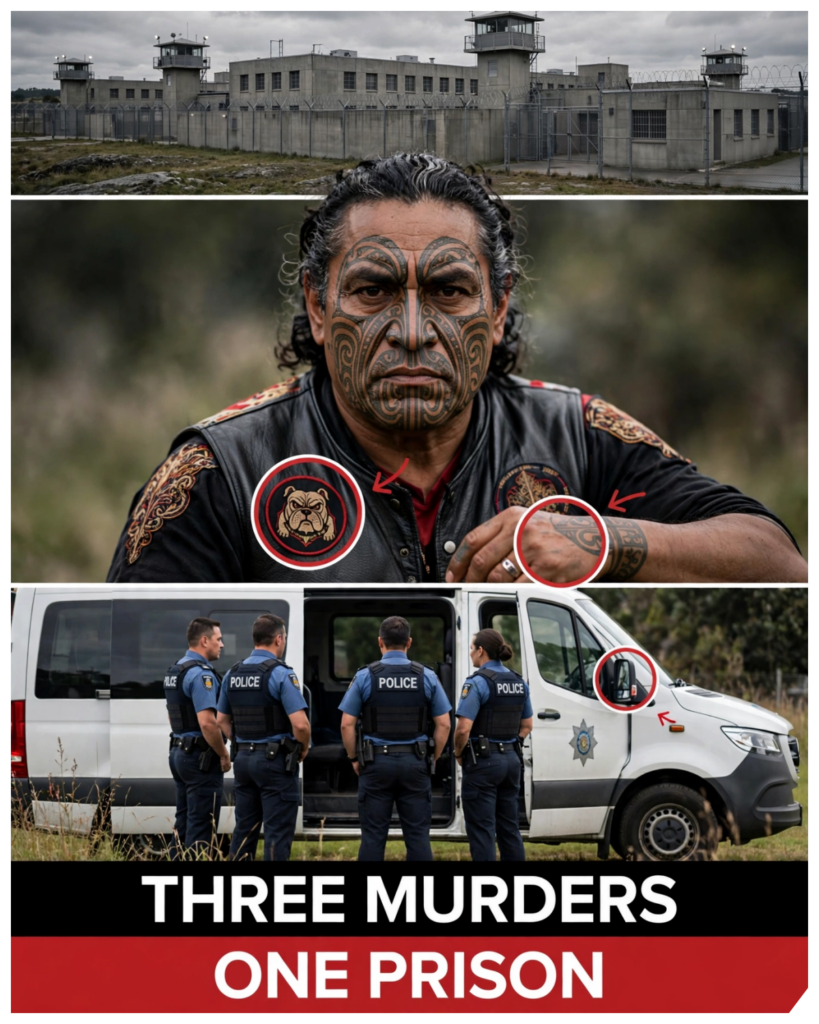
In the early 1990s, inside the east wing of Christ Church’s Paparua prison, a small group of inmates built something that had never existed in New Zealand before.
A gang founded entirely behind bars, organized around one idea, that only white prisoners belonged in their wing, and that anyone else had to fight, convert, or leave.
They called themselves the fourth Reich.
At its peak, according to researchers who’ve studied the group, it numbered around 20 members.
That’s a tiny gang by the standards of New Zealand’s prison system, where organizations like the Mongrel mob and Black Power count their membership in the thousands.
But size was never the point.
Inside Paparua’s east wing, any skin head sent to the block was reportedly given an ultimatum.
Join the gang, grow out the shaved head, or transfer to the protection wing.
Outside prison walls, the group’s reach was small geographically, the West Coast, the Nelson region, but the violence it produced was severe enough that New Zealand’s national security sector would later assess it as a credible domestic terrorism concern.
Between the late 1990s and 2011, members of the Fourth Reich were convicted over some of the most disturbing hate-motivated killings in modern New Zealand history, a Mai rugby player beaten and left to drown in the Buller River.
A gay man strangled at a party after a comment about someone’s sister, a Korean backpacker murdered for being Asian.
These weren’t rumors or gang mythology.
They were charges heard in open court, verdicts delivered by juries, and some of the longest sentences handed down in the country at the time.
And yet almost everyone who has studied this gang seriously.
Criminologists, corrections researchers, journalists keep circling back to the same uncomfortable starting point.
The men who built the fourth Reich weren’t recruited off the street by a functioning hate movement.
Multiple researchers who interviewed New Zealand skin head gang members found a consistent backstory, disrupted, often abusive childhoods, time in state institutions, poverty, addiction, long before any ideology entered the picture.
New Zealand’s own Royal Commission of Inquiry into abuse and care, later heard directly from gang members and their families about exactly this pipeline, state care as children, abuse and neglect inside it, and prison not long after.
None of that explains away what the fourth Reich did.
A beaten man dumped in a river is dead regardless of what happened to his killer at age 8.
But understanding how a prison wing in Christ Church produced a organized hate gang means asking two questions at once.
What ideology did these men choose to build their identity around?
And what system produced the men in the first place?
In this episode, we go through the public record, the gang’s origins, its worst crimes, the state care history now under formal inquiry, and what became of the fourth Reich by the 2010s.
A quick note on how this channel handles material like this.
We report on extremist and hate motivated crime because it’s part of the historical record, not because any ideology involved deserves airtime.
Nothing in this video endorses white supremacist beliefs.
The opposite is true throughout.
If you’re new here, subscribe and turn on the bell for more researched source-based true crime and social history.
We’ll start in Christ Church in a prison wing in the early 1990s.
The Fourth Reich’s origin story is unusual among New Zealand gangs for one specific reason.
Almost every other major gang in the country, the Mongrel Mob, Black Power, the various outlaw motorcycle clubs formed on the outside first and later developed a presence inside prisons.
The Fourth Reich ran the process in reverse.
According to researchers who’ve documented the gang’s history, it was the first group in New Zealand known to have formed entirely within a prison and only afterward carried its structure and identity out into the wider community.
The setting was Paparua Prison in Christ Church, now known as Christurch Men’s Prison, in the early 1990s.
The exact date of formation is contested among the small number of researchers who’ve studied the gang closely, but the broader context is well documented.
New Zealand had by this point already seen a wave of racist skin head activity take hold in parts of the South Island through the late 1970s and into the 1980s.
Groups with names like United Skin Heads and White Power had emerged in Christ Church amid an economic downturn and rising unemployment.
Borrowing heavily from skin head subcultures overseas.
A related group called Bandon, German for gang war, sometimes referred to as the Young Germans, operated as a feeder organization for an established South Island motorcycle gang, the Road Knights, based out of Tamaru.
Academic accounts of the period note that the 1992 Australian film Romper Stomper, a brutal portrait of skin head gang culture, gave the broader movement a fresh jolt of visibility and appeal right around the time the fourth Reich was taking shape.
What made the Fourth Reich different from these earlier street level groups was where it took root and how it organized itself.
Inside Paparua’s east wing, the gang didn’t just recruit sympathetic inmates.
It imposed itself on anyone who fit a particular profile.
Corrections researchers who’ve studied the gang’s internal dynamics describe a stark rule that governed the wing during the fourth Reich’s period of control.
Any inmate identifiable as a skin head who ended up in the East Wing was expected to join the gang outright, let his hair grow out to blend in, or request a transfer to the prison’s protection wing to escape the pressure entirely.
That’s a strikingly formal structure for a gang with by most estimates no more than around 20 members at its height, a fraction of the size of the country’s dominant Maui and Pacific Islander gangs, which by the 1990s already counted their membership in the thousands nationally.
The Fourth Reich never tried to compete on numbers.
Its power came from control of a specific physical space and a willingness to enforce that control with violence.
The ideology the gang organized itself around was explicit neo-nazism, not vague or generalized racism.
Members adopted the language and symbolism of national socialism directly, framing their project as a defense of what they described as Aryan heritage against multiculturalism with open hostility directed at Mai, other ethnic minorities, and as later murders would make clear, gay men as well.
The name itself was a deliberate historical reference, positioning the gang as a kind of ideological successor to Nazi Germany.
Researchers tracing the roots of this thinking point to the same international skin head movement that had produced groups across the UK, the United States, and Australia from the 1970s onward.
A subculture that began as workingclass youth fashion before fusing in some corners with explicit neofascist politics and white power music scenes.
In New Zealand’s prison system specifically, that imported ideology fused with a much older and more practical dynamic.
The tendency of inmates to organize along racial lines for protection and status inside a hierarchical, often violent institutional environment.
A pattern that echoes prison gang formation in other countries, but took on its own local shape here.
Once the Fourth Reich’s core had formed inside Paparua, its influence didn’t stay contained to that single prison wing.
Members moved in and out of custody, and the gang’s reach extended outward into specific South Island communities, most notably Westport and the wider Buller district on the West Coast and the Nelson region.
These were smaller, more ethnically homogeneous parts of the country than the North Island’s major cities, which researchers note made them more fertile ground for an explicitly white power group to operate with less immediate community resistance than it might have faced in a more diverse urban center.
By the mid 1990s, the Fourth Reich had grown from a prison faction into something New Zealand’s security establishment was beginning to take seriously as a standalone threat.
It was still small.
It was still by national standards a minor player next to the country’s largest patched gangs.
But the violence its members were about to commit against a mai rugby player, a gay man at a party, a Korean backpacker walking through the wrong town would place the fourth Reich among the most notorious names in New Zealand’s criminal history, and raise a question the country is still working through.
How does a handful of men in a South Island prison wing end up capable of killing three people for who they were?
Between the mid 1990s and the early 2000s, members of the Fourth Reich were convicted of three separate killings that taken together are what actually earned the gang its lasting notoriety.
Each victim was targeted, according to the public record, because of who they were rather than any personal dispute with their killers.
Each case ended in a criminal trial, a jury verdict, and a lengthy prison sentence.
None of what follows is disputed gang mythology.
It comes from court proceedings and the reporting and research that followed them.
The first and most widely documented case is the killing of Hemi Hutley, a 23-year-old Mai rugby player.
In 1997, Hutley was beaten severely by two Fourthre Associates, Aaron Howy and Nhana Foster, both 26 at the time.
According to the trial record, Hutley was beaten unconscious and then dragged around 125 m to the Buller River where his body was left in the water.
He drowned.
Howy and Foster were both convicted of murder and sentenced to life imprisonment, among the most serious penalties available under New Zealand law.
The case became and remains one of the defining examples of racially motivated violence associated with the gang, precisely because the attack fit a pattern researchers would later identify across the Fourth Reich’s history.
A targeted assault on a member of an ethnic minority carried out by multiple gang members acting together, followed by an attempt to dispose of the body rather than seek help.
Howie later severed his ties with the gang after his release from prison.
A detail that matters because it complicates any simple story about permanent ideological commitment.
For at least one of Hutley’s killers, gang membership did not turn out to be a lifelong identity.
The second killing, and in some ways the one most explicitly tied to the gang’s stated ideology, was the murder of James Janice Bamborough in 1999.
Bamro was a gay man, 54 years old, killed on the West Coast in an attack that the trial record ties directly to his sexuality.
According to evidence given in court, the killing followed an incident at a party where Bamborough had embraced Leighton Wilding and made a comment about Wilding’s sister.
Later that night, a witness testified to hearing Hayden Brent McKenzie say that they were going to deal with Bambro because of a slur relating to his sexuality and that the group did not accept gay men.
Wilding was reported to have said nothing in response, while witnesses described Bambbero as visibly terrified.
Once the mood in the room shifted, McKenzie and Wilding were both convicted.
In 2005, years after the killing, they were sentenced.
McKenzie and Wilding both received life sentences for their roles in Bambber’s death.
What separates this case from the Hutley killing is how directly the gang’s own hateful rhetoric surfaces in the court record itself.
This wasn’t a killing later interpreted as ideologically motivated by outside researchers.
The words used by the men involved as reported to the jury made the motive explicit at the time.
The third case, the 2003 murder of Korean backpacker Jay Hyun Kim extended the pattern of the gang’s violence beyond its usual South Island targets to a visitor from overseas.
Evidence.
Researchers have argued that the group’s hostility wasn’t confined to specific local grievances, but reflected a broader racial ideology capable of targeting anyone who didn’t fit the gang’s definition of belonging.
According to the historical record compiled by researchers who’ve studied the gang, Kim was killed by a founding member of the fourth Reich, specifically because he was Asian.
The killing is consistently cited alongside the Hutley and Bambber murders as one of the three defining hate motivated homicides associated with the group.
Attacks that together span the gang’s core targets.
A Mai man, a gay man, and an Asian visitor, each killed for the same underlying reason.
It’s worth pausing on what these three cases have in common because the pattern is not incidental.
In each instance, the victim was killed not as the result of a personal conflict that escalated, but because of a fixed characteristic: race, sexuality, ethnicity that the killers had already decided disqualified the victim from safety in their presence.
Researchers who’ve examined New Zealand’s skin head gangs more broadly have noted that this kind of ideologically framed violence sets groups like the Fourth Reich apart from the country’s larger, more established gangs whose violence, while often severe, has more commonly centered on turf, rivalry, drugs, or internal discipline rather than targeted killings of people entirely outside the gang.
At the same time, it would be inaccurate to describe the Fourth Reich as a tightly organized, ideologically disciplined terrorist cell in the way the term might suggest.
New Zealand’s national security sector did at points in the early 2000s treat the gang as a credible domestic threat, and that assessment shaped how seriously law enforcement approached its members.
But researchers who’ve interviewed people connected to New Zealand’s skin head scene describe a membership marked less by coherent political organization and more by social marginalization.
Men with disrupted upbringings, histories of drug use, and long records of criminal behavior that predated any ideological commitment.
That description is echoed in academic comparisons between New Zealand skin head gangs and similar groups overseas.
Unlike some skin head movements in the United States, which researchers have characterized as better organized, more likely to include employed and socially integrated members, and possessing what one study called a more developed political consciousness.
New Zealand’s version tended to draw from a more chaotic base of social estrangement and addiction.
The ideology gave the violence its shape and its targets.
It didn’t necessarily give the men who carried it out a stable political identity beyond the gang itself.
This is not offered as an excuse.
Three people are dead.
A young rugby player with his life ahead of him.
A 54year-old man attacked for who he loved.
A backpacker who had traveled across the world and encountered at the end of it men who decided his life was worth less because of his ethnicity.
Courts weighed the evidence.
Juries reached verdicts and the men responsible received some of the longest sentences available under New Zealand law at the time.
Life imprisonment in the most serious cases.
The legal system treated these as what they were, murders motivated by hatred carried out by people who chose at each step to act on an ideology they had adopted.
But understanding why the fourth Reich was capable of producing this pattern of violence.
Three ideologically driven killings from a gang that at its largest numbered perhaps 20 people requires looking past the murders themselves and toward the men who committed them and the systems that shaped them well before any of them set foot in Paparua prison.
New Zealand’s own government has since opened a formal inquiry into exactly that kind of question, examining what happened to children and young people inside state care institutions in the decades before gangs like the Fourth Reich took root and what, if anything, that history has to do with how men end up in a prison wing organizing violence around a fantasy of racial purity.
That’s where the story needs to go next.
Not to excuse what these men did, but to understand what came before it.
In 2018, the New Zealand government set up a Royal Commission of Inquiry into abuse in care, the highest level of formal inquiry available under New Zealand law to examine what had happened to children, young people, and vulnerable adults inside state and faith-based institutions between 1950 and 1999, with some evidence taken from more recent decades.
As well.
Over more than 5 years, the commission heard from close to 3,000 survivors.
Its final report, released in July 2024, ran to roughly 3,000 pages, and reached a conclusion its authors did not soften.
Between an estimated 113,000 and 253,000 children, young people, and adults, had been abused or neglected while in the States or a church’s care over that period.
Of the 650,000 people who passed through some form of care between 1950 and 2019, the commission found that close to a third had endured physical, sexual, verbal, or psychological abuse, with many more subjected to exploitation and neglect.
On top of that, the commission described the scale of what it had uncovered as a national disgrace.
It found that children had frequently been removed from their families arbitrarily and unfairly, that Mai children had been placed in care and in harsher facilities at rates far beyond their share of the population.
And that many of those children were subjected to abuse specifically tied to their ethnicity, punished for speaking tero, for practicing tikonga, or simply degraded because of their race.
Disabled people, deaf people, and Pacific peoples were also singled out for mistreatment.
At one former psychiatric facility, Lake Alice, the commission’s findings were severe enough that the government later formally acknowledged what happened to child patients there, including unesthetized electric shocks and painful injections used as punishment rather than treatment, amounted to torture.
Prime Minister Christopher Luxon delivered a formal national apology to survivors in November 2024, telling Parliament the state had failed the very children it was supposed to protect.
For the purposes of understanding gangs like the Fourth Reich, the most directly relevant section of the commission’s findings concerns a specific set of institutions, state-run boys homes, and in particular Hokio school and the Kohed Boys Training Center, both in the Levan area.
The commission’s report described these facilities in blunt terms, characterizing the environment inside them as one defined by routine, normalized violence, staff inflicting severe physical punishment on boys as a means of control and humiliation, in some cases using weapons, and in some cases directing that violence at the boy’s genitals.
Alongside physical brutality, staff also imposed extreme physical training regimes and degrading tasks.
As further punishment.
These were not isolated incidents reported by a handful of survivors.
The commission treated the pattern as systemic across the institutions it examined.
What makes this history directly relevant to a discussion of gangs, the fourth Reich included, is that the commission explicitly connected these institutions to the later emergence of New Zealand’s gang landscape.
Multiple survivors who later became prominent figures in gang life, in academia, or in social work, told the commission the same underlying story in different words.
One survivor who went on to become an academic described walking into a prison yard at 18 and recognizing the great majority of the men there from his time in the same social welfare homes years earlier.
A moment that made the connection between the care system and the prison system impossible to ignore.
Another survivor who later left the Mongrel mob and trained as a social worker told the commission that New Zealand’s gang phenomenon accelerated through the 1960s and 1970s precisely because the country’s boys homes were producing large numbers of disaffected, poorly supported young people with nowhere else to belong.
A third survivor who went on to work as a prison counselor, put it even more directly, tracing what he called the country’s ongoing gang problem back specifically to Kohit and describing how many of the boys held there alongside him ended up in gangs together afterward.
The commission’s report backed up these individual accounts with a broader statistical judgment.
It concluded that the majority of New Zealand’s gang members and prisoners are believed to have passed through some form of state care as children.
That is a striking claim on its own, and it reframes how a gang like the Fourth Reich needs to be understood.
This isn’t a case of an already formed hate movement recruiting from the general public.
It’s closer to the reverse.
A state system that across decades systematically damaged large numbers of children, disproportionately Mai, and disproportionately poor, and then released many of them into adulthood with little support, few options, and for some, a criminal record and a prison cell waiting at the other end.
Gangs of various kinds, not only ones built around explicit racist ideology, absorbed a significant share of that population.
None of this is unique to New Zealand in a global sense.
Australia and Canada, dealing with their own historical inquiries into indigenous child removal and institutional abuse, have identified strikingly similar patterns.
But the specific New Zealand detail that matters for this story is the direct evidence-based link the commission drew between state institutions and the country’s gang culture broadly.
Combined with what earlier academic research had already found about the specific men who built and joined groups like the fourth Reich.
Recall the pattern researchers identified in part one and part two of this story.
Disrupted and often abusive childhoods, time spent in state institutions, poverty, addiction, and criminal behavior that predated any ideological commitment to white power politics.
The Royal Commission’s findings, released decades after the Fourth Reich first formed inside Paparua prison, provide the missing institutional context for that pattern.
Not proof that any specific fourthre member was a royal commission witness, but a national level accounting of exactly the kind of system that by the commission’s own conclusion fed large numbers of young New Zealanders into gang life during precisely the decades before the fourth Reich emerged.
This is where the story requires real care because it would be easy to draw the wrong lesson from it in either direction.
It would be wrong to read the Royal Commission’s findings as an excuse for what Fourthre members did to Hemi Hutley, James Bambber, and Jay Hian Kim.
Millions of people who experienced hardship, poverty, or even abuse as children never go on to kill anyone, let alone organize their adult lives around an ideology that marks entire categories of people as acceptable targets.
The men responsible for those three deaths made a specific sustained choice to adopt neo-Nazi beliefs and to act on them with lethal violence.
And the courts held them individually responsible for that choice as they should have.
Whatever happened to them as children does not transfer moral responsibility for those killings onto anyone else.
But it would be equally wrong to treat the Fourth Reich’s violence as something that simply appeared from nowhere, disconnected from any wider system.
A few uniquely evil individuals who happen to end up in the same prison wing.
New Zealand’s own highest level inquiry into its care system spent 5 years and heard thousands of survivor accounts specifically to establish that the pipeline from state care into gangs and prisons was real, was large, and was substantially the state’s own doing.
Understanding the fourth Reich honestly means holding both of those things at once.
Individual men who chose an ideology of hatred and carried out murders because of it.
Operating inside a wider national failure that had already spent decades funneling damaged, unsupported young people toward exactly the kind of institutions, first boys homes, later prisons where gangs recruit.
That dual accounting is also in a more limited but concrete way part of what happened to the fourth Reich itself over time.
Some of its most notorious members didn’t remain inside the ideology for life.
Aaron Howey, convicted of Hemi Hutley’s murder, cut ties with the gang after his release from prison.
Ivan Guggage, convicted in a separate earlier fourth Reich linked assault case, did the same.
Whatever pulled these men toward a neo-Nazi prison gang in their 20s did not in every case hold permanently once they were no longer inside the institution that had produced and sustained it.
What happened to the Fourth Reich as an organization, its decline through the 2000s, and what, if anything, remains of it today, is where this story turns next.
By the time the Fourth Reich’s worst crimes were working their way through New Zealand’s courts in the late 1990s and 2000s, the gang that had once controlled an entire prison wing was already coming apart.
Some of that unraveling happened through simple attrition and internal betrayal.
The James Bambber case is the clearest example.
Bambber’s body went undiscovered for 5 years after his 1999 murder.
His killers had hidden the crime well enough that it took a break inside the gang itself rather than any external police breakthrough to crack it open.
In 2004, Hayden McKenzie turned on his own associate, naming Leighton Wilding as the one responsible for dragging Bamro into the Buller River, which finally led police to the remains.
At trial, the two men who had once stood together over a helpless victim turned entirely on each other.
Each claiming the other had been the one to hold Bamro under the water.
It’s a useful reminder that gangs built around loyalty to a shared ideology are not necessarily built around loyalty to each other.
When the stakes got high enough, the bond dissolved into fingerpointing.
What happened to individual members afterward complicates any simple story about permanent commitment to the cause.
Wilding testified that he’d already left the gang back in 1998, well before his arrest.
McKenzie, for his part, later had a forehead tattoo reading a racial slur removed, was reported to have turned away from the skin head scene altogether and married in 2004 while serving his sentence in a protection wing.
The same kind of unit the fourth Reich had once forced rival inmates into.
Aaron Howey, one of Hemi Hutley’s killers, cut his ties with the gang after his release.
None of this undoes what these men did, but it does suggest that for at least some of the fourth Reich’s most notorious members, the ideology that drove them to kill was not, in the end, a fixed identity they carried for life.
It was something closer to a violent phase tied tightly to the specific conditions of a South Island prison wing in the 1990s that some of them eventually walked away from once those conditions changed.
The broader white power skin head movement the fourth Reich had emerged from was fading for reasons that had little to do with any single arrest or court case.
Researchers who’ve studied the scene describe a movement that even at its height was less a disciplined political operation than a loose collection of young men hanging around street corners, drinking cheap alcohol, and posturing at outsiders.
Recruits drawn less by coherent ideology than by social marginalization, unemployment, and a search for belonging.
As New Zealand’s economy improved through the 2000s and youth unemployment eased, that pool of disaffected recruits shrank, the wider skin head fashion that had briefly flourished in the wake of films like Romper Stomper, faded along with it.
Even in Christ Church, the movement’s traditional stronghold, the visible street presence of skin head gangs, had largely disappeared by the end of the 2000s.
That didn’t mean New Zealand’s organized farright vanished entirely.
It changed shape instead.
Kyle Chapman, a figure who moved through several of the country’s white nationalist groups over the decades.
The New Zealand National Front, later his own creation, right-wing resistance, founded in 2009, represents that transition from prison and street gang culture towards something more consciously political, even as it retained many of the same trappings, paramilitary style ranks, Nazi derived symbolism, public patrols targeting minority communities.
Right-wing resistance grew for a period into an international network with branches reported across a dozen countries by the mid2010s before Chapman’s own falling out with the group and more decisively the aftermath of the March 2019 Christurch mosque attacks.
That massacre, an act of white supremacist terrorism that killed 51 people in two mosques carried out by an Australian gunman, did not originate within any New Zealand skin head lineage, but it transformed the environment those older groups had operated in almost overnight.
Chapman himself later said publicly that the backlash following the attacks had driven organized far-right groups in New Zealand into hiding with members retreating from public activity into more isolated online spaces rather than street level gangs.
Where does that leave the fourth Reich specifically decades on from its formation in Paparua prison?
The honest answer based on the available research is that there is little evidence the gang still exists in any organized form either inside New Zealand’s prison system or in the wider community.
It isn’t listed as an active entry on New Zealand police’s national gang list in the way that older larger gangs like the Mongrel Mob and Black Power still are.
Its most notorious members are dead, imprisoned for life, or in at least a few documented cases, long since walked away from the ideology that once defined them.
The specific prison conditions that allowed a small hardcore group to seize control of an entire wing and enforce ideological conformity on other inmates appear, at least based on the public record, not to have been replicated at that scale since.
That doesn’t make The Fourth Reich a closed chapter exactly.
The three murders its members were convicted of remain part of New Zealand’s criminal history, regardless of whether the gang itself persists and the pattern of violence it represents.
Organized racial and homophobic hatred taking root inside a prison system already straining under the weight of a much larger well-documented pipeline from state care into incarceration has not gone away just because one specific gang name faded from use.
The Royal Commission’s 2024 findings on abuse in care were not about the fourth Reich.
They were about a system that across decades produced the raw material that groups like it and New Zealand’s much larger gangs drew from.
What the Fourth Reich’s rise and fall actually demonstrates, taken as a whole, is something narrower and perhaps more useful than a simple story about hate and its defeat.
A specific set of conditions.
A prison wing, a handful of vulnerable young men with already damaged histories, an imported ideology that gave their marginalization a target and a name, produced roughly a decade of organized lethal violence.
When those specific conditions shifted, the gang that had emerged from them largely dissolved, even as some of the individual men involved carried the consequences of what they’d done for the rest of their lives.
It’s a smaller and less tidy conclusion than either evil triumphed or evil was defeated.
It’s closer to a particular machine built from particular parts eventually broke down, but not before it had already taken three lives that should never have been lost.
The fourth Reich belongs to history now, but the debate it left behind.
How much power the state should have to suppress a gang and what that power costs is very much alive in New Zealand politics.
The most significant recent shift came into force on 21 November 2024 when two new laws took effect together.
The Gangs Act 2024 and the Sentencing Amendment Act 2024.
The Gangs Act made it a criminal offense to display gang patches or insignia in any public place, including inside a private vehicle if the insignia is visible and meant to be seen.
It gave police the power to issue dispersal notices, ordering groups of gang members to leave an area and stay away from each other for 7 days if police judge them to be disrupting the public.
It also created non-consorting orders allowing courts to bar specified serious gang offenders from associating or communicating with one another for 3 years.
The Companion Sentencing Amendment Act made gang membership itself an aggravating factor judges can weigh at sentencing, meaning the same offense can now draw a harsher penalty if the offender is a known gang member.
The law applies to 35 named gangs, a list the Minister of Police can update.
Enforcement began almost immediately.
New Zealand police made their first arrest under the new patch ban within minutes of it coming into force after CCTV caught a group of patched head hunters riding through the night.
Since then, the law has thrown up genuinely difficult edge cases.
In one instance that reached the high court, a mongrel mob members seized patch had been ordered returned by a lower court judge who accepted the gang vest carried real personal and cultural meaning for him.
Police appealed and the high court ultimately ruled that forfeite under the act is automatic once a patch is seized following conviction.
The law gives judges no discretion to hand it back, whatever meaning it holds for the person who wore it.
The government’s justification for all this rests heavily on numbers it has cited publicly.
Gang members make up under a quarter of 1% of New Zealand’s adult population, the government says, yet are linked to a disproportionate share of serious crime, including close to a fifth of homicides and roughly a quarter of the country’s kidnapping and drugrelated harm.
Supporting parties argued the laws were a direct response to a rise in gang membership and gang rellated violence over the preceding several years.
Opposition to the laws was substantial and came from more than one direction.
The Green Party and Tapati Maudi opposed the legislation outright, arguing it would deepen New Zealand’s already high rates of Mai incarceration without addressing why people join gangs in the first place.
The Labor Party supported the goal of reducing gang harm, but pushed back on specific provisions, including a late unconsulted amendment, adding an automatic 5-year ban on possessing gang insignia after three convictions.
A change the New Zealand Law Society itself warned intruded on private life in ways not clearly justified by the evidence.
New Zealand’s own attorney general flagged concerns that the patch ban and dispersal powers sat uneasily with rights to freedom of expression, association, and peaceful assembly under the Bill of Rights Act.
And at least one former gang member who gave evidence against the bill.
A man who had left black power and now works on dganging efforts, argued publicly that legislation like this only pushes gang members further from mainstream society and that the government would do better addressing the underlying drivers of gang membership.
Poverty, poor health outcomes, and a lack of housing.
That argument connects directly back to everything this series has already covered.
The Royal Commission’s 2024 findings established at a national level that the majority of New Zealand’s gang members and prisoners pass through the same damaged state care system before they ever put on a patch.
The Gangs Act targets what gangs visibly do.
The patches, the public gatherings, the intimidation.
It does very little on its own to address the pipeline.
The Royal Commission spent 5 years documenting.
Both things can be true government policy at once.
A harder legal line on gang activity in public running alongside an official on the record acknowledgement that the state itself manufactured a significant share of the problem it’s now policing.
Whether New Zealand can hold both of those truths at the same time, enforcement and accountability, is more than three decades after the fourth Reich first formed inside a Christurch prison wing, still an open question.
Measured against the world’s most notorious white supremacist prison gangs, the Fourth Reich looks almost minor.
That comparison isn’t meant to minimize what its members did.
Three people are still dead, but it does help explain both what the gang was and just as importantly, what it never became.
The obvious point of comparison is the Aryan Brotherhood, formed at California’s San Quentin State Prison in 1964.
Widely described by researchers and watchdog organizations as the oldest and most violent white supremacist prison gang in the United States.
Where the fourth Reich peaked at around 20 members, the Aryan Brotherhood has grown into an organization estimated at 15,000 to 20,000 members both inside and outside prison walls with a formal militarystyle command structure, a governing commission, and a documented history stretching back more than 60 years.
Membership requires a lifetime commitment enforced by a bloodin, blood out code.
New members are typically required to kill someone as an initiation, and there is no path out of the gang except death.
Analysts who track the group note that despite its overtly neo-Nazi symbolism and rhetoric, the Aryan Brotherhood functions primarily as a criminal enterprise focused on drug trafficking, extortion, and murder for hire.
With ideology serving more as an internal recruiting and bonding tool than a genuine political program, it has at various points formed pragmatic business alliances with non-white gangs when profit demanded it.
A detail researchers point to as evidence that greed, not racial purity, ultimately drives the organization’s decisions.
The fourth Reich never operated anywhere near that scale, and the difference isn’t incidental.
It reflects real structural differences between the two prison systems that produced them.
The Aryan Brotherhood emerged from 1960s era racial desegregation battles inside vastly larger American prisons where thousands of inmates from rival racial and ethnic gangs were suddenly forced into shared spaces, creating a demand for organized large-scale protection blocks that could sustain themselves for decades.
New Zealand’s prison population and its total population generally is a fraction of the size.
There simply was never the raw numbers available for a group like the Fourth Reich to grow into anything resembling the Aryan Brotherhood’s reach.
What the two organizations shared was not scale, but function.
Prison gangs formed initially around the logic of protection and racial solidarity inside a hierarchical, often violent institution, which over time hardened into an ideology that outlasted the original practical need that had created it.
New Zealand’s Fourth Reich also lacked something the Aryan Brotherhood built deliberately, a durable criminal economy.
Researchers who’ve studied the Fourth Reich describe a group whose members were themselves opiate users, prone to internal violence over drugs and loyalty rather than running an organized trafficking operation the way the Aryan Brotherhood eventually did on both coasts of the United States, where the Aryan Brotherhood evolved from ideological street gang into full organized crime syndicate.
One capable, according to reporting on the group, of striking business arrangements with figures as prominent as an imprisoned American mafia boss.
The Fourth Reich never made that transition.
It stayed a small, violent, ideologically driven prison faction that spilled outward into a handful of South Island communities and then within roughly a decade and a half largely burned itself out.
That comparison matters for understanding what actually happened in New Zealand because it undercuts a certain kind of mythology that sometimes attaches itself to groups like the Fourth Reich after the fact.
The idea of a disciplined, far-reaching criminal political organization on the scale of America’s most entrenched prison gangs.
The evidence doesn’t support that.
What New Zealand produced instead was something smaller and in its way more directly traceable to specific institutional failures.
A handful of severely damaged young men shaped by the same state care pipeline the Royal Commission later documented at a national scale who organized around an imported ideology inside one particular prison wing and who were capable of real lethal violence without ever building the kind of lasting criminal infrastructure that has kept groups like the Aryan Brotherhood operating for six decades and counting.
There’s a harder lesson buried in that difference too.
Watchdog organizations that monitor the Aryan Brotherhood and similar American gangs have specifically flagged white supremacist prison gangs as a radicalization risk.
Places where individuals absorb extremist ideology inside custody and then carry it back out into the wider community once released.
New Zealand’s own experience with the fourth Reich fits that same pattern on a smaller scale.
An ideology formed and enforced inside a single prison wing that then produced real violence against real people once its members walked free.
The scale was different.
The mechanism prison as an incubator for organized hatred regardless of the country or the specific gang size was not.
On 15 March 2019, a gunman opened fire inside two Christ Church mosques during Friday prayers, killing 51 people and wounding dozens more.
It remains the deadliest mass shooting in New Zealand’s history and one of the worst acts of white supremacist terrorism anywhere in the world in recent decades.
The attacker was an Australian citizen who had traveled to New Zealand, and he live streamed part of the attack online, spreading it further before platforms could remove it.
This series has spent six parts examining the Fourth Reich, a small neo-Nazi prison gang that formed in Christ Church in the early 1990s and killed three people over the following decade.
It would be a mistake to draw a straight line from that gang directly to the 2019 attack.
The perpetrator had no documented connection to the Fourth Reich, and researchers who study New Zealand’s far right have been careful not to claim one.
But it would be an equally serious mistake to treat the two as unrelated.
Both are part of the same longer thread, a strain of organized white supremacist ideology that has surfaced in New Zealand repeatedly since at least the late 1970s, moving through different forms.
Street skin head gangs, prison-based gangs like the Fourth Reich, uniformed groups like Kyle Chapman’s right-wing resistance, and eventually the more diffuse internet-driven far-right that researchers say has replaced the old street gang model.
Writers examining Christ Church’s specific history have noted that the city had produced an unusually dense concentration of these groups across five decades and that this history had gone largely undisussed in New Zealand’s wider public conversation before the attack forced a reckoning.
That reckoning was real, but it was also uneven.
In the days after the attack, longtime far-right figures, Kyle Chapman among them, publicly claimed that organized groups like right-wing resistance and the National Front had effectively dissolved with members retreating from public activity into private online spaces to avoid scrutiny.
Websites shut down.
Social media accounts were scrubbed or deleted.
On the surface, it looked like the visible uniformed Street Patrol version of New Zealand’s far right, the direct descendant of the world the Fourth Reich had come from, had been driven into hiding.
Researchers studying the movement since, have offered a more cautious assessment.
Rather than disappearing, the far right in New Zealand appears to have changed shape again, following a pattern researchers have tracked internationally, away from visible, hierarchical street gangs with patches and uniforms, and towards smaller, more loosely organized groups that avoid overt Nazi symbolism, deny being racist or fascist, even while promoting the same core ideas, and organize primarily online rather than through public marches.
That shift makes the movement harder to see and in some ways harder for law enforcement to monitor using the tools built for an earlier era.
Community advocates, including groups representing New Zealand’s Muslim community, had in fact been warning security agencies about rising far-right activity for years before 2019 and had met directly with intelligence officials to raise concerns.
Testimony to a gap between what was quietly being flagged and what the wider public and possibly the security apparatus itself was prepared to treat as a serious threat before an attack made it impossible to ignore.
The Royal Commission of Inquiry into the Christurch attack established separately from the later abuse and care inquiry this series has already covered examined exactly that gap.
What New Zealand’s intelligence and security agencies knew about the far right before 2019 and why an attack of that scale wasn’t prevented.
Its findings released in 2020 concluded that New Zealand’s counterterrorism resources had been overwhelmingly focused on the risk of Islamist extremism in the years leading up to the attack, largely mirroring international post 911 priorities.
While white supremacist and far-right extremism received comparatively little sustained attention despite a documented history stretching back through the Fourth Reich’s own era of organized racist violence on New Zealand soil.
That’s the uncomfortable throughine connecting a small prison gang from the early 1990s to a mass casualty terrorist attack three decades later.
It isn’t that the Fourth Reich caused Christ Church or that stopping one would have stopped the other.
It’s that New Zealand had by 2019 already accumulated a long documented history of organized white supremacist violence.
The skin head gangs of the late 1970s, the fourth Reich’s murders through the 1990s and early 2000s, Kyle Chapman’s decades of shifting far-right organizations, and that history had never quite translated into the kind of sustained institutional attention and resourcing that might have changed what happened next.
Individually, each chapter of that history was treated to some degree as a contained problem.
A gang that formed and eventually dissolved, a street movement that rose and faded, a series of prosecutions that closed once verdicts were delivered.
Taken together across five decades, it reads less like a series of isolated incidents and more like a pattern the country kept encountering without ever fully reckoning with as a pattern.
Whether New Zealand has genuinely learned from that now.
Whether the post209 shift toward better resourced monitoring of far-right extremism alongside the entirely separate reckoning over state care abuse that produced the 2024 Royal Commission findings adds up to a country that understands both where groups like the Fourth Reich come from and what they can grow into is not a question this series can answer for you.
It’s one New Zealand is still visibly working through.
Eight parts ago, this series opened with a question.
What does it say about a country when a handful of men inside one prison wing organize themselves around hatred and end up killing three people for who they were?
By now, the honest answer is more complicated than either side of that question suggests on its own.
It is not an excuse.
Nothing in the state care history this series has covered.
The Royal Commission’s findings on Kohiti and Tokyo.
The survivor accounts of a documented pipeline from boys homes into gangs and prisons changes what Aaron Howi and Nihana Foster did to Hemi Hutley.
What Hayden McKenzie and Leighton Wilding did to James Bambborro, or what happened to Jay Hi Kim.
Each of those men chose as adults to organize their identity around an ideology built on the idea that some people don’t deserve to live because of their race or their sexuality.
Courts weighed the evidence and delivered verdicts, and those verdicts stand.
Understanding where violence comes from is not the same as forgiving it.
And nothing in this series has tried to blur that line.
But it is also not a story that can be honestly told as three isolated acts of individual evil disconnected from everything around them.
New Zealand’s own highest level inquiry spent 5 years and heard thousands of survivor accounts specifically to establish that state institutions manufactured at scale exactly the kind of damaged unsupported young men who became vulnerable to groups like the fourth Reich in the first place.
That’s not a theory advanced by this series.
It’s the conclusion of a royal commission the New Zealand government itself established and a prime minister who stood in parliament in 2024 and apologized for it directly.
Sitting between those two facts, individual responsibility and institutional failure is where this story actually lives.
And it’s worth resisting the urge to collapse it into something simpler.
The Fourth Reich was never large.
Compared to the Aryan Brotherhood’s tens of thousands of members and six decades of continuous operation, it was a minor, short-lived faction that rose and largely dissolved within about 15 years.
But its violence was real.
Its victims are still dead, and the pattern it represents.
Prison as an incubator where imported ideology meets already damaged people and produces organized hatred did not end when the fourth Reich itself faded from New Zealand’s prison system.
It resurfaced in a different form in the years of scrutiny gaps the 2019 Royal Commission identified before Christ Church.
It’s visible today in the ongoing argument over the Gangs Act 2024, a law aimed squarely at gang symptoms passed by a government that in the same period was also formally acknowledging the state’s own role in producing the underlying problem.
None of that is a tidy conclusion, and this series isn’t going to manufacture one it doesn’t have.
What it leaves you with instead are two questions worth sitting with rather than answering too quickly.
First, when a country produces a documented decadesl long pipeline from state neglect into organized violence and later documents that pipeline formally in public with an apology from its own prime minister, how much responsibility does that shift and how much stays exactly where it belongs with the individuals who chose violence?
Second and harder is the right response to a threat like the fourth Reich stronger policing and tougher laws after the fact or serious investment in the institutions, foster care, boys homes, child protection that by the state’s own admission helped create the men who built it in the first place.
New Zealand’s current gang legislation leans hard toward the first answer.
The Royal Commission’s 138 recommendations point insistently toward the second.
Whether the country can do both at once rather than choosing one and calling it enough is still an open question, and it’s one every reader of this story gets to have an opinion on.
We report on cases like the Fourth Reich because they’re part of the historical and institutional record, not because any ideology involved deserves airtime or sympathy.
Three people are dead who shouldn’t be.
And their names Hemi Hutley, James Bambber, Jay Hyun Kim, deserve to be remembered as more than footnotes in a story about the men who killed them.
If you want more researched source-based coverage of true crime and social history like this, subscribe and turn on the bell.
We’ll see you in the next one.


