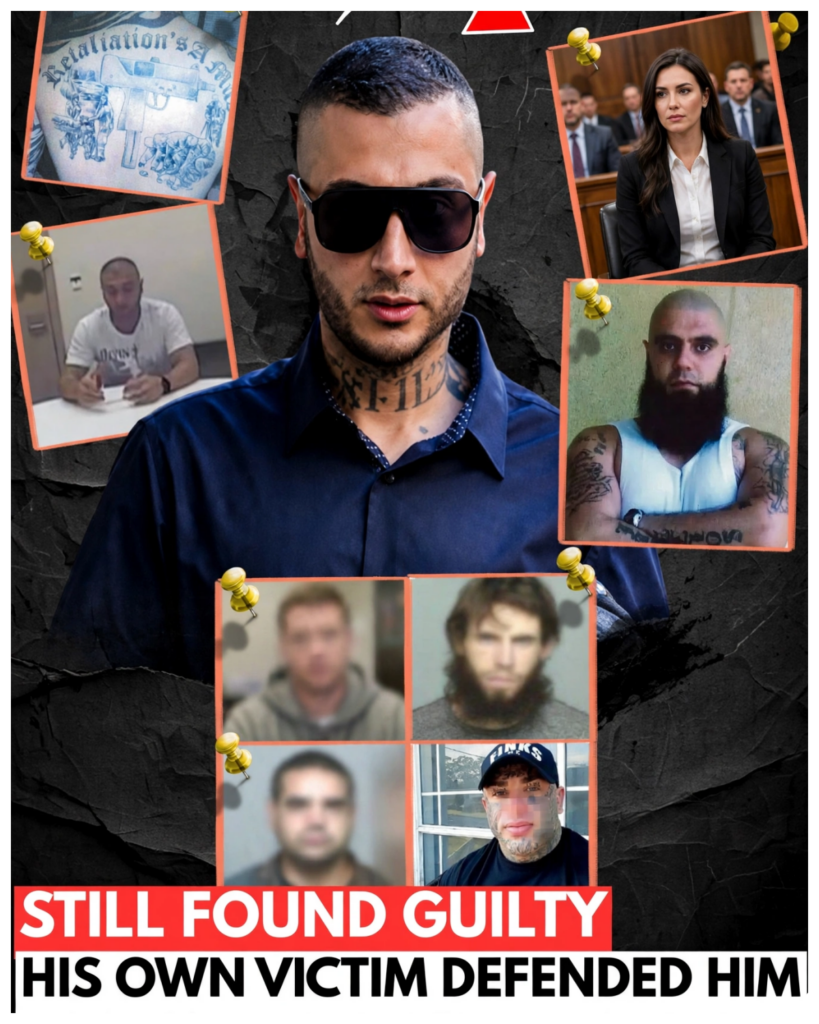
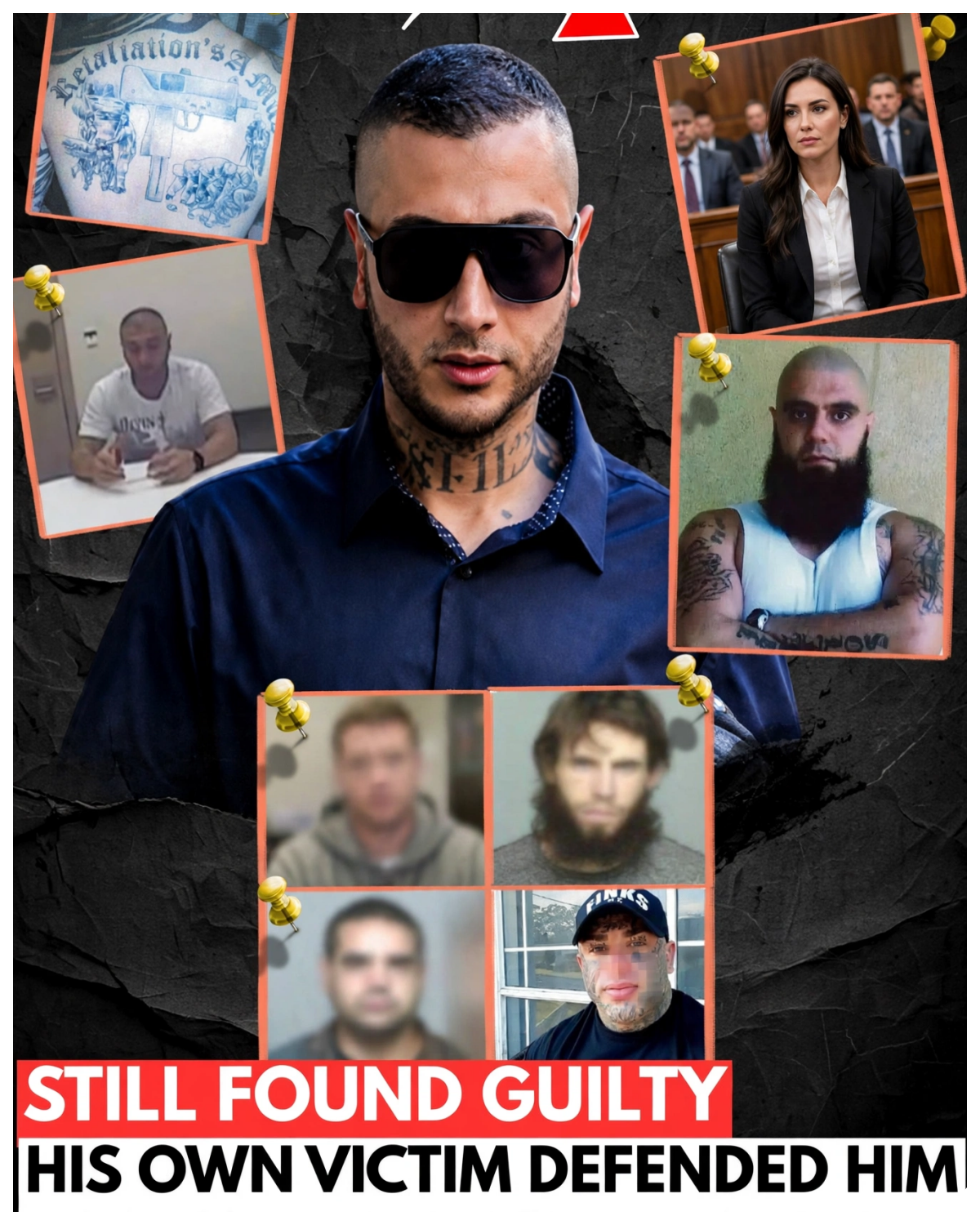
There’s a phrase tattooed across a man’s neck in Sydney’s West.
We trust in God, but just in case, keep one loaded.
Below it, on his back, a submachine gun sits beneath the word retaliation.
His knuckles spell out Mio, the name of the very police squad that spent over a decade investigating him.
That man is Michael Odisho.
And by his mid20s, he’d already been named a person of interest in an unsolved murder, survived being shot six times outside his own mother’s house, and risen to a senior position inside one of Sydney’s most violent organized crime networks.
None of that is what makes his story unusual.
What makes it unusual is what happened at his own trial.
In 2013, police allege Odisho loaded a handgun and passed it to another man in a car on a quiet Bass Hill Street.
Moments later, the man in the back seat, a friend and a fellow gang associate, was shot three times in the legs, punishment for a cocaine debt he couldn’t pay.
When the case reached court years later, the victim did something almost no one expected.
He stood up in front of the jury and said Odisho had nothing to do with it at all.
The jury convicted him anyway, and that should have been the end of it.
It wasn’t because prosecutors would later allege that Odisho didn’t just lose that trial.
He tried to buy his way out of the one before it, arranging through associates a payment to make sure that same witness never took the stand in the first place.
The scheme that followed dragged through the courts for the better part of a decade, delayed twice by a global pandemic before ending with Odisho convicted a second time.
This time for corrupting the very trial that had already put him away.
Before we go further, a note on how this video is put together.
Everything here is drawn from court reporting and public records cross-cheed across independent sources.
Not from any single documentary or channel.
Some details reported elsewhere about this case, including at least one alleged alias used in an unrelated civil matter, couldn’t be independently verified, and we’ll flag that clearly where it comes up rather than presenting it as fact.
In this video, we’ll go through Michael Odisho’s record in order.
His early ties to a violent Assyrian street gang.
The unsolved cafe murder that first put his name in police files.
His rise inside Brothers for Life.
The shooting that nearly ended his own life, the trial where his own victim tried to save him, and the second trial that finally caught up with him.
If you’re new here, this channel covers organized crime history across Australia and New Zealand using court records and verified public reporting.
No dramatizing, no glorifying.
Hit subscribe and turn on the bell so you don’t miss the rest of this one.
We’ll start with a teenager from Fairfield years before any of this had a name.
Michael Odisho was born in 1987 and grew up in Sydney’s southwestern suburbs in the Fairfield area as part of the city’s Assyrian Australian community.
A community with roots tracing back to displaced Christian populations from Iraq and the wider Middle East, many of whom settled in this specific corner of Sydney from the 1970s onward.
It’s in this same setting, according to Odisho’s own later account, that his path toward organized crime began, not through any single decisive moment, but gradually through friendships that started in the schoolyard.
Speaking years later on the ABC current affairs program 7.30, 30.
Odisho pushed back directly on the idea that his teenage years had been shaped by anything resembling a formal criminal induction.
He described a group of school friends who’d simply grown up together, whose relationship slowly hardened into something the outside world would eventually label a gang.
He acknowledged in the same interview that he understood how that world looked from the outside.
He said he didn’t disagree with the public perception, but insisted that from the inside, among people who’d known each other since childhood, it never felt the way the label suggested.
That group of friends became known in police and media reporting as DLA, an acronym for the last hour, a street level Assyrian gang operating around Fairfield and the surrounding suburbs through the early 2000s.
Like several ethnically aligned street groups active in Sydney’s West during this period, Glassther’s history includes documented turf conflict with rival crews chasing the same territory and the same drug trade.
In 2002, a shooting outside a hotel near Bankstown, targeting a man named Dmitri Debaz was attributed by police to exactly this kind of competition over local drug distribution between Glassa and a rival Assyrian group known as the Bronx Boys.
It was this same environment that produced the first serious event connected to Odisho’s name.
In 2005, when he was 18 years old, three masked gunmen opened fire inside the Babylon Cafe in Fairfield’s Civic Center Arcade, spraying at least 15 rounds into a crowded venue.
Raone Canna, an innocent 29-year-old bystander with no connection to the underlying dispute, was killed.
Three other people were wounded.
Police believed the shooting was connected to broader tit fortat violence involving Glassa and Odisho was named as one of several persons of interest during the subsequent investigation.
It’s worth being precise about what that designation does and doesn’t mean because it’s a distinction this account will need to return to repeatedly across Odisho’s record.
Being named a person of interest reflects police suspicion at a specific stage of an investigation.
It isn’t a charge and it certainly isn’t a conviction.
Odisho was never formally charged in connection with the Babylon cafe shooting.
When the matter eventually reached a coronial inquest in 2011, the presiding officer found the evidence against the key suspects police had identified was, in his words, cogent, meaning genuinely substantial, but not strong enough to support a conviction if put before a jury.
The case into who was actually responsible for Ramon Kana’s death has never been formally resolved through a criminal conviction.
This pattern, serious police suspicion without a matching criminal outcome would recur throughout the following decade of Odisho’s public record.
According to his own account and independent reporting alike, he faced and beat several serious charges in the years following the Babylon cafe shooting and at one point received a payout after being able to establish that a prosecution against him had been malicious.
It’s a genuinely unusual detail for a figure this channel has covered.
Most organized crime figures profiled in this series accumulate a growing list of convictions over time.
In Odisho’s case, the pattern through his 20s was closer to the opposite.
Repeated police attention without the criminal record to match it, at least not yet.
That changed indirectly through an entirely unplanned connection made while he was in custody on charges that would themselves eventually be dropped.
It was there, inside the prison system rather than on the street, that Odisho first made contact with associates of an organization that would come to define the next chapter of his life, Brothers for Life.
Brothers for Life wasn’t built the way most organized crime groups are, growing outward from a street corner or a clubhouse.
It was built from inside a prison cell.
The gang’s founder, Bassam Hamsy, was already serving a lengthy sentence for killing a teenager during a night out in Sydney when he was just 18 years old.
According to court and media reporting on the gang’s origins, Hamsy began recruiting from inside Lithgow Correctional Center in 2007, using contact with Muslim converts and existing prison networks to build the foundations of what would become Brothers for Life.
Sometimes referred to in reporting as the Hamsy family, what started as an internal prison network built around protection and influence expanded rapidly.
Once released members and their associates began operating on the outside into a street level organization involved in drug trafficking, extortion, kidnapping, and according to some reporting, torture.
Even after Hamsy was transferred to Goldburn’s Supermax facility, the most secure prison in New South Wales, designed specifically to isolate the country’s highest risk inmates.
He continued directing parts of the organization’s operations using smuggled mobile phones, a detail that illustrates just how limited even maximum security proved at actually cutting off his influence.
The gang adopted its own visual identity early on using crossed ACT 47s as insignia.
Imagery deliberately evoking the kind of outlaw motorcycle club branding this channel has covered extensively elsewhere adapted for a very different kind of organization.
Rather than a single centralized structure, Brothers for Life operated through semi-autonomous chapters, each with its own local leadership and as later events would prove, its own capacity to turn against the others.
By August 2011, police had publicly declared a separate rival youth organization, the Muslim Brotherhood Movement based in Orburn, dismantled and disrupted.
Rather than that disruption ending organized crime activity in the area, Brothers for Life simply absorbed what remained of it along with the remnants of Glassther, the Fairfield street gang Michael Odisho had grown up inside.
It’s worth pausing on what this absorption meant in practice.
Police pressure aimed at breaking up one organized crime network didn’t eliminate the people involved in it.
It redirected them into a larger, more centrally coordinated one.
Odisho’s own path into Brothers for Life came through an unplanned connection made while in custody on charges that would ultimately be dropped.
Once released, he became the group’s only Christian member.
A genuinely notable detail given that Brothers for Life’s leadership and broader membership skewed heavily towards Sydney’s Muslim and Middle Eastern communities, reflecting Hamsy’s own background and the networks he’d built from prison.
Despite that difference, Odisho rose to a senior position within the gang’s Paramata chapter, a role that placed him inside the organization’s genuine internal hierarchy rather than at its periphery.
By 2012, the scale of what Brothers for Life had built was substantial enough to draw sustained, dedicated police attention.
According to reporting from the period, the gang’s core drug operation was estimated to be generating roughly $250,000 a week.
A figure that helps explain why the internal power struggle that erupted that same year between the group’s founding figures and rival members seeking to seize control of that operation escalated into the kind of open sustained violence this account will trace across they following months.
It was against this backdrop in February 2013 that Odisho became directly involved in the specific incident that would define the next decade of his public record.
A younger brothers for life associate referred to in later court reporting as witness a his identity protected by the court throughout the proceedings that followed had been fronted a significant quantity of cocaine by senior figures within the gang worth roughly $7,000 with clear instructions to sell it and return the proceeds instead.
According to evidence later put before the court, the young man disappeared for two days, using up the entire supply during a bender with friends in a Bankstown unit.
When he resurfaced, broke, and increasingly aware of how serious a problem he’d created, gang leadership decided the situation required a response severe enough to send a message to anyone else who might consider doing the same thing.
According to the Crown’s case, Odisho was directed to accompany a fellow gang associate to carry out that response.
The two men picked up witness A and drove him along Eric Avenue in Bass Hill.
In the front passenger seat, Odisho loaded a 25 Calibbra handgun before passing it to the man beside him.
From the back seat, witnesser later told police he could hear the sound of the magazine being loaded and understood in that moment exactly what was about to happen to him.
The gunman turned and fired three shots.
Two struck witness as right calf and a third lodged in his left thigh.
What happened immediately afterward is worth including in some detail because it speaks directly to how casually this specific act of violence was treated by the people who carried it out.
Rather than taking witness a to hospital, the two men reportedly laughed and told him to make his own way there, dropping him near a second vehicle before leaving.
Witnesser drove himself to Bankstown Hospital, discarding the shell casings from the shooting in a bin near the hospital entrance as he went in.
A decision made in the panic of the moment that would later prove critical to how the entire case eventually came together.
It’s worth being clear about the specific legal framing the crown would later build around Odisho’s role in this incident because it’s a distinction this channel has returned to across several other cases involving multiple participants in a single violent act.
Odisho wasn’t accused of pulling the trigger.
The case against him rested on the allegation that he’d loaded the weapon and accompanied the shooter specifically to ensure the punishment was carried out.
Participation in what the law treats as a joint criminal enterprise where responsibility for an outcome can be shared among multiple people, even when only one of them fires the actual shot.
It’s the same basic legal structure this channel has documented in other cases involving group violence connected to organized crime.
And it would prove just as significant here as it has elsewhere.
In the immediate aftermath, witness initially refused to cooperate with the police investigating how he’d come to be shot three times in the legs.
A response consistent with the same code of silence this channel has documented repeatedly across other organized crime cases where cooperating with police carries its own serious risk within the world the victims still belong to.
That refusal didn’t last.
A nurse at Bankstown Hospital discovered the discarded shell casings and handed them to detectives, giving investigators a physical starting point they otherwise wouldn’t have had.
Over the following weeks, according to reporting on the case, two plain clothed officers worked to build enough trust with witness A to eventually convince him to cooperate directly, not just by giving a statement, but by agreeing to wear a covert recording device and meet the man who’d shot him under the pretext of discussing repayment of the original cocaine debt.
That recorded meeting held in AMS McDonald’s car park captured the gunman making statements investigators would later characterize as effectively admitting to the shooting, combined with forensic evidence, including Michael Odisho’s own DNA recovered from a $5 note left inside the vehicle used that day and fingerprint evidence placing the shooter at the scene.
Police finally had enough to move.
The gunman was arrested first.
Odisho followed, granted bail, and when questioned directly about his connection to Brothers for Life, denied any real involvement with the group at all.
A denial that sat awkwardly alongside gang- branded clothing investigators found during a subsequent search of his bedroom.
What Odisho couldn’t have known in the months immediately following his arrest was that the case against him was about to become considerably more complicated.
Not because the evidence against him would weaken, but because the man who’d actually fired the gun was about to be offered something that would put both of them on a genuinely unusual collision course with New South Wales own justice system.
Even before Michael Odisho’s own case reached trial, the man who’d actually pulled the trigger on Eric Avenue was about to test how far New South Wales justice system would bend to secure cooperation in a much bigger organized crime investigation.
Facing years in prison over the base hill shooting and with detectives from the Middle Eastern organized crime squad eager to use his knowledge of brothers for life’s broader operations.
The gunman, later identified in reporting as FA Echimoi, struck a deal with the New South Wales Crime Commission in exchange for his cooperation across a range of separate investigations, including underworld murders and organized crime networks well beyond the single shooting he’d been arrested for.
He was granted an indemnity from prosecution over what he’d done to witness a rather than facing trial, he was released from custody under a new identity.
It’s worth pausing on how this decision landed among the detectives who’d actually built the original case.
According to reporting from the period, officers within the Middle Eastern Organized Crime Squad were furious about the arrangement, arguing publicly that it sent exactly the wrong message to victims of gang violence, that a person could shoot someone three times in the legs as gang discipline and walk away entirely, provided they had something valuable enough to trade.
It’s a genuine tension this channel has documented in other organized crime cases.
The gap between what investigators believe is the right outcome for a specific victim and what prosecutors and crime commissions judge to be the more strategically valuable outcome for dismantling a larger criminal network.
The deal went ahead regardless of that internal disagreement, leaving Michael Odisho as effectively the only person facing consequences for a shooting someone else had actually carried out.
While that arrangement was being finalized and while Odisho remained on bail awaiting his own trial, Brothers for Life itself was tearing apart from the inside.
A conflict that would within months put Odisho directly back in the path of gunfire himself.
The gang’s internal structure had by 2012 split into semi-autonomous chapters.
The largest and most significant being Bankstown and Blacktown.
Bankstown’s chapter operated under Muhammad Hamzy known within the organization as little crazy who held the position of chapter president.
Blacktown’s chapter had by 2012 come under the control of Farad Cormi appointed to the role directly by Bassam Hamsy himself who continued exercising influence over the organization’s structure even from inside Goldburn Supermax.
According to evidence later put before the New South Wales Supreme Court, Cormi and Muhammad Hamsey had initially reached an agreement dividing the group’s territory with Corm’s Blacktown chapter controlling an area stretching from Granville through to Penri.
That arrangement collapsed when Cormi became convinced based on information reaching him from within the organization that Muhammad Hamsy was planning to have him killed.
Whether that belief was accurate isn’t something this account can independently verify, but the response it triggered is extensively documented.
Cormi ordered his brother J alongside other Blacktown aligned members to travel to Reversby Heights and kill Muhammad Hamzy directly while Cormi himself and his other brother Mumtaz established an alibi at a city pub.
On the 29th of October 2013, gunman opened fire at Muhammad Hamsey’s home on Bardau circuit in Reeves Heights.
Hamsy himself managed to escape the line of fire.
His cousin, Mahmud Hamsy, wasn’t as fortunate and was killed in the attack.
A third man present, Omar Ajai, was shot and wounded.
Rather than treating the immediate aftermath with any caution, other Bankstown aligned members reportedly arrived at the scene shortly after, including Muhammad Hamsy himself, who returned in a $150,000 Ford Mustang bearing a number plate referencing the very police squad investigating the organization.
A detail that captures something about the specific almost performative bravado that ran through brothers for life’s public conduct throughout this period.
Even in the immediate aftermath of a killing connected directly to their own internal war, it was this same conflict, a war within an organization Odisho himself belonged to rather than violence connected to any rival gang that reached him directly less than a week later.
On the 3rd of November 2013, gunman targeted Odisho at his mother’s home in Winston Hills, approaching the property around 11:15 at night and opening fire as he answered the door.
He was shot six times across his arms and thighs.
His mother, sheltering inside during the attack, sustained minor injuries from shattered glass.
Odisho survived, was taken to West Med Hospital, and underwent surgery for what were ultimately non-life-threatening wounds.
Consistent with the pattern already established in this account, Odisho’s cooperation with the investigation into his own shooting was limited.
Asked directly in a later interview whether he’d assisted police, he was blunt.
If someone comes to his mother’s home and shoots him without identifying themselves, he wasn’t going to help police find out who.
He went further, suggesting that had he been armed himself that night, the outcome would have been very different.
That he wouldn’t have aimed for the legs the way he and his associate had with witness a months earlier, but for the head on the basis that a dead witness can’t talk.
It’s a genuinely striking admission for someone to make on camera.
And it’s worth including here precisely because of what it reveals.
A man shot six times by people he believed belonged to his own broader organization.
Responding not with any apparent reconsideration of the life that had produced this outcome, but with open regret that he hadn’t been better armed to retaliate in kind.
The violence didn’t stop with Odisho.
The very next night, gunman targeted the Blacktown home of a second Bankstown aligned member, Massud Zakaria.
Zakaria himself wasn’t home at the time.
His younger sister, 13 years old, was struck by pellets fired through the front door as the attackers left, suffering wounds to her back that required hospital treatment.
She had no connection to the underlying conflict beyond sharing a house with her brother and became, in the most direct sense an entirely innocent casualty of a war being fought over drug territory and internal gang leadership.
This specific incident drew significant public attention and not only because of the victim’s age.
Then Premier Barrier Farrell, responding publicly to the escalating violence, made comments that were widely criticized at the time for appearing to place responsibility on the victim’s own families for their reluctance to cooperate with police investigations, given the well-documented genuine danger that cooperation carried within this specific criminal environment.
A danger Odisho himself had described in blunt terms just days after his own shooting.
Those comments drew sustained backlash with critics arguing they fundamentally misunderstood the position families like Zakarias were actually in.
Caught between a police investigation they had reason to distrust and a criminal organization that had already demonstrated its willingness to shoot a 13-year-old girl in the back to send a message to her brother.
Odisho’s own physical appearance by this stage of his life had itself become a subject of ongoing media coverage not for its own sake but for what it seemed to communicate about his relationship with the very investigation surrounding him.
Journalists covering the case repeatedly noted the specific imagery covering his body.
The submachine gun and the word retaliation inked across his back.
The phrase about trusting God but staying armed across his neck.
And perhaps most pointedly, the letters Mio tattooed directly onto his knuckles.
A direct public reference to the Middle Eastern Organized Crime Squad, the specific police unit that had spent years building cases against him and the organization he belonged to.
It’s a detail that speaks to the same instinct Odisho would later display in a formal television interview.
An apparent comfort with being seen publicly and unmistakably as exactly the kind of figure police believed him to be, even while simultaneously disputing the specific charges brought against him in court.
By early 2014, with two members dead or wounded within the gang’s own internal war, a 13-year-old girl recovering from gunshot wounds she had no part in causing, and Odisho himself still recovering from his own shooting while awaiting trial for the base hill incident.
New South Wales police moved to dismantle what remained of Brothers for Life’s operational structure.
Strike forces were established specifically to investigate the string of shootings connected to the Bankstown Blacktown conflict, leading to a wave of arrests through 2014 that would eventually bring Farad Cormi, his brothers, and dozens of other senior figures before the courts on charges ranging from murder and conspiracy to solicit murder through to the string of individual shootings that had defined the gang’s final self-destructive year.
Odisho’s own case, delayed by the broader chaos consuming the organization around him, still hadn’t reached trial.
When it finally did in 2016, it would produce one of the more genuinely unexpected moments this channel has documented in any case across its coverage of Australian organized crime.
A victim standing in open court, choosing to defend the very man accused of arranging his own shooting.
By the time Michael Odisho’s case reached the New South Wales District Court in 2016, more than three years had passed since the shooting on Eric Avenue.
Farad Cormi and his brothers were already working through their own much larger prosecution over the Bankstown Blacktown war.
Faoy, the man who’d actually pulled the trigger on witness a was living under a new identity protected by the indemnity deal he’d struck with the crime commission.
What remained was a comparatively narrow but still serious case whether Odisho had loaded the weapon and accompanied Echimoi specifically to ensure witnesser was shot as punishment for the missing cocaine.
The crown’s case rested substantially on the physical evidence gathered in the initial weeks after the shooting.
The shell casings recovered from the hospital bin, Odisho’s DNA on the $5 note left inside the vehicle, and cell tower data placing him at the relevant location at the relevant time.
It also rested on testimony from Echimawi himself, who protected from prosecution over his own role, gave evidence supporting the crown’s account of how the shooting had unfolded and Odisho’s specific part in it.
What no one on the prosecution side appears to have anticipated was witness’s own conduct once he took the stand.
Having initially cooperated extensively with police, agreeing to wear a recording device, providing a detailed account naming both men involved, witnesser used his testimony at trial to directly contradict the account he himself had given years earlier.
He told the court in terms that left little room for ambiguity that Odisho had nothing to do with the shooting at all.
It’s worth sitting with how unusual this is.
Even within the broader pattern of witness reluctance and reversal this channel has documented across other organized crime cases.
Witnesses in cases like this, one frequently become uncooperative, refuse to testify, or simply can’t be located by the time a matter reaches trial.
Fewer actively appear in court and use their own testimony to argue for the defendant’s innocence in direct contradiction of statements they’d previously given police under caution.
The reasons behind that reversal aren’t fully explained in available court reporting, and this account isn’t in a position to resolve them definitively.
It’s possible witness A had by 2016 genuinely reconsidered his account of events.
It’s possible the same pressures that had made him reluctant to cooperate with police in the first place.
Pressures this account has already documented in some detail given the broader culture of retaliation this entire case sits inside.
Had simply caught up with him again years after his initial cooperation.
What can be said with confidence is that this reversal would later become the subject of an entirely separate criminal investigation, one this account will return to shortly.
Despite witness A’s dramatic reversal, the jury wasn’t ultimately persuaded to accept it over the combination of forensic evidence and Echoy’s own corroborating account.
Michael Odisho was found guilty on all counts, including wounding with intent to cause grievous bodily harm and the unauthorized use of a pistol.
Judge David Arnot sentenced him to a minimum of 5 years and 8 months for the wounding charge with a further 3 years added for the firearms offense structured so that Odisho became eligible for parole from November 2021.
It’s worth pausing here to note something about how this specific outcome fits into the broader pattern this account has traced across Odisho’s record up to this point.
For close to a decade, from the unsolved Babylon cafe shooting through a string of charges he’d successfully defeated, Odisho’s public record had been defined by police suspicion that consistently failed to produce a matching conviction, to the point where he’d previously received compensation over what a court accepted was a malicious prosecution.
The 2016 verdict broke that pattern decisively.
For the first time, a serious allegation connected to organized gangdirected violence had actually stuck, secured, despite the one person with the most direct knowledge of events standing up in court and arguing the opposite.
What Odisho did next suggests he wasn’t prepared to accept that outcome as final.
Furious at the conviction, he launched an appeal from custody.
According to allegations that would later form the basis of an entirely separate criminal prosecution, he didn’t stop at conventional legal channels.
Prison authorities intercepted a letter written by an associate named Armed Hobos warning Odisho that witnesser was reportedly on the verge of reverting to his original account of the shooting, the one that implicated Odisho directly unless he was paid to maintain the version he’d given at trial.
Investigators went on to allege that a specific sum, $25,000, had been arranged with the details worked out through phone calls intercepted from inside Parkle Correctional Center.
According to the Crown’s later case, participants in those calls used deliberately vague coded language, referring cryptically to Mickey Mouse and an associate who, in the Crown’s characterization, weren’t supposed to be talking to each other.
Language prosecutors would later argue was a thinly veiled reference to Odisho and the man he’d been convicted of shooting.
It was also alleged that Hobau subsequently agreed to sign a false affidavit in support of Odisho’s appeal, falsely asserting that witnesser had never actually been approached by police for a formal statement in the first place.
An assertion directly contradicted by the extensive documented cooperation witness a had provided years earlier, including the recorded meeting in the M.
McDonald’s car park that had helped build the original case.
The resulting prosecution on two counts of perverting the course of justice became one of the longerrunning matters this channel has documented in any case across its coverage of Australian organized crime.
Stretching across 7 years and surviving not one but two separate mistrials caused directly by the co9 pandemic.
The first mistrial came when a juror fell ill partway through proceedings.
The second followed when the prosecutor herself developed flu-l like symptoms during a period of heightened concern about virus transmission inside the courtroom, forcing the case to be abandoned and restarted yet again.
When the matter finally reached a conclusion, the trial itself produced testimony that struggled in places to hold together under cross-examination.
One of the men alleged to have helped arrange the $2500 payment told the court he had difficulty remembering key details, attributing his memory problems to concussions sustained playing rugby league.
Crown prosecutor Sally Trainer challenged that explanation directly, pointing out that hospital records from the relevant period showed only a presentation for a dislocated shoulder, not the head injuries he was citing, and suggested to the court that he was being, in her words, deliberately evasive.
Under cross-examination from Odisho’s own barrista, the same man ultimately conceded he’d never actually spoken with either Odisho or witnesser directly, nor personally passed on any message connecting the two regarding the alleged payment.
Testimony that cut in different directions depending on how directly it was weighed against the broader pattern of intercepted calls and circumstantial evidence.
The crown had assembled on the 5th of March 2021.
After the seven-year process finally reached its conclusion, Michael Odisho and armed Hobos were both found guilty.
The presiding judge, Peter Zahra, told the court directly that the offending had struck at the very heart of the justice system.
Language reserved for conduct judges consider a fundamental threat to the court’s ability to function rather than simply one more instance of ordinary criminal behavior.
Odisho was sentenced to 7 years in prison with a non-p parole period of four years and 5 months, making him eligible for release from February 2025.
Hobos received a shorter sentence with parole available roughly a year earlier than Odisho’s own eligibility date.
There’s a specific difficult symmetry worth naming at this point in Odisho’s story, one this account has already touched on, but that deserves to be stated directly.
Witnesses dramatic courtroom reversal in 2016, standing up and insisting Odisho had nothing to do with his own shooting didn’t ultimately save Odisho from conviction on the original charge.
But according to the crown’s later case, it may have been the very thing that put him away for considerably longer in the end.
A man who had, by the crown’s account, tried to buy a favorable verdict rather than simply accept an unfavorable one, ended up serving a longer sentence for corrupting that verdict than he’d initially faced for the shooting itself.
Michael Odisho’s public record, as this account has traced, it effectively stops in early 2021 at the point of his second conviction.
What happened after that is considerably harder to establish with confidence, and it’s worth being direct about the limits of what’s available here.
In keeping with the standard this channel tries to hold across every case it covers, Odisho became eligible for parole on his perverting justice sentence from February 2025.
Available reporting doesn’t confirm whether that parole was actually granted, when he may have been released if it was, or what he’s been doing since.
That’s a genuine gap in the public record as of when this account was put together, not a detail this channel has simply chosen to leave out.
Cases that resolve through a guilty verdict and a straightforward custodial sentence without an appeal, a parole hearing controversy, or some other event that generates fresh reporting, often simply stop appearing in searchable news coverage once the sentence is handed down.
A pattern this channel has encountered in other cases as well where the absence of further coverage reflects a lack of newsworthy developments rather than a lack of anything having happened at all.
What can be said with more confidence is the shape of the decade that preceded that gap and what it reveals about how differently the justice system can treat closely related conduct depending on exactly how it’s classified.
Odisho was never convicted or even charged over the 2005 Babylon cafe shooting that killed Ramon Kana.
Despite being formally named a person of interest, and despite a coronial inquest years later, finding the evidence against the suspects police had identified was substantial, even if it fell short of what a jury would need to convict.
He beat several further serious charges across the years that followed, receiving compensation at one point for what a court accepted was a malicious prosecution.
And yet the one matter that did stick, the base hill shooting and the subsequent scheme to interfere with the trial connected to it produced two separate convictions and a combined sentence stretching well beyond a decade when both matters are considered together.
There’s a specific pattern worth drawing out here.
One this channel has now documented across several different organized crime cases in Australia.
The gap between a person’s broader reputation within their own criminal environment and the considerably narrower set of specific acts the justice system actually manages to prove against them.
Odisho’s tattoos, his public interview on national television, his own blunt admissions about how he’d have preferred to retaliate against whoever shot him.
All of this built a public image of someone deeply unmistakably embedded in serious organized violence.
But for most of his adult life, the formal criminal justice system struggled to convert that reputation into matching convictions.
It was in the end not the shooting of an innocent bystander, not his own survival of a targeted assassination attempt, but a comparatively smaller act of gang discipline over a missing ounce of cocaine and his own subsequent attempt to interfere with the trial that followed that finally produced the convictions that stuck.
It’s also worth reflecting briefly on what happened to the organization Odisho belonged to during this same period because it offers a useful contrast to his own individual story.
Brothers for Life as a functioning criminal network didn’t survive the internal war that nearly killed Odisho himself in November 2013.
The strike forces established to investigate that specific string of shootings led directly to the arrests and eventual convictions of Farad Cormi, his brothers, and a wide range of other senior figures across both the Bankstown and Blacktown chapters dismantling through sustained police pressure following a period of extraordinary internal violence.
An organization that had just a year or two earlier been generating an estimated quarter of a million dollars a week from its drug operations alone.
Odisho’s own case moved on a separate, slower track from that broader collapse, but it unfolded against the backdrop of an organization that by the time his trial finally concluded in 2016, had already been substantially broken apart by the same police response his own shooting had helped trigger.
What this account can’t tell you is where Michael Odisho is now, or what, if anything, his life looks like since February 2025.
That’s an honest limitation, not a deliberate omission.
And it’s worth stating plainly rather than filling the gap with speculation, this channel isn’t in a position to support.
What the available record does support clearly and across multiple independent sources is the decade that came before it.
A teenager from Fairfield, absorbed first into a street gang and then into one of Sydney’s most violent organized crime networks, who survived being shot himself, participated in shooting someone else, and ultimately served more time for trying to interfere with his own trial than the justice system had initially imposed for the underlying crime that started it all.
Michael Odisho’s public record, as this account has traced it, effectively stops in early 2021 at the point of his second conviction.
What happened after that is considerably harder to establish with confidence, and it’s worth being direct about the limits of what’s available here in keeping with the standard this channel tries to hold across every case it covers.
Odisho became eligible for parole on his perverting justice sentence from February 2025.
Available reporting doesn’t confirm whether that parole was actually granted, when he may have been released, if it was, or what he’s been doing since.
That’s a genuine gap in the public record as of when this account was put together, not a detail this channel has simply chosen to leave out.
Cases that resolve through a guilty verdict and a straightforward custodial sentence without an appeal, a parole hearing controversy, or some other event that generates fresh reporting, often simply stop appearing in searchable news coverage once the sentence is handed down.
A pattern this channel has encountered in other cases as well, where the absence of further coverage reflects a lack of newsworthy developments rather than a lack of anything having happened at all.
What can be said with more confidence is the shape of the decade that preceded that gap and what it reveals about how differently the justice system can treat closely related conduct depending on exactly how it’s classified.
Odisho was never convicted or even charged over the 2005 Babylon cafe shooting that killed Ramon Kana.
Despite being formally named a person of interest, and despite a coronial inquest years later, finding the evidence against the suspects police had identified was substantial, even if it fell short of what a jury would need to convict.
He beat several further serious charges across the years that followed, receiving compensation at one point for what a court accepted was a malicious prosecution.
And yet the one matter that did stick, the base hill shooting and the subsequent scheme to interfere with the trial connected to it produced two separate convictions and a combined sentence stretching well beyond a decade when both matters are considered together.
There’s a specific pattern worth drawing out here, one this channel has now documented across several different organized crime cases in Australia.
The gap between a person’s broader reputation within their own criminal environment and the considerably narrower set of specific acts the justice system actually manages to prove against them.
Odisho’s tattoos, his public interview on national television, his own blunt admissions about how he’d have preferred to retaliate against whoever shot him.
All of this built a public image of someone deeply, unmistakably embedded in serious organized violence.
But for most of his adult life, the formal criminal justice system struggled to convert that reputation into matching convictions.
It was in the end not the shooting of an innocent bystander, not his own survival of a targeted assassination attempt, but a comparatively smaller act of gang discipline over a missing ounce of cocaine and his own subsequent attempt to interfere with the trial that followed that finally produced the convictions that stuck.
It’s also worth reflecting briefly on what happened to the organization Odisho belonged to during this same period because it offers a useful contrast to his own individual story.
Brothers for Life as a functioning criminal network didn’t survive the internal war that nearly killed Odisho himself in November 2013.
The strike forces established to investigate that specific string of shootings led directly to the arrests and eventual convictions of Farad Cormi, his brothers, and a wide range of other senior figures across both the Bankstown and Blacktown chapters, dismantling through sustained police pressure following a period of extraordinary internal violence, an organization that had just a year or two earlier, been generating an estimated quarter of a million dollars a week from its drug operations alone.
Odisho’s own case moved on a separate, slower track from that broader collapse.
But it unfolded against the backdrop of an organization that by the time his trial finally concluded in 2016, had already been substantially broken apart by the same police response his own shooting had helped trigger.
What this account can’t tell you is where Michael Odisho is now, or what, if anything, his life looks like since February 2025.
That’s an honest limitation, not a deliberate omission.
And it’s worth stating plainly rather than filling the gap with speculation, this channel isn’t in a position to support.
What the available record does support clearly and across multiple independent sources is the decade that came before it.
A teenager from Fairfield, absorbed first into a street gang and then into one of Sydney’s most violent organized crime networks, who survived being shot himself, participated in shooting someone else, and ultimately served more time for trying to interfere with his own trial than the justice system had initially imposed for the underlying crime that started it all.
P6 S Y N T H E S I Zed D legal mechanics institutional credibility gaps and organized crime pattern synthesized legal mechanics institutional credibility gaps and organized crime patterns P6 the price of cooperation about 2,000 words there’s a specific tension sitting at the center of Michael Odisho’s case that’s worth examining directly because it isn’t unique to him it’s a structural feature of how New South Wales prosecutes organized crime more broadly and it’s worth understanding the actual legal mechanics behind it rather than treating it as a simple unfairness.
When a person cooperates with authorities in exchange for protection from their own prosecution, New South Wales law distinguishes between two different kinds of arrangement.
An indemnity provides full protection.
The person can’t be prosecuted at all for the matter they’re giving evidence about in exchange for a promise to testify truthfully against someone else.
An undertaking is narrower.
It means the specific evidence a person gives can’t be used against them directly, but doesn’t necessarily protect them from prosecution built on other evidence entirely.
Only the state’s attorney general can actually grant an indemnity based on a recommendation from the director of public prosecutions.
And that recommendation is meant to weigh two factors above all others.
Whether the person’s evidence is genuinely necessary to secure a conviction against the accused and how their own degree of culpability compares to the person they’re testifying against.
It’s worth applying that second criterion directly to what happened in Odisho’s case because the outcome sits in real tension with it.
Faimoi was the man who actually fired the gun that shot witnesser three times in the legs.
Odisho’s alleged role by the crown’s own account was to load the weapon and accompany Echamoi to ensure the act was carried out.
Participation certainly, but participation in service of an act someone else physically committed under the stated logic of how indemnities are meant to be weighed.
The person with greater culpability granted the greater protection is exactly the outcome the system is supposed to guard against.
And yet Echimoi walked away entirely, protected by an indemnity broad enough to cover not just this shooting, but a range of separate, unrelated, organized crime investigations, while Odisho, the accomplice, served years in prison for the same underlying act.
This isn’t necessarily evidence that the system got this specific decision wrong.
Prosecutors weighing an indemnity request aren’t only considering relative culpability in a single incident.
They’re also weighing what a person’s cooperation might unlock across an entire criminal network.
And Echimo’s knowledge of Brothers for Life’s broader operations, including its connections to unsolved murders, was reportedly extensive enough to justify the deal in the eyes of the crime commission officials who approved it.
What it does illustrate clearly is the genuine and difficult trade-off this entire legal mechanism is built around.
Securing broader convictions and disrupting larger criminal networks sometimes requires protecting individuals whose own conduct considered in isolation would otherwise warrant serious punishment.
It’s the same trade-off this channel has documented in other organized crime cases involving cooperating witnesses.
And Odisho’s case is simply one of its more starkly illustrated examples.
A man serving years in prison for an act someone else physically carried out while that same someone else disappeared entirely under a new identity.
It’s worth placing this specific tension inside a broader genuinely troubling piece of context about the very institution responsible for making these decisions.
In 2011, the New South Wales Crime Commission, the same kind of body whose indemnity powers shaped the outcome of Odisho’s case, was itself rocked by scandal when Mark Standon, one of its assistant directors, was convicted of conspiring to import 300 kg of a chemical used to manufacture crystal methamphetamine, a hall estimated to be worth $60 million once converted, alongside a separate conviction for perverting the course of justice.
Standon had spent three decades rising to genuine prominence in New South Wales fight against organized crime.
Trusted by successive police commissioners and government ministers before being unmasked as someone who’d apparently been working both sides of that fight simultaneously.
He was sentenced to 22 years.
The fallout from Stanton’s conviction prompted a formal special commission of inquiry into the crime commission’s own conduct, examining exactly the kind of powers and processes that would later shape how Odisho’s case unfolded, its management of informants, its handling of complaints, its accountability structures, and its use of covert operations.
That inquiry’s findings led directly to New South Wales rewriting the legislation governing the commission entirely in the Crime Commission Act 2012.
The same legal framework still operating when Odisho’s own case and the indemnity deal that shaped it worked its way through the courts several years later.
It’s worth being fair about what this history does and doesn’t establish for Odisho’s specific case.
There’s no suggestion in available reporting that the indemnity granted to Echimoai was connected in any way to the kind of corruption that brought down Mark Standen.
The commission that approved Echimoi’s deal was operating under the reformed post202 legislative framework specifically built in response to those earlier failures.
But the broader history matters for understanding why a system built around granting serious criminals protection from prosecution in exchange for testimony against other criminals remains a genuinely contested tool even in its properly functioning form.
A tool capable of being misused by corrupt insiders at its worst and capable of producing outcomes like odish shows where the person who did comparatively less ends up serving considerably more time than the person who did more even when operating exactly as designed.
There’s a second related pattern worth drawing out from Odisho’s broader story, one this channel has now documented across multiple different Australian organized crime cases.
The persistent difficulty authorities face in actually severing a gang’s leadership from its operations once that leadership is behind bars.
Bassam Hamzy built Brothers for Life from inside Lithggo Correctional Center using smuggled mobile phones to direct the gang’s early operations and continued exercising influence over its structure, including, according to court evidence, personally appointing Farad Cormi to lead the Blacktown chapter, even after being transferred to Goldburn’s Supermax facility, the most secure prison in the state, specifically designed to prevent exactly this kind of continued influence.
It’s a pattern this channel has documented before in different forms across other Australian organized crime figures who’ve continued directing criminal enterprises from custody.
Maximum security in Hamsy’s case, as in others, proved considerably less absolute than its name suggests.
What connects these two threads?
The indemnity systems uneasy tradeoffs and the recurring failure of even the country’s most secure prisons to fully sever a leader’s connection to their organization is a broader observation this channel keeps returning to across its coverage of organized crime in Australia and New Zealand.
The formal justice system for all its investigative resources and legal tools consistently struggles to align legal outcomes with something resembling proportionate moral responsibility.
Sometimes that struggle produces outcomes like odishos, a comparatively junior participant serving real time while the person who fired the actual shot disappears under a new name.
Sometimes it produces outcomes like Hamsy’s continued influence from inside Supermax, a systems most secure facility proving unable to fully contain the very thing it was built specifically to contain.
Neither outcome reflects a system functioning as its architects presumably intended, and neither is unique to this single case.
But Odisho’s story, more than most this channel has covered, puts both patterns on direct display within a single connected sequence of events.
Michael Odisho’s story, laid out in full, resists the kind of simple moral this genre often reaches for.
He wasn’t a low-level associate swept up in violence beyond his control.
And he wasn’t the singular architect of it either.
He was across roughly two decades a genuinely difficult figure to categorize cleanly.
Someone named in connection with a bystander’s death he was never charged over.
Someone who survived an assassination attempt against his own life while openly wishing he’d been better armed to return the favor.
And someone who ultimately served more prison time for corrupting a trial than the justice system had.
Initially imposed for the crime that trial was actually about.
It’s worth returning one final time to the specific shape of what actually happened to him legally because the sequence itself tells its own story.
For close to a decade following the Babylon cafe shooting, Odisho’s public record was defined by suspicion that consistently outran the evidence needed to convict him.
Enough serious allegations to make him a recognizable figure to the Middle Eastern Organized Crime Squad, but not enough to secure a matching conviction to the point where he’d actually been compensated for a prosecution a court found had been malicious.
Then, in a single incident in a car on Eric Avenue, that pattern broke.
A man he’d helped shoot stood up in court years later and tried to save him from the consequences of that same act, and the jury convicted him anyway.
And then in perhaps the most self-defeating turn in his entire record, his own attempt to interfere with that verdict produced a second conviction carrying a longer sentence than the first.
There’s something worth sitting with in that specific sequence because it cuts against a version of Odisho’s story that would be easier to tell but less accurate.
It would be simple to frame him as someone who spent two decades evading consequences before finally, belatedly facing them.
The record doesn’t quite support that framing.
He was convicted for a specific provable act.
Loading a weapon and accompanying a man who used it to shoot a data three times in the legs, not for the broader pattern of violence and organized criminal activity that had surrounded him since he was a teenager.
Everything else this account has traced from the unsolved Babylon cafe shooting to his own survival of a targeted attack outside his mother’s home remains exactly what it’s always been in the formal legal sense.
Documented, extensively reported, and never resolved through a matching conviction.
That gap between reputation and conviction isn’t a flaw unique to Odisho’s case.
It’s a pattern this channel has now traced across a genuinely wide range of organized crime figures in different cities, different decades, and different criminal organizations entirely.
What makes Odisho’s version of it worth telling in detail isn’t that it’s unusual.
It’s that so much of it happened in open court on the record with the kind of specific granular detail.
A $5 note left in a car, shell casings discarded in a hospital bin, a recorded conversation in AM’s car park, intercepted prison calls about someone named Mickey Mouse that rarely survives this clearly into the public record for cases of this kind.
What this account genuinely can’t offer is an ending in the conventional sense.
Odisho became eligible for release in February 2025, and what’s happened since then isn’t something this channel has been able to establish through available reporting.
That’s worth sitting with rather than glossing over.
Most of the organized crime cases this channel covers reach some kind of visible conclusion.
A funeral, a life sentence, a public reinvention, an ongoing legal battle still working through the courts.
Odisho’s case simply stops at the edge of what’s currently searchable and verifiable with a release date that may or may not have already come and gone by the time this account was put together.
There’s a version of Odisho’s own philosophy offered in his own words during that 7.30 interview years ago that’s worth returning to hear.
Not because it resolves anything, but because it’s one of the only places in this entire account where Odisho speaks for himself rather than being described through court documents and police allegations.
He didn’t dispute how his life looked from the outside.
He simply insisted that the version people saw in headlines and tattoos wasn’t the whole picture, that something that started among school friends had hardened into something else gradually, almost without anyone involved fully choosing it at any single moment.
It’s a familiar kind of explanation, one this channel has heard in different forms from other figures across other cases.
And like most of those explanations, it doesn’t cancel out what actually happened afterward.
It simply sits alongside it.
One more piece of a record that never quite resolves into something simple.
What can be said with confidence, drawing together everything this account has traced is this.
Michael Odisho spent the better part of two decades moving through some of the most violent organized crime networks Sydney has produced in recent memory.
Survived being shot himself, participated in shooting someone else, and ultimately faced real substantial consequences.
Not for the totality of that record, but for one specific night on Eric Avenue and everything he subsequently did to try to make that night disappear from the official account of his life.
The attempt didn’t work.
If anything, it’s the reason his name carries the specific weight it does today in court records that will outlast whatever happened to him after February 2025, whether or not this channel or anyone else ever finds out what that was.
This channel covers organized crime and gang history across Australia and New Zealand using court records and verified public reporting rather than speculation.
If that’s useful to you, subscribing means you’ll see the next one when [music] it goes up.