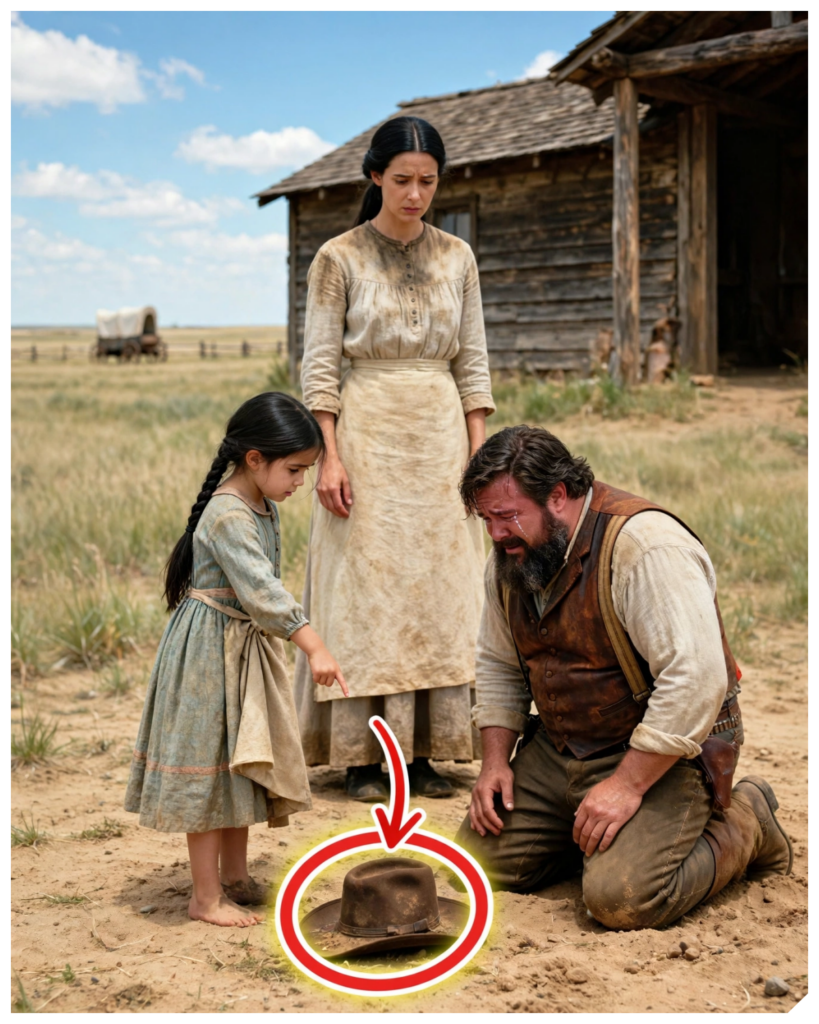
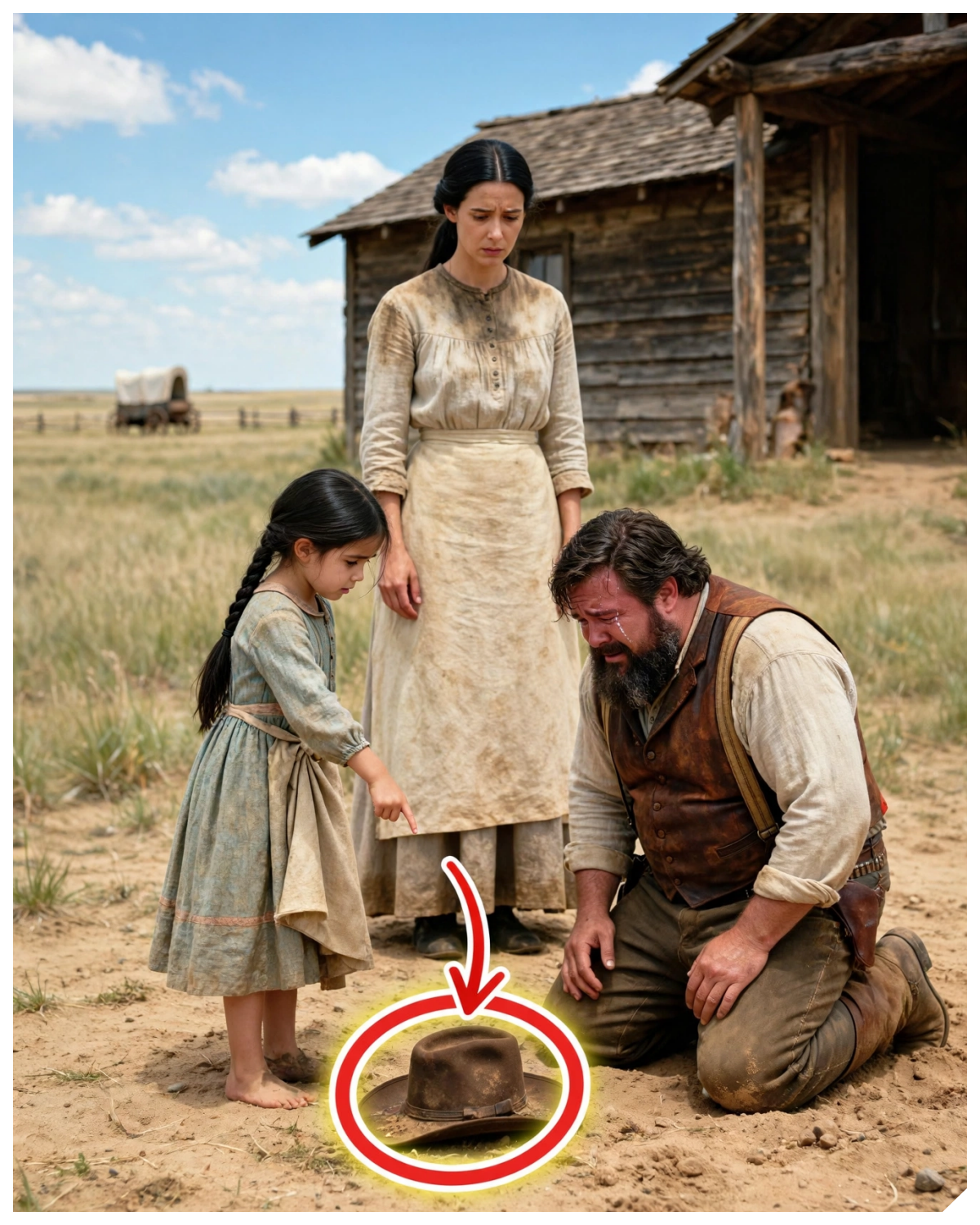
Mama, that’s the man from my dream,” said the child, and the fat rancher fell to his knees.
The wind had been against them all morning, pushing dust across the empty road until it coated the child’s eyelashes like pale sand, and Maria lifted him higher on her hip each time he rubbed at his eyes, whispering for him not to cry, because there was no water left to wash the grit away.
They had slept near a broken fence the night before, wrapped in her thin shawl, the stars cold and sharp overhead.
And when dawn came, he had woken with that same sentence he’d said for three nights straight.
Mama, he’s close.
The man from my dream.
And each time she’d hushed him gently, afraid of what hope could do to a hungry child.
The valley opened before them in a wide sweep of yellow grass and distant ranches.
The mountains rising blue and soft on the horizon, and with every step Maria listened for the sound of riders, because traveling alone with a child meant danger if the wrong men passed by.
She kept her gaze low, her son’s small fingers gripping her collar, his cheek pressed against her shoulder, as if he feared the wind might steal him away.
When they reached the crossing where wagon tracks cut through the road, she paused to catch her breath, scanning the far ridge for movement.
Nothing but sunlight.
She knelt to check the child’s worn boots, tying the frayed laces again, and he touched her face the way children do when trying to understand exhaustion.
“Mama, he’s kind,” he murmured as if continuing a story she never heard.
“He doesn’t talk, but he’s kind.”
She forced a smile.
Dreams can be kind, little one.
He shook his head.
Not a dream, a man.
She didn’t know how to answer that, so she simply lifted him again and walked on.
By midday, they reached the shadow of a deserted storage barn, its boards rattling softly in the wind.
Maria set him down, gave him the last dry crumbs of cornbread, and wrapped her shawl around his shoulders.
The boy didn’t eat much.
He only watched the road with an odd calm, as if waiting for someone he had already met somewhere she couldn’t follow.
The sun dipped lower, turning the dust gold, and they continued toward the faint outline of town.
As the roofs of Redemption Grove came into view, small, scattered, painted in the tired colors of frontier life, Maria felt her stomach twist.
Towns were unpredictable.
Kindness was rare.
Suspicion common.
But the child pointed suddenly, his voice breathless.
Mama, he’s here.
She followed his gaze toward a distant figure by a corral.
A large man in a sweat darkened shirt, broad as the barn behind him, struggling to lift a sack of grain onto a wagon.
Even from far away, she could see the strain in his posture and the slump of tired shoulders.
The kind of heaviness life leaves on gentle men.
The child whispered again, almost in awe.
That’s him, the man from my dream.
Maria’s heart pounded as the man straightened and turned slightly, the wind carrying the outline of his face toward them.
She didn’t believe in signs or visions or destiny.
Yet something in the child’s certainty made her grip his hand tighter.
They were too far for the rancher to notice them yet.
But in that moment, she felt the world tilt.
Subtle, but undeniable, as if the road beneath their feet had just shifted toward a story neither of them could see coming.
The closer they came to Redemption Grove, the tighter Maria held her son’s hand, and the boy’s small fingers curled trustingly around hers as if the road itself might disappear beneath them.
Yet his eyes never left the man by the corral.
The rancher, broad, heavy set, shoulders like two halves of an anvil, wrestled with a burlap sack nearly as big as the feed barrels beside him, his breath rising in visible puffs in the late afternoon chill.
He tried lifting the sack onto the wagon bed, got it halfway, then lost his grip.
The whole thing slipped and burst against the dusty ground, spilling grain like pale gold across his boots.
Instead of cursing or kicking the dirt the way most men would, he just sighed, rubbing the back of his neck as if quietly apologizing to the world for taking up space in it.
Maria slowed her steps, keeping distance.
But the boy tugged her forward, whispering, “Mama, he’s sad, but he’s good.”
She tried to hush him.
Yet something in the rancher’s posture, the slump of a man who had carried too much alone, stirred a faint ache of recognition in her chest.
As they drew nearer, the rancher turned to fetch a shovel, and for the briefest moment their eyes met, her worn, cautious gaze, and his weary, startled one.
He froze midstep, the shovel slipping from his hand with a soft thud, not because he recognized her, but because the sight of a tired mother and small child on foot hit him somewhere unguarded, a place he didn’t let many people see.
Before either could speak, a pair of ranch hands nearby snickered loud enough for the sound to carry.
“Look at him,” one muttered, elbowing the other.
“Fat Harland can’t lift a sack without breaking it.”
The other laughed.
“Maybe he’ll ask the lady to lift it for him.”
Shame flickered across the rancher’s face.
Quick, sharp, practiced.
Yet, he said nothing.
Simply bent down to gather the spilled grain with bare hands.
Maria felt her own stomach twist.
She’d seen cruelty before, but there was something painful about cruelty aimed at someone who didn’t fight back.
The child tugged again harder this time.
“Mama, can I go?”
She knelt swiftly, holding him close.
“No, Corinho, not yet.”
But he whispered with that same strange certainty.
He won’t hurt us.
Before she could argue, the rancher straightened again, brushing off his palms, and saw the child staring at him with open, innocent recognition, as if meeting a longlost friend.
The rancher blinked, confused.
Then the boy lifted his hand in a tiny wave, shy but sure.
Something in the rancher’s face broke open.
Surprise, then disbelief, then something almost like fear of hope.
He dropped the grain scoop he’d just picked up, the metal clanging against the wagon wheel.
When he finally managed to speak, his voice rasped low.
“You know me, kid?”
The child nodded with a soft smile.
“From my dream.”
A hush fell over the yard, broken only by the creek of the corral gate in the breeze.
The ranch hands stopped laughing.
Even the horses seemed to hold still.
Maria’s breath caught as the rancher took one unsure step toward them, then stopped himself as if afraid his nearness might frighten them away.
He lowered his gaze, cleared his throat, and said quietly, “Ma’am, you two look cold.
I ain’t much, but I got water and shade if you need.
It wasn’t an invitation.
It was an apology wrapped inside a kindness.
The kind that made Maria’s heart tremble with something almost forgotten.
Safety.
Maria thanked him with a polite nod, keeping her son close as they stepped beneath the shade of the corral roof.
And the rancher, Harlon, as she soon overheard someone call him, brought over a tin cup of water with both hands, as if afraid the slightest show of force might startle them.
The boy drank first, little sips, eyes never leaving Harland’s face, while Maria watched every movement with the practiced caution of a woman who had crossed too many hard miles.
“You two from around here?”
Harlon asked softly, but when she hesitated, he lifted a hand quickly.
“It’s all right.
You don’t owe me answers.”
The kindness in that gesture caught her off guard, and for a heartbeat, she almost told him the truth.
That they’d left behind a ranch that wasn’t safe, a town that stopped being home, and a man who thought fear could raise a child.
But she swallowed the words and simply said, “We’re passing through.”
Harlon nodded once, the way a man nods when accepting half a truth instead of demanding the rest.
Yet even as he stepped back, giving them space, she saw something shift in his posture, like hope bracing itself against disappointment.
The boy tugged her sleeve.
“Mama, can he come with us?”
She stiffened.
“No, Miam.”
But the child persisted in a whisper.
“He’s supposed to.”
Harlon’s brows lifted, gentle confusion softening his whole face.
He opened his mouth to ask something, then closed it, suddenly embarrassed by how much he wanted to understand.
Instead of pressing, he turned away, pretending to busy himself with sweeping spilled grain.
But Maria could see the truth.
He was running from whatever he’d felt in that first look.
As towns folk drifted past, their eyes lingered on him, some with pity, some with disdain, and Harlon bore each stare with the weary patience of a man used to being underestimated.
A pair of boys snickered as they walked by.
“Too soft to run his own ranch,” one muttered.
“Too big to get on a horse without a crane,” the other laughed.
Maria waited for Harland to snap, to shout, to defend himself like any man would.
But he didn’t.
He just kept sweeping slow and steady as if the broom were the only thing in the world he had the right to control.
For reasons she couldn’t name, that hurt her more than if he’d yelled.
When the laughter faded, Harlon risked a glance at the boy.
One quick look, almost shy, then looked away again, burying his hands in his pockets.
The avoidance wasn’t cruelty.
It was fear.
Fear of wanting something he believed he didn’t deserve.
Fear of misreading a moment that felt too big for a man who’d never been chosen for anything except hard labor.
Maria lifted her son.
We should go, she murmured, and the boy’s face crumpled with confusion.
But mama.
She hushed him gently and turned towards the road.
Behind them, Harlon took a half step forward as if to speak, but stopped, clenching his jaw, watching them walk away with a look so lonely it pressed against the ribs like a bruise.
Maria didn’t look back until the boy whispered again, “Mama, he’s supposed to come.”
And when she finally turned, Harlon was still standing there, broom in hand, eyes lowered, shoulders trembling under the weight of a man trying to shrink himself small enough not to scare away the only child who had ever smiled at him.
Maria tried to keep her pace steady as they walked toward the far end of town.
The boy clutching her hand with the urgency of someone certain he was being pulled away from destiny.
But she didn’t dare slow down, because every instinct she had told her that staying still was dangerous for a mother with no home, and a child who spoke too boldly.
Yet even as she moved, her ears strained for the faint sound of steps behind them, hoping and fearing at the same time that the rancher might follow.
He didn’t.
The silence behind them stayed hollow, and that somehow hurt more than if he’d shouted after them.
They reached the market square where vendors shouted over one another.
Horses snorted against hitching posts and dust rose in small storms around boots.
Maria lifted her son into her arms to keep him from being jostled, whispering for him to stay close, but his eyes searched the crowd with a desperation far too old for a child so young.
Mama, he’s still there,” he said into her shoulder, his voice trembling with certainty.
She tried to hush him.
Yet something in his tone, a quiet knowing, made her heartbeat quicken.
She turned to step around a wagon when the crowd shifted, and suddenly the rancher appeared at the other end of the square, carrying a sack of flour, braced awkwardly against his chest, trying not to look toward them, but failing with every other step.
The moment the child saw him, he squirmed down from her arms and slipped through the crowd before she could catch him.
Panic surged through her.
“Mamore!
No!”
She cried, shoving past a pair of towns folk and nearly knocking over a basket of apples.
The boy darted through boots and skirts straight toward the rancher, who froze in the street like a startled deer, arms tightening around the flower sack as if it were a shield.
The child stopped right in front of him, looking up with a strange, quiet relief.
For a moment, neither moved.
Then, with the smallest, bravest motion Maria had ever seen, her son reached out and tugged gently at the rancher’s sleeve.
Harlon flinched, not from fear, but from disbelief, his breath catching in a soft, broken sound.
The flower sack slipped from his arms, landing in the dirt with a muffled thump.
White dust rising like smoke.
The square grew still.
A few vendors stopped calling prices.
A woman paused with a basket under her arm.
The rancher stared at the tiny hand on his sleeve, tears gathering before he could blink them away.
Kid,” he whispered, voice cracking around the word as if speaking it hurt.
Maria reached them breathlessly, pulling her son close, apologizing in soft words that tangled with fear.
But the boy leaned into her arms and said simply, “Mama, he’s not afraid of me.”
That sentence struck something deep in Haron, deep enough that he had to look away, shoulders shaking once before he studied them.
Slowly, so carefully it felt like prayer.
He knelt to gather the fallen flower, but his hands were trembling.
And when the boy reached out again to help him scoop it, Harlon let out a soft, broken laugh.
“You don’t need to help me, little man,” he murmured.
“But he didn’t stop him either.”
Maria watched, torn between fear and something she had not dared feel in months, a whisper of trust.
Around them.
The square remained quiet.
The afternoon sun settling warm against three figures who didn’t yet belong to each other, but no longer stood as strangers.
Clouds had been gathering since morning, but no one in Redemption Grove expected the storm to roll in as fast as it did, sweeping over the valley in a low, bruised line that swallowed the sun.
By the time Maria left the square with her son’s hand in hers, the wind had sharpened, stirring dust into their eyes and tugging at her shawl like impatient fingers.
She hurried toward the old wagon trail on the edge of town, hoping to find shelter before the rain broke.
But the boy kept glancing back with anxious, jerking motions, as if he could hear something she could not.
“Mama, he’s coming,” he whispered.
She tried to keep her voice calm.
No, Mamore.
He’s busy.
We need to find cover.
But the child shook his head with an urgency that frightened her.
Mama, he’s coming because the dream said he had to.
She didn’t know what that meant.
Yet the certainty in his voice made her look over her shoulder.
And there he was.
Harlon came running down the road, breathless, hat in one hand, the other bracing the flower sack against his chest to keep it from splitting open again.
His heavy boots pounded the dirt, kicking up dust as he tried to reach them before the storm hit.
When he caught up, he bent over with his hands on his knees, struggling for air, but managing a strained apologetic smile all the same.
“Ma’am, storm’s coming in fast,” he panted.
Ain’t safe out here with no roof.
Maria tried to protest.
She didn’t want to rely on a stranger, especially not in a town where trust was scarce.
But the child pressed his cheek to her shoulder and whispered, “Please, Mama.”
The first drop of rain hit Maria’s face like a cold stone.
Then another.
Then the sky opened.
Harlon didn’t wait for permission.
He lifted the flower sack higher under one arm and extended his other hand, not touching her, simply offering direction.
“My ranch is close.
Just pass them cedars.
You and the boy can keep dry there.”
The rain came hard and sudden, soaking Maria’s dress in seconds, and thunder rolled across the valley so loud the child flinched and buried his face in her neck.
She gathered him tighter and nodded once.
Quick, decisive, Harlon led the way, shielding his eyes with his forearm as the downpour thickened, the wind lashing sideways.
Each step through the mud felt heavier than the last.
Twice Maria stumbled, her boots slipping, and each time Harlon stopped instantly, giving her space, waiting until she found her footing again.
Not once did he reach for her arm without being asked.
Not once did he assume he had the right.
By the time the ranch house came into view, a sturdy structure of dark logs with a wide porch and a light flickering in the window, the storm had swallowed the world, turning the air silver with rain.
Harlon rushed ahead and shoved the door open, stepping aside so they could enter first.
Maria hesitated only a second before crossing the threshold, clutching her shivering child.
The warmth hit them like a blessing.
Fire light dancing on wooden walls, the smell of stew lingering in the air.
Harlon set the flower down with a soft grunt and closed the door against the storm, leaning his weight into it until the latch clicked.
For a moment, no one spoke.
Rain hammered the roof in a steady roar.
The boy lifted his head from Maria’s shoulder, eyes wide with the kind of wonder that made the world feel gentler.
“Mama,” he whispered.
The dream said he would save us in the rain.
Harlon heard the words, and something in his expression softened completely.
“Surprise, sorrow, humility.”
Before he looked away, rubbing the back of his neck like a man who didn’t know how to carry gratitude that wasn’t his to claim.
The warmth inside the ranch house felt almost unreal after the storm, and Maria stood just past the doorway for several seconds, letting the water drip from her shawl, steadying her breath, while the boy gazed around as if he had stepped into the very place his dreams had been pointing toward.
Harlon moved quietly, almost silently for a man of his size, setting aside his hat, and moving to stoke the fire with careful, practiced motions, each movement gentle enough that Maria wondered how someone so large could carry himself with such softness.
He didn’t speak, and somehow the silence made the room feel safer, not heavier.
When the fire strengthened into a steady glow, he straightened and glanced toward the kitchen table, where an unfinished bowl of stew sat beside a loaf of bread, as if he’d been eating alone when the storm first began.
Without a word, he took two tin bowls from a cabinet, ladled warm stew into them, and placed them at the table, one in front of the larger chair, one in front of the smaller.
He didn’t gesture for them to sit.
He simply stepped back, wiping his hands on a cloth, waiting with the kind of patience that made Maria’s throat tighten.
“It’s warm,” he murmured almost apologetically.
“Ain’t fancy.”
The boy reached for her hand.
“Mama, can we?”
She hesitated, torn between hunger and the instinct to rely on no one, but the storm outside rattled the shutters and reminded her that she had very few choices left.
She nodded and guided her son toward the table.
Harlon pulled out the smaller chair for the boy, then backed away again, giving them space.
He didn’t sit.
He didn’t eat.
He stood by the kitchen counter, arms folded loosely as if he didn’t trust himself to share a table without overwhelming them.
The boy dipped his spoon into the stew, blew on it, and started eating with small, eager bites.
Maria waited until she saw he was chewing safely, then tasted her own.
Warmth flooded her chest, not just from the food, but from the first moment of dignity they’d had in days.
She lifted her gaze to thank Harlon, but he wasn’t looking.
He was watching the storm through the window, shoulders low, expression unreadable.
She realized suddenly why he kept his distance.
He didn’t want them to feel beholden.
He didn’t want to take up more space than he already did.
The boy finished his stew quickly, crumbs of bread clinging to the corners of his mouth.
He slid off the chair and patted across the wooden floor until he stood right beside Haron.
The rancher stiffened, startled, then slowly looked down at the small hand tugging his sleeve.
The boy didn’t say anything.
He didn’t need to.
He just leaned his head lightly against Harland’s arm, as if confirming something he already knew.
Harlland’s breath caught.
One hand hovered awkwardly at his side, trembling before he finally let it rest.
Barely, just a touch, against the boy’s back.
Maria watched, feeling something deep inside her shift, something that had been clenched for too long.
The fire crackled softly.
The storm faded to a gentler patter.
In that warm, wordless room, three lives that had been drifting in separate directions, took their first quiet step toward the same horizon.
And Haron, who had been eating alone for years, whispered more to himself than anyone?
Reckon you ain’t afraid of much, little fella?”
The boy smiled, the same soft, knowing smile he’d worn since morning.
Maria didn’t understand it yet, but she would.
Soon, by morning, the storm had passed, leaving the world washed clean and smelling of wet earth.
But Maria felt the weight of a new kind of cloud settling over her as she quietly folded the blankets Harlon had given them, and watched her son trace circles in the dust near the hearth with the toe of his boot.
Harlon had risen before dawn, moving around the kitchen with an awkward gentleness that made the old floorboards creek softly under his weight, setting out a small plate of cornbread and a pot of warm milk, as though afraid to intrude on whatever silence the mother and child needed.
“You ain’t got to rush out,” he said, rubbing the back of his neck with a kind of embarrassed sincerity.
Storm tore up the trail something fierce.
Safer to wait.
Maria opened her mouth to answer when a firm knock shattered the stillness.
Harlon stiffened immediately, his breath hitching at the sound.
He barely had time to move before the door swung open, and Sheriff Kellen stepped inside without waiting for permission, brushing rain from his coat, though no rain was falling.
His eyes swept the room hard and assessing, lingering on the mother and child with a spark of suspicion that made Maria’s hand instinctively reach for her son’s shoulder.
Morning, Haron.
The sheriff drawled, though his voice carried no warmth.
Town says you dragged yourself out into the storm last night.
Brought home company.
Harlland swallowed, jaw tightening.
Storm wasn’t safe.
They needed shelter.
Kellen stepped closer, boots thuing on the wooden floor, and Maria felt her pulse quicken.
The sheriff was the kind of man who believed rules outweighed compassion.
And his gaze sharpened the longer he looked at her and the boy.
“You got papers?”
He asked Maria flatly.
She shook her head.
“We’re just passing through.”
“Funny,” Kellen said.
Most folks pass through using roads, not storms, not barns, not hiding from folks either.
Harlon took a slow breath, stepping subtly between them.
Not aggressively, simply placing himself where the sheriff’s gaze had been drifting.
“Ain’t nobody hiding,” he said, voice calm, but steady.
“They’re tired.
That should be enough.”
Kellen raised a brow.
“You taking in strays now, Harlon?”
Big man like you ought to know you can’t save every lost soul.
The words struck deeper than Kellen understood, judging by the way Harlon flinched as if the insult were familiar, worn into him by years of being underestimated.
The boy peered around Harlland’s leg, eyes weary but bright.
And in that moment, the sheriff noticed him fully.
“What’s your name, son?”
The sheriff asked.
The child didn’t answer.
He pressed closer to Maria.
Kellen’s mouth twitched in annoyance.
“Quiet, little thing.”
Harlon shifted again, shielding the child from view.
“He don’t owe you words.”
The sheriff stared at him for several long seconds, the air tightening like wire, until finally he took a step back.
“Fine,” he muttered.
“But watch yourself, Harlon.
Folks talk when you start bringing strangers under your roof.
He left with the same heavy boots and cold eyes that had entered, letting the door bang shut behind him.
Silence reclaimed the room, thick and trembling.
Maria exhaled shakily.
Harland did too, though he tried to hide it.
The boy slipped his hand into Harlland’s large calloused one, squeezing once, and Harland’s breath seemed to steady instantly.
He knelt down slowly, not bowing, not yet, but lowering himself to the child’s height with a reverence that made Maria’s throat ache.
“Ain’t no one taking you from here,” he murmured.
“Not while I’m standing.”
Those words, quiet and unpolished, carried more protection than any badge in town.
The day warmed slowly, sunlight spilling across the muddy yard in soft streaks, but unease clung to Maria like cold cloth as she stood on the porch, watching Harlon hitch his horse to the wagon, movement stiff from the sheriff’s visit.
He kept glancing toward the house as if making sure the boy was still safe inside.
And every time their eyes met, his expression carried the same quiet apology, as though he believed offering shelter had already caused them trouble.
Maria tried to reassure him with a nod.
Yet her pulse never settled.
Something in the air felt too still.
The way a valley holds its breath before a rock slide.
When the boy tugged her hand and asked if they could go to town for more bread, she hesitated.
But she couldn’t hide from the world forever.
And Harlon insisted on walking with them despite Maria’s protests.
“Ain’t right you face folks alone after Kellen snooping,” he said, adjusting his coat awkwardly across his broad shoulders.
“I’ll keep to the side.”
But he didn’t keep to the side.
He walked a step behind, eyes steady, watching every passing face like a man who had spent his life being judged, and refused to let a child taste the same bitterness.
When they reached town, whispers rose like dust, curious, sharp, suspicious.
A few men paused mid conversation.
A pair of women lowered their voices.
Someone muttered, “There’s fat Harlon playing hero again.
Maria stiffened, ready to pull her son closer.
But before she could, the boy broke away and walked straight into the center of the street where sunlight pulled on the dirt like a spotlight.
“My she exclaimed, reaching out, but the child stood rooted, staring down the road with an expression far older than his years.
Then she saw what he saw.
Sheriff Kellen approaching with two townsmen behind him, boots slow, posture rigid.
Harlon tensed immediately, instinctively moving forward, but the sheriff lifted a hand.
“Hold it,” he said.
“I need a word with the lady.”
Maria’s heart slammed against her ribs.
“We have done nothing,” she managed.
“Maybe not,” Kellen replied.
But strangers without papers, especially with a child, need explaining.
The boy took one step backward, bumping gently into Harlland’s leg.
And in that small motion, barely a shift of air, something in the rancher shattered.
All the shame, all the whispers, all the years of being mocked for his size, his softness, his silence, none of it mattered anymore.
Only that one trembling child leaning into him did.
The sheriff opened his mouth again, but before another word could leave it, the boy looked up at Harlon with quiet certainty and said the sentence that would change every life on that street.
Mama, that’s the man from my dream.
The world stilled.
Even the wind seemed to stop.
And Harlon, big, gentle, self-doubting Harlon, fell to his knees.
Not from fear, not from defeat, but because the boy’s trust struck him like grace.
The entire town watched as he bowed his head, both hands resting softly at the child’s sides, his breath shaking with a reverence no one expected from a man of his size.
Gasps rippled through the crowd.
A woman covered her mouth.
A man lowered his hat.
Sheriff Kellen’s voice faltered.
Haron, what are you doing?
Harlon lifted his face, eyes shining, voice thick but steady.
Protecting what’s good.
And this boy, he placed one gentle hand over the child’s back.
This boy ain’t lying.
If he dreamed me, then maybe God’s finally given me a purpose.
Maria felt her knees weaken, not from fear, but from the quiet truth settling over the street like warm rain.
This wasn’t just a moment.
This was a turning.
And no matter who watched, no matter what the sheriff demanded next, the boy had chosen Haron.
And Harlon had answered with a kneel that shook the whole town awake.
For a long trembling moment, no one in Redemption Grove moved, as if the sight of a giant rancher kneeling before a small child had cracked something open in the town’s hardened spine.
Dust drifted lazily between them, sunlight warming Harlland’s bowed shoulders while the boy rested his hand, tiny, steady, on the rancher’s hair, as though comforting him instead of seeking protection.
Maria stood frozen, one hand pressed to her throat because everything she thought she knew about men, about power, about what people were capable of in public unraveled right there in the middle of the street.
Sheriff Kellen shifted uneasily, his certainty fraying as towns folk gathered along the storefronts, whispers turning from suspicion to something she hadn’t heard in her direction for years.
Compassion.
“Harlen, get up,” the sheriff muttered.
But the words lacked force.
Harlon didn’t rise.
Instead, he lifted his head, meeting the sheriff’s gaze with a strength that wasn’t loud, not violent, but devastatingly sure.
“I ain’t standing between you and the boy,” he said quietly.
“But I ain’t moving aside neither.”
A murmur rippled through the watching crowd.
A woman near the feed store nodded once.
A ranch hand, one who had mocked Harlon for his size just the day before, lowered his eyes, guilt softening his jaw.
And slowly, subtly, the town’s posture shifted, shoulders eased, arms uncrossed, anger deflated into uneasy reflection.
Maria felt her son’s hand slip into hers, warm and steady, and she realized he wasn’t afraid at all.
The sheriff exhaled sharply, glancing around as though realizing he no longer spoke for the majority.
“Lady,” he said, frustration fighting with caution.
“I don’t know where you came from.
Don’t know what trouble follows you, but this town ain’t a place to it’s a place to be safe,” Maria said, surprising even herself with the firmness in her voice.
“Just for one day, one night, one moment without fear.
The sheriff opened his mouth, but a voice cut through the crowd before he could speak.
“She ain’t wrong,” said old Mrs.
Thatcher, perched on her porch railing with arms folded.
“Storm like last night?
You’d have helped him, too, if you had half the heart Harland does.”
Someone else chimed in.
“Let him breathe, Kellen.”
Another Ain’t no law against being kind.
Bit by bit, the sheriff found himself standing alone against a shifting tide of decency.
His jaw clenched, but he finally stepped back, tipping his hat in stiff acknowledgement.
“Fine, I’ll give you time, but I’ll be watching.”
He walked away with the weight of a man whose certainty had been publicly undone.
When he was gone, an unexpected quiet settled.
Not awkward, not hostile, but reverent, as if everyone sensed something sacred had just happened.
Harlon rose slowly, brushing dust from his knees, but the tremble in his hands betrayed the enormity of the moment.
He turned to Maria, not with pride, but with humility so deep she felt it in her bones.
I don’t know your story,” he said softly.
“Don’t need to.
Just let me help.
Don’t got much in this world, but I got a roof and two extra chairs at a table that’s been empty too long.”
Maria met his gaze, and for the first time since fleeing her old life, she felt the fragile weight of a choice that didn’t come from fear, but from hope.
Behind her, the boy tugged her skirt, whispering, “Mama!
This is the place.
And as she looked at the man who had knelt for her son without knowing anything about him, she understood the truth.
The dream wasn’t about destiny.
It was about mercy, finding someone who had never been chosen.
Dawn came soft over the valley, brushing the hills in pale gold and painting long, gentle shadows across the ranchyard, and Maria stood on the porch, holding a mug of warm milk between her hands, while her son chased a sleepy chicken across the grass with laughter bright enough to make the morning feel young again.
The storm had passed.
The sheriff had not returned, and for the first time in many months, Maria felt the unfamiliar, trembling warmth of a day that did not begin in fear.
Haron stepped out of the barn just then, wiping his hands on a faded cloth, the early sun catching in his hair and softening the lines of worry that hard living had carved into his face.
He paused when he saw the boy laughing, his whole body going still in a way that felt like awe, as though watching a moment he had never believed he’d be allowed to witness.
Maria lifted her eyes to him, offering a small nod that carried gratitude heavier than words, and Harlon dipped his head shily the way he always did when emotions rose too close to the surface.
Fixed the fence rail, he said, voice low, almost apologetic.
Ain’t much, but it’ll keep the goats in.
She smiled.
You’ve done enough, Haron.
He opened his mouth to disagree, then shut it, rubbing the back of his neck in the same nervous gesture she’d grown to recognize as humility rather than discomfort.
The boy ran toward him at full speed, colliding into his leg with an enthusiastic hug.
And Harlon froze for a heartbeat before bending down carefully, lifting the child with hands gentle as sunlight.
The boy rested his head on Harland’s shoulder like he’d been doing it all his life, and Maria felt something in her chest loosen, tender, aching, real.
They moved into the kitchen where Harlon put a skillet on the stove, preparing breakfast with quiet intention, never assuming, always asking with his eyes before reaching for something.
Maria helped slice bread while the boy sat on the counter swinging his feet, humming a tune only children and angels ever remember.
When they finally sat to eat, Harlon waited until they both took the first bite before lifting his own fork, a small courtesy that struck Maria harder than any grand gesture could.
After breakfast, the three stepped outside again, sunlight warm on their faces.
The valley stretched wide and forgiving, the world washed clean by rain and mercy.
The boy took Harlland’s hand, tugging him toward the fence line where a few wild flowers had sprouted overnight.
Tiny bursts of yellow stubborn enough to survive the storm.
“They came back,” the child said happily.
Harlon looked at the flowers, then at the boy, then at Maria standing a few steps behind, her eyes soft with something she had not allowed herself to feel in years.
Rest.
He crouched beside the child, his large frame folding with surprising grace, and whispered just loud enough for both of them to hear.
Reckon some things were meant to grow here.
Maria approached slowly, her hand brushing the boy’s hair, her gaze meeting Harlland’s in a silence deeper than speech.
Nothing was asked, nothing was claimed.
But something new, fragile, sacred, steady, rooted itself in the quiet space between them.
The boy squeezed both their hands and whispered, “Mama, this is home.”
And as the morning sun climbed over Redemption Grove, Maria realized he wasn’t wrong.
They had walked through fear, weathered storms, faced judgment, and found a place where protection didn’t demand payment and kindness didn’t come with a chain.
For the first time in her wandering life, the day began with peace.
And that was enough.
Please like, share, and subscribe to support more truehearted stories on stories left behind.
If you saw a mother and her twins sleeping on a bench, would you have stopped like the cowboy did or walked on?


