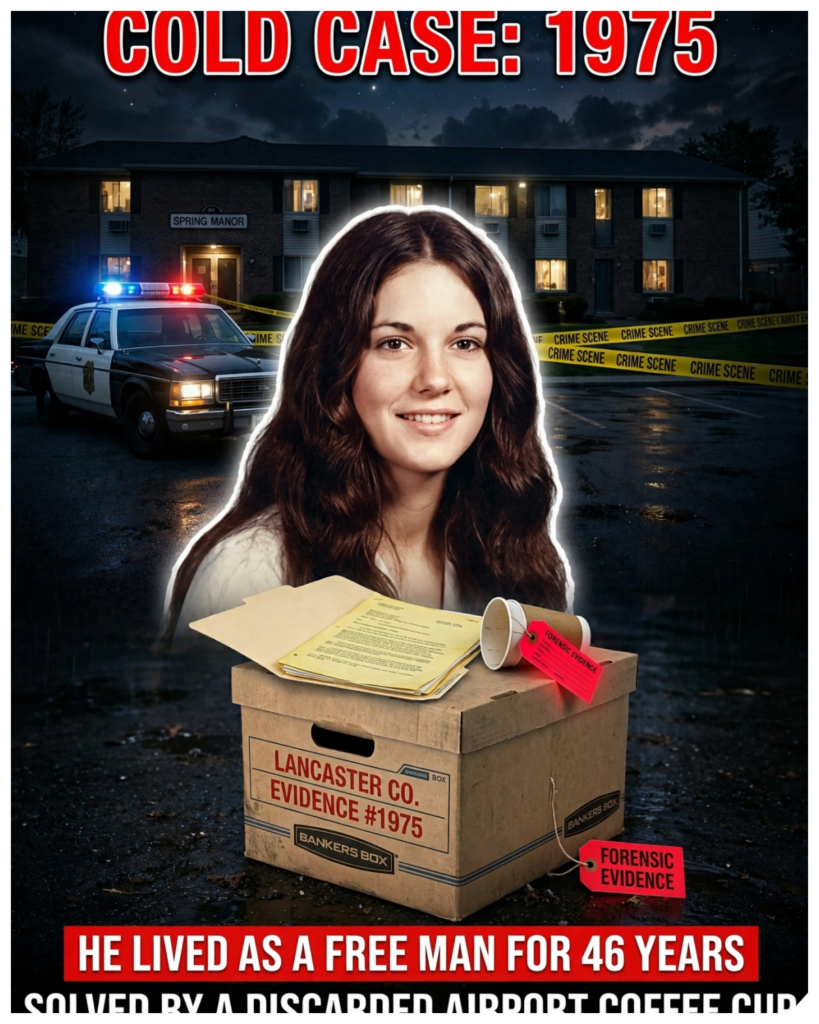
In the offices of the Lancaster County District Attorney in the heart of Pennsylvania’s Amish country, there is a case file older than most of the people who have worked on it.
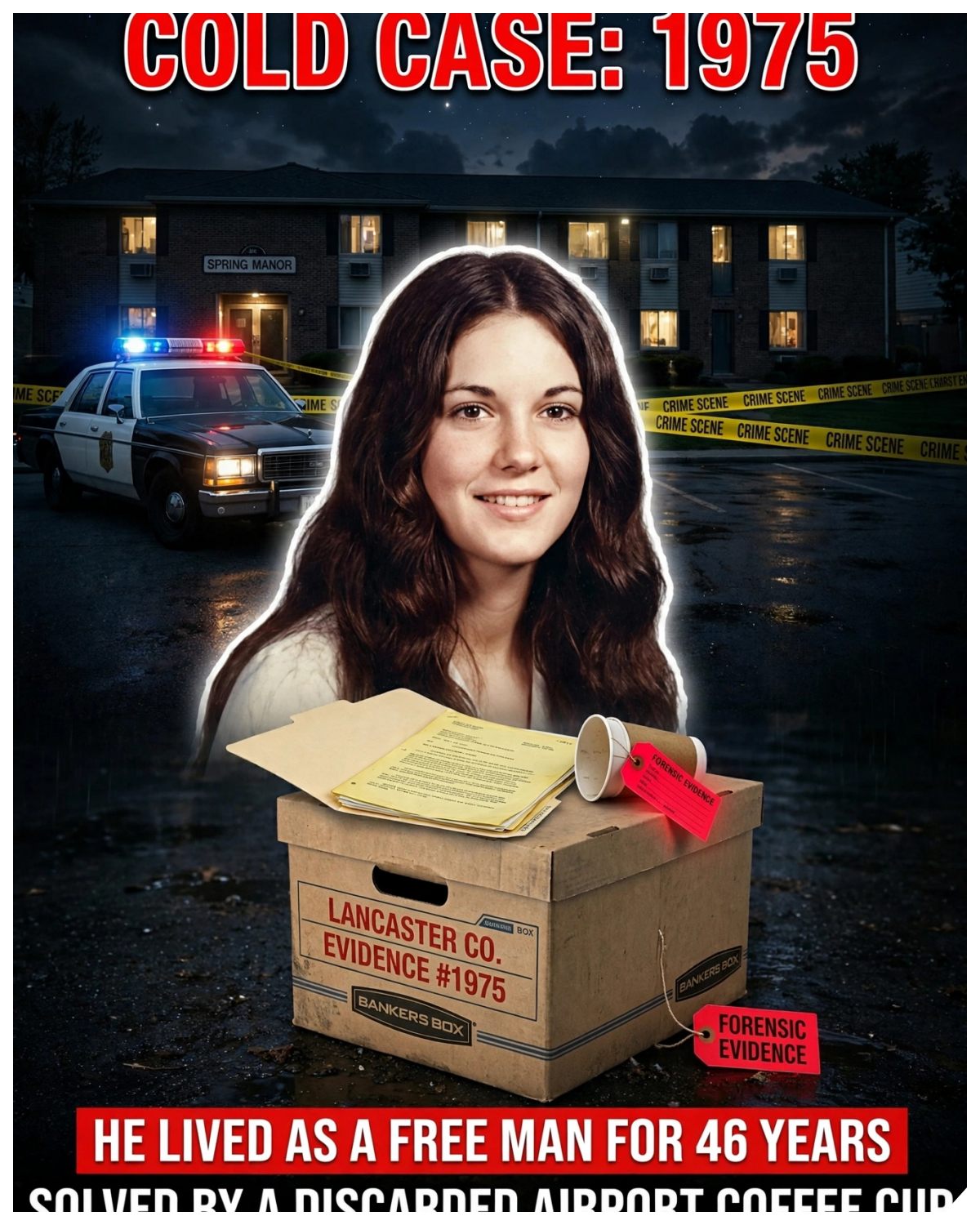
Over the decades, it has moved from a township police station to filing cabinets to evidence rooms, carried from one generation of investigators to the next, like a family heirloom nobody asked to inherit.
Open it and the paper tells you its age before the words do.
Onion skin carbon copies so thin the typing on the back shows through.
Reports pecked out on manual typewriters.
A letter here and there struck so hard it punched a tiny hole in the page.
Staples gone to rust.
Black and white photographs of a small living room, a sofa, an end table, a hurricane lamp lying on its side on the carpet, a diagram of a front door with small marks where the blood was.
A coroner’s report.
A list of names, dozens of them, each one followed by a single word that took weeks or months of someone’s life to write.
Cleared.
Cleared.
Cleared.
And in an evidence room sealed away from the light, there is a small piece of clothing that a detective in 1975 had the instinct to keep, even though no one alive could have told him what it would one day be worth.
We like to believe that the people who do the worst things imaginable are strangers, drifters, men who blow into town on a dark highway and are gone by morning.
It is a comforting belief because it means the monster is out there somewhere else far from the people we know.
The truth is usually closer.
Killers do not vanish into thin air.
Most of the time they simply go home.
They go to work in the morning.
They get married.
They raise children.
They wave to the neighbors and pay their bills and take vacations with their friends.
And while they do, the evidence of what they did waits in a cardboard box, patient and silent, for the day the world finally learns how to read it.
This is the story of one of those boxes.
It is the story of a 19-year-old newlywed who came home from the grocery store on a Friday night in December and never made it through the evening.
It is the story of the aunt who found her, the husband who lost her, and the family who refused to let her be forgotten.
It is the story of a killer who had once lived at the same apartment complex, who was never questioned, never suspected, never even named in the file, and who went on to live 46 years as a free man in the same county.
And it is the story of how a paper coffee cup tossed into a trash can at Philadelphia International Airport by a 67year-old man about to go on vacation closed the oldest cold case homicide in Lancaster County’s history.
It began on Friday evening, December 5th, 1975 in a firstf flooror apartment on Clauss Drive in Manor Township, Pennsylvania.
This is the file on the murder of Lindy Sue Beckler.
Lindy Sue was 19 years old that winter.
The people who remember her describe long flowing hair and a gentle smile.
She worked as a clerk at a flower shop.
And there is something fitting in that.
A young woman who spent her days surrounded by arrangements for weddings and birthdays and anniversaries, the small celebrations that make up a life.
She was also, in a way that seems almost unbearably young now, a married woman.
She had wed Philip Beckler about a year earlier and the couple had set up their first home together in an apartment complex called Spring Manor off Millersville Road just outside the city of Lancaster.
Their unit was 104A on the first floor.
It was the kind of place young couples start out in.
Modest rent, thin walls, neighbors coming and going on the stairs.
A first apartment furnished with whatever you could afford and whatever your relatives were willing to give you.
Her family was close.
Lindy Sue’s aunt and uncle Merl Little and his wife lived nearby and they were the sort of relatives who stopped by, who checked in, who were part of the ordinary weekly rhythm of her life.
She and her aunt had made plans to trade recipes the way a young bride learns her way around a kitchen from the women who came before her.
Her father would later describe her to reporters as surprisingly strong.
Big boned, he said.
A relative put it another way.
There was nothing frail about Lindy Sue.
To understand that December night, you have to understand the place.
Lancaster County in 1975 was a patchwork of farmland and small towns, of horsedrawn buggies sharing two-lane roads with Ford pickups, of church suppers and high school basketball.
On Friday nights, Manor Township sat along the Suscuana River on the edge of the city, a mix of farms, new subdivisions, and apartment complexes for the young families and working couples who wanted to live close to their jobs in Lancaster.
It was the kind of community where doors were left unlocked, where people knew which car belonged to which neighbor.
Phones were mounted on kitchen walls with long coiled cords.
There were no cell phones, no doorbell cameras, no security systems.
Murder was something that happened in Philadelphia, 60 mi to the east.
Not here.
Friday, December 5th, began as an ordinary day.
That afternoon, Lindy Sue took care of the household business.
She went to the bank and deposited two paychecks, hers and her husbands, the weekly ritual of a young couple living on two modest incomes.
Then she went grocery shopping.
It was early December, the Christmas season just beginning, the days at their shortest.
By the time she pulled back into the lot at Spring Manor, it was dark.
It was around 7:00.
She carried her groceries inside into the first floor apartment.
What happened over the next 2 hours would not be fully understood for nearly half a century.
At about 8:40 that evening, Merl Little and his wife were driving home from a high school basketball game.
They decided to stop by their niece’s apartment.
It was the kind of spontaneous visit that families made in those days.
No phone call ahead, just a knock on the door.
Mr.
Little stayed in the car with the engine running.
His wife walked up to the building.
At 8:42 p.m., she found Lindy Sue.
Her niece was lying on her back on the living room floor.
There was blood on the carpet in several large patches.
There was blood on the wall of the entranceway.
There was blood on the front door, on the inside, and on the outside as well.
And in Lindy Sue’s neck, there was a knife, a kitchen butcher knife, its wooden handle wrapped in a tea towel.
Years later, a member of Lindy Sue’s family who had served in the Second World War would stand up in a Lancaster County courtroom and say that even after everything they had seen in that war, they had never seen so much blood.
Someone called the police.
Officers from the Manor Township Police Department arrived first, followed by the Pennsylvania State Police.
The scene was cordoned off.
Photographers went to work, the flash of their cameras lighting up the small living room.
Again and again, detectives moved carefully through the apartment, room by room.
The details they recorded that night would fill the first pages of the file.
The knife in Lindy Sue’s neck matched the set in the knife block in her own kitchen.
Whoever had done this had used her own knife against her.
The tea towel wrapped around its handle had left no fingerprints.
Investigators would later conclude there had been another knife too, a smaller one about 4 in long that the attacker had used first.
In the living room, a hurricane lamp had been knocked off an end table.
It was one of the few signs of a struggle in the room, but the blood told its own story.
Blood near the front door, both sides.
Signs that Lindy Sue had fought, that she had perhaps tried to reach the door to get out, to get help.
In the kitchen, investigators found a footprint, a large one, a man’s shoe, size 10 or bigger.
The autopsy would reveal the full horror.
Lindy Sue Beakler had been stabbed 19 times in the neck, the chest, the upper abdomen, and the back.
Early reports in the newspaper said 11 wounds.
The final count, the one prosecutors would site decades later, was 19.
She had died of massive bleeding and she had been sexually assaulted.
The Lancaster County Coroner ruled it a homicide.
The lead investigator was Lieutenant Harvey West of the Manor Township Police.
He was working alongside state troopers and within days the office of the district attorney D.
Richard Ecman who called a conference of investigators to intensify the search for the killer.
Lancaster County wanted this solved.
The early hours of a homicide investigation are a race against time.
The first 72 hours are when witnesses memories are freshest, when a suspect is most likely to make a mistake, when physical evidence is most intact.
Lieutenant West and his team worked the scene and the neighborhood without rest.
They had a rough timeline.
Lindy Sue had been out running errands until early evening.
Police believe the killer entered the apartment sometime after 6:30, most likely shortly after she came home with the groceries around 7:00.
He was gone by 8:42 when her aunt walked through the door, a window of perhaps an hour and a half in a building full of neighbors on a Friday night.
Detectives knocked on every door at Spring Manor.
Had anyone heard screaming, seen a stranger on the stairs, noticed a car that didn’t belong?
One lead emerged.
Someone had seen a car parked near the apartment that night.
Police made a public appeal for the driver to come forward.
Then they did something that tells you exactly how limited their tools were because they had that large footprint in the kitchen.
Investigators asked residents of the complex to hand over their shoes.
They wanted to compare the soles, one pair at a time, against the print left on Lindy Sue’s kitchen floor.
It is hard to overstate how primitive forensic science was in 1975.
Fingerprints.
If you were lucky enough to find a clean one, could only be compared by hand against cards on file, and there was no national computer system to search.
The killer had wrapped the knife handle in a towel.
Blood could be typed A, B, AB, or O, and biological fluids could sometimes be grouped, but those results could only place a man in a category shared by a large share of the male population.
They could rule people out.
They could never point to one man.
There was biological evidence at that scene.
The killer had left semen on Lindy Sue’s underwear, and there were small spots of blood on her panty hose that might not have been hers.
In 1975, that evidence could tell investigators almost nothing.
The technique that would one day identify a single human being from a stain like that, DNA profiling, would not be invented for another decade.
It would not be used in an American courtroom until the late 1980s.
But someone in the winter of 1975 made the decision to preserve it anyway, to bag it, label it, and keep it.
That decision would turn out to be the most important thing anyone did in this case for the next 20 years.
Lindy Sue Beckler’s funeral was held on the Monday evening after her death at the Snyder Funeral Home on East Orange Street in Lancaster.
Her husband, her parents, her aunt and uncle, her friends from the flower shop.
All of them gathered to say goodbye to a 19-year-old who had been married for barely a year.
Meanwhile, the investigation pushed outward.
Detectives interviewed everyone in Lindy Sue’s life.
Her husband as investigators always must in the murder of a married woman.
Her co-workers, her friends, the neighbors in her building and the buildings around it.
Former residents of the complex, men with records for burglary or assault in the area, delivery drivers, anyone who might have had a reason or simply an opportunity to be at Spring Manor that Friday night.
Over the months and years that followed, Manor Township police and the state police chased lead after lead.
Dozens of people came under scrutiny.
One by one, each was investigated and cleared.
Every time a name was eliminated, it was a small victory for that person and a small defeat for the case.
The public record does not preserve the names of the men who were looked at and cleared.
And that is as it should be.
They were innocent and many of them lived for years under a shadow they did not deserve.
What the record does tell us is this.
Across all those dozens of interviews, across all those years, one name never appeared in the file.
Not as a suspect, not as a person of interest, not even as a tip.
It was the name of a young man about 21 years old, a Lancaster native who had lived at Spring Manor himself.
He had lived in a secondf flooror apartment in a 4-unit building at that same complex.
And he had moved out sometime before August of 1975, just a few months before the murder.
His name was David Vincent Synopoly, and no one ever asked him where he was that night.
The month stretched into years.
The tip slowed to a trickle and then stopped.
Lieutenant West and the original investigators moved on to other cases, then to retirement.
The case of Lindy Sue Beckler went cold and it stayed cold.
The 1970s became the 1980s.
Lancaster County changed around the case.
The farmland around the city filled in with housing developments and shopping centers.
Spring Manor’s apartments filled with new tenants who had never heard Lindy Sue’s name.
Philip Beckler, widowed before he had been married 2 years, eventually rebuilt his life.
He remarried, but he did not forget.
Decades later, when the case finally went to court, he would be there in the room.
Lindy Sue’s family carried the loss the way families of the murdered always do.
Christmas was forever shadowed by early December.
Her parents grew old without ever learning who had taken their daughter or why.
Her aunt, who had walked into that apartment at 8:42 on a Friday night, carried the image of what she found for the rest of her life.
And somewhere in Lancaster County, a man went on living.
In the late 1980s, DNA profiling arrived in American courtrooms.
And with it, a flicker of hope for cases like this one.
In 1997, more than two decades after the murder, the Lancaster County District Attorney’s Office submitted the old evidence from Lindy Sue’s case for DNA analysis.
The underwear that had sat in storage since 1975 still held what investigators had hoped for.
Analysts developed a male DNA profile from the semen on the garment.
For the first time in 22 years, the killer had a genetic signature.
It is worth pausing on how remarkable that was.
DNA is a fragile molecule.
Heat breaks it down.
Moisture invites bacteria and mold that consume it.
Sunlight damages it.
For a damp basement for 22 years might yield nothing at all.
The profile the analysts built in 1997 relied on a method called short tandem repeat analysis which looks at specific spots on the genome where short sequences of genetic code repeat a different number of times from person to person.
Compare enough of those spots and the odds of two unrelated people matching become vanishingly small.
But it only works if the DNA survives.
In this case, it had whoever bagged and stored that garment in 1975 had done the job right.
In 2000, that profile was entered into Cotus, the FBI’s combined DNA index system.
The national database of profiles taken from people convicted of certain crimes.
If the man who killed Lindy Sue had ever been convicted of a qualifying offense and swabbed, the system would find him.
It found nothing, no match.
It would stay that way for nearly 20 more years.
The profile sat in Cotus checked automatically against every new offender added to the system and every time the answer was the same.
The man who killed Lindy Sue Beakler had never been convicted of a crime that put his DNA in the database.
What David Synopoly did with those years is for the most part a quiet story.
He stayed in Lancaster.
He married.
He had children, two sons from a first marriage and later a daughter.
He went to work.
At one point, he worked at a hair salon in the area called Sissy’s Hair Boutique.
And it was there in 2003 that The Quiet Story cracked open just for a moment.
Synopoly admitted to secretly spying on a woman while she was naked at the salon.
He was charged with invasion of privacy and disorderly conduct, and he was sentenced to one year of probation.
It was a minor case, a misdemeanor level offense, the kind that rarely makes more than a paragraph in the local paper.
And under the rules that governed the DNA database, it was not the kind of crime that required him to give a sample.
His genetic profile never entered Cotus.
The one brush he had with the justice system in nearly half a century passed right by the evidence that would have identified him.
Criminologists who study offenders who evade capture for decades often describe a pattern of compartmentalization.
The crime is sealed off.
The man builds an ordinary life on top of it.
Layer by layer, marriage and children and work and holidays until the ordinary life becomes the only one anyone can see.
Perhaps even the only one he allows himself to see.
We cannot know what David Synopoly thought about in those years or whether he thought about Lindy Sue at all.
He has never publicly explained.
What we know is that he stayed.
He did not run.
He lived and worked in the same county for decades while her case sat unsolved.
By the time the case was 40 years old, it had a grim distinction.
The murder of Lindy Sue Beckler was the oldest unsolved homicide in Lancaster County.
Her family refused to let it fade.
Along the way, they found common cause with another Lancaster County family, living through the same nightmare.
In December 1992, an elementary school teacher named Christy Merik had been raped and murdered in her home in East Lamparder Township.
Her case, too, had gone cold.
The two families joined forces and together they paid for a billboard, a giant public plea asking anyone with information about either murder to come forward.
In 2018, the Marak case broke open.
A genetic genealogologist named CC Moore, working with a company called Parabon Nanolabs used a new technique, investigative genetic genealogy, to trace the DNA from that crime scene to a local disc jockey named Raymond Row.
Investigators confirmed the match with DNA from chewing gum and a water bottle he had discarded at a school where he was working an event.
Ro pleaded guilty.
For the Beakler family, it was proof that the impossible was possible.
If it could happen for Christy, perhaps it could happen for Lindy Sue.
In January 2019, the Lancaster County District Attorney’s Office under District Attorney Heather Adams formed a dedicated cold case unit.
The Beakler case was one of the first it took on.
By June 2019, the unit had asked Parabon Nanolabs for further DNA analysis.
Parabon’s first step was something called DNA phenotyping.
Using the killer’s genetic profile, the lab predicted his physical traits, his ancestry, his skin tone, his eye color, his hair color.
In September 2019, the district attorney’s office released composite images showing what the killer might look like.
They hoped someone would recognize the face.
The next step was genealogy.
And here the case ran into a wall.
Investigative genetic genealogy works by comparing an unknown DNA profile against the profiles of people who have taken consumer DNA tests and uploaded their results to public databases like GN match, choosing to allow law enforcement matching.
Instead of the few dozen markers Cotis uses, the technique reads hundreds of thousands of tiny genetic variations called single nucleotide polymorphisms.
When two people share long stretches of identical DNA measured in units called centmorggans, it means they share an ancestor.
The more DNA they share, the closer the relationship.
A first cousin shares a great deal.
A third cousin shares much less.
Genealogologists take those matches and build family trees out of public records.
Birth and death certificates, marriage licenses, obituaries, census data, gravestones, until they find where the trees of different matches meet.
Then they work forward generation by generation looking for a man who fits.
The trouble was that Lindy Sue’s killer had almost no close relatives in the databases.
When Parabon ran his profile through GE D match, the closest matches were 10th cousins.
People who shared an ancestor with him roughly three centuries back.
That is a relationship so distant it is close to useless.
Ordinarily, a case like that is declared not viable for genetic genealogy and set aside.
But CC Moore did not set it aside.
She had already helped solve the Morac case in the same county.
And so in her spare time, she kept working on Lindy Sue’s.
Those faint distant matches did have one thing in common.
Their family trees all led back to the same small place, Gaspirina, a hilltop village in Calabria in the toe of Italy’s boot.
The killer, it seemed, was descended from immigrants who had come from that one village.
Moore described the approach she took next as novel.
Instead of trying to build the killer’s family tree outward from distant cousins, she turned the problem around.
If the killer was a man of Calabrian descent living in Lancaster in 1975, then she would look for the descendants of Gasparina who had settled in Lancaster.
She dug into records that most genealogologists never touch.
The membership of Italian social clubs in Lancaster, World War Draft registration cards, Ellis Island passenger logs, the handwritten lists of immigrants stepping off ships from Naples in the early 20th century.
She traced families from Gasparina to Pennsylvania, and then forward, generation by generation, looking for men of the right age in the right place.
There were very few people in Lancaster who fit the age, the sex, and the family tree.
And then she found something that made one of them stand out.
An old newspaper clipping, a David synopoly listed with an address at the Spring Manor apartment complex, the same complex where Lindy Sue Beckler had been killed.
In December 2020, Parabon passed the name to Lancaster County investigators, as a person of interest, a man who had never once appeared in the case file.
A man who, in District Attorney Heather Adams’s words, had never been on their radar.
A name from a genealogologist is not evidence.
It is a lead, a powerful one.
But no prosecutor can charge a man with murder because of a family tree built from distant cousins and immigration records.
To make a case, the detectives needed David Synopoly’s own DNA compared directly against the profile from Lindy Sue’s underwear.
And they needed to get it without him knowing.
They could have knocked on his door and asked for a cheek swab, but if he refused and if he was the killer, he would know they were coming.
So they did what cold case detectives across the country have learned to do.
They watched him and they waited for him to throw something away.
The law allows it.
In 1988, in a case called California versus Greenwood, the United States Supreme Court ruled that people have no reasonable expectation of privacy in items they discard in public or leave out with the trash.
A cup thrown in a public bin, a napkin left on a restaurant table, a cigarette butt dropped on a sidewalk.
All of it is fair game.
Investigators had used exactly this technique to solve the Morac case with that chewing gum and water bottle.
The surveillance stretched on for months.
The man the detectives were following was now in his late 60s, a husband of more than three decades, a father.
He did ordinary things in ordinary places.
And for weeks, he gave the detectives nothing they could use.
Then in February 2022, investigators learned something useful.
David Synopoly, his wife, and another couple were planning a trip.
They would be flying out of Philadelphia International Airport.
Airports are, in a strange way, perfect for this kind of work.
People eat and drink while they wait.
They buy coffee, and when they finish, they throw their cups into public trash cans, and then they get on a plane and leave.
On February 11th, 2022, detectives followed David Synopoly to Philadelphia International Airport.
Picture the scene.
An older man in a busy terminal traveling with his wife and friends, a paper coffee cup in his hand, his mind on the trip ahead.
Somewhere in the crowd, plain clothes.
Investigators kept their distance.
He finished his coffee.
He dropped the cup into a trash can and he walked away.
The detectives moved in.
They retrieved the cup from the trash, sealed it in an evidence bag, documented exactly where and when it had been collected, and started the chain of custody that a jury would someday rely on.
David Synopoly boarded his flight with no idea that he had just handed investigators the thing they had been waiting nearly 47 years to get.
The cup went to a private forensic laboratory, DNA Labs International.
Swabs from the rim were processed, the DNA extracted, then copied millions of times over through a process called polymerase chain reaction, PCR, which can amplify the tiniest traces of genetic material into enough to analyze.
In April 2022, the results came back.
The cup held a mixture of DNA, which is common with items handled in public.
But within that mixture, there was a single male contributor.
To separate that man’s profile from the mixture, investigators turned to Cybergenetics, a laboratory in Pittsburgh that specializes in interpreting complex DNA mixtures with probabilistic software.
Cybergenetics separated out the male profile from the coffee cup and compared it to the seaman on Lindy Sue Beakler’s underwear.
It matched and the statistic attached to that match was staggering.
A likelihood on the order of 10 trillion.
10 trillion is more than a thousand times the number of human beings who have ever been alive at the same time on Earth.
There was more.
The small spots of blood found on Lindy Sue’s panty hose back in 1975, the blood investigators had always suspected might belong to her killer were tested, too.
They matched the same profile.
The man who had left his semen on Lindy Sue’s underwear, had also bled at the scene, perhaps cut by the knife in the struggle.
And that man was David Synopoly.
More than 46 years after Lindy Sue Beckler was murdered, the detectives knew who had done it.
At about 7:00 on the morning of Sunday, July 17th, 2022, investigators arrived at David Synopoly’s home in Lancaster.
A Sunday morning arrest is a deliberate choice.
People are home.
Streets are quiet.
There are fewer neighbors outside.
Less chance of a confrontation.
Synopoly was 68 years old.
He was taken into custody without incident.
He was charged with one count of criminal homicide and driven to the Lancaster County prison where he was arraigned and held without bail.
The next day, District Attorney Heather Adams stood before reporters and announced an arrest in Lancaster County’s oldest cold case homicide.
She said Lindy Sue Beckler had been on the minds of many people through the years.
She called the arrest the beginning of the criminal process and the first step toward obtaining justice for her.
And she was candid about what had made it possible.
Without the genetic genealogy, she said quite honestly, she did not think they ever would have solved it.
The news stunned Lancaster County.
The man arrested was not a drifter or a career criminal.
He was a local man, a husband and father in his late 60s with one minor conviction in his past, and he had once lived at the same apartment complex as the young woman he was accused of killing.
That detail raises the question at the heart of this case.
Why?
Why would a young man walk into the home of a 19-year-old newlywed at a complex where he had once lived and do what was done to Lindy Sue?
The honest answer is that we do not know.
David Synopoly has never publicly explained what happened that night.
In contrast to many cold case arrests, no recorded confession has ever been made public, and no account of a dramatic interrogation room breakdown exists in the public record.
He did not testify.
When reporters asked for comment after his court appearances, he gave none.
Investigators asked the public for anyone who knew Synopoly around December 1975 to come forward, but the record has never filled in his motive.
What the evidence does show is this.
The killer entered Lindy Sue’s apartment that Friday evening.
He attacked her first with a small knife about 4 in long and then with a butcher knife from her own kitchen.
He wrapped the handle in a tea towel.
He stabbed her 19 times.
He sexually assaulted her and he left back out through a front door marked with blood into a December night and went on with his life.
The 2003 voyerism case, small as it was, takes on a different shade in that light.
A man who secretly watched a woman without her knowledge.
It proves nothing about 1975.
But it is the kind of detail investigators note because it speaks to how someone might view women as things to be watched, taken, controlled.
The psychology of a man who keeps a secret like this for nearly half a century is something criminologists have studied in case after case.
The man sealing off the crime living above it.
The marriage, the children, the job, each one another layer of insulation between him and the person who was in that apartment in 1975.
Some of these men live in quiet dread.
Some perhaps convince themselves it never really happened or that it happened to someone else.
Some simply come to believe year after year that they have gotten away with it.
Whatever went on inside David Synopoly’s mind, the facts were now beyond dispute and his defense would have to decide what to do with them.
In September 2022, Synopoly appeared for a preliminary hearing before Millersville District Judge Joshua Keller.
There was no dramatic testimony.
Instead, assistant district attorney Christine Wilson presented a set of stipulations restating the DNA findings and Sopoly’s attorney Alan Saddamsky agreed to them in advance.
Judge Keller ruled that the evidence was enough for the homicide charge to go to trial.
Sitting in that small courtroom was Philip Beckler, Lindy Sue’s husband in 1975.
He had waited nearly 47 years to see the face of the man accused of killing his wife.
He declined to speak to reporters.
In October 2022, Synopoly waved his formal arraignment and pleaded not guilty.
Then for a year, the case moved slowly through the system.
[clears throat] The defense had the old evidence to examine.
The DNA worked to challenge, the genealogy to question.
Families of victims in cases like this live in a peculiar suspended state during those months.
Knowing the answer, but still waiting for it to be made official.
On Thursday, October 19th, 2023, David Sonopoly stood in a courtroom in Lancaster in front of Judge David L.
Ashworth and changed his plea.
He pleaded guilty to thirddegree murder, aggravated assault, and burglary.
Because the crime took place in 1975, the plea had to be built around the laws that existed then, decades before modern sentencing guidelines.
The judge imposed the sentence agreed to under that plea 25 to 50 years in a state prison.
Synopoly was 69 years old.
Judge Ashworth said plainly that given his age, it was essentially a life sentence.
District Attorney Adams called it a muchdeserved life sentence.
Before the sentence was imposed, Christine Wilson, the prosecutor, placed a photograph of Lindy Sue Beckler on display beside the defendant so that the court would have to look at both of them at once.
The 19-year-old with the long hair and gentle smile and the 69-year-old man who had taken her life.
Wilson told the court that Synopoly had thought he had gotten away with this horrific murder for 48 years and she said that justice for Lindy had finally occurred.
Then the family spoke.
Several of Lindy Sue’s relatives stood and read statements.
It was there that the family member who had served in the Second World War described the scene and said that even after the war, they had never seen so much blood.
Philip Beckler, who had remarried and built another life, but had come back to this room for her, was among the family members there that day.
Sitting in the courtroom were members of Cyny’s own family, including his wife of more than three decades.
Families on both sides of the aisle, all of them living with what one man had done.
When Judge Ashworth asked whether he wished to say anything, David Cynopoly stood up and spoke a single sentence.
I would like to apologize to everyone, including my wife.
That was all.
Judge Ashworth was not moved.
He told Synopoly that his words and his conduct did not show he was truly sorry.
He called the damage done incomprehensible, and he said the depravity of what had been done to Lindy Sue could not be overstated.
After the hearing, Synopoly’s attorney told reporters that his client was in fact remorseful.
But the apology he gave in court after 48 years was one sentence long and it named his wife, not hers.
David Synopoly was led out of the courtroom and returned to the Lancaster County Prison to await transfer to the state department of corrections where he would serve the rest of his sentence.
Lancaster County’s oldest cold case homicide was closed.
But this story should not end with David Synopoly.
He had 48 years of freedom that he did not deserve.
He has had more than enough of our attention.
So let us end with her.
Lindy Sue Beckler was 19 years old.
She had long flowing hair and a gentle smile.
She worked in a flower shop helping people mark the happiest days of their lives.
She had been married for one year.
She had a husband who loved her and an aunt she was going to swap recipes with.
On the last afternoon of her life, she did the most ordinary, hopeful things a young person can do.
She deposited two paychecks.
She bought groceries for the week.
She came home.
She deserved Christmas that year and the one after that and 50 more.
She deserved an anniversary and a house and children if she wanted them and gray hair and grandchildren and a long and ordinary life.
She was remembered by an aunt who walked into her apartment at 8:42 on a Friday night and carried that moment for the rest of her life.
By a family that refused to let the oldest case in the county stay buried, that stood beside another grieving family to put both girls names on a billboard.
By a husband who sat in a courtroom nearly half a century later because she still mattered to him.
She was remembered by whoever in the winter of 1975 made the decision to keep a piece of evidence that no one yet knew how to read.
By the analysts who pulled her killer’s profile from it in 1997.
By the investigators who formed a cold case unit and put her file on top of the pile.
By a genealogologist who looked at a list of tenth cousins that everyone else would have called a dead end and followed it across an ocean to a hilltop village in Italy and back again through Ellis Island and draft cards and old newspapers to a single name.
And by the detectives who stood in an airport terminal watching a man finish his coffee.
Killers count on time.
They count on witnesses dying, on families giving up, on detectives retiring and files gathering dust.
David Synopoly counted on all of it.
For 46 years, he was right.
But time is not forgiveness.
Time is only waiting.
The truth was kept in an evidence bag through the winter of 1975 and every winter after it.
And it waited for science and it waited for memory and it waited for someone to follow it home.
Her name was Lindy Sue Beekler.
And she has not been


