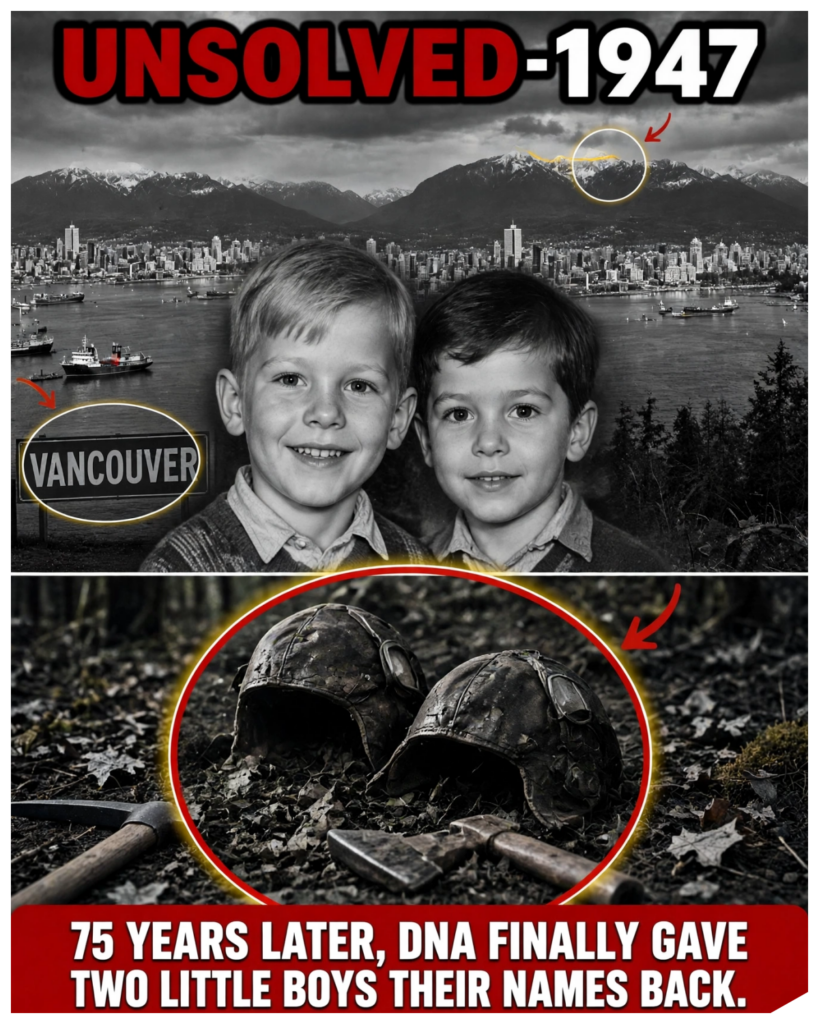
Under the leaves in Stanley Park, beside two small skeletons, [music] a groundskeeper found two leather flying helmets, children’s size.
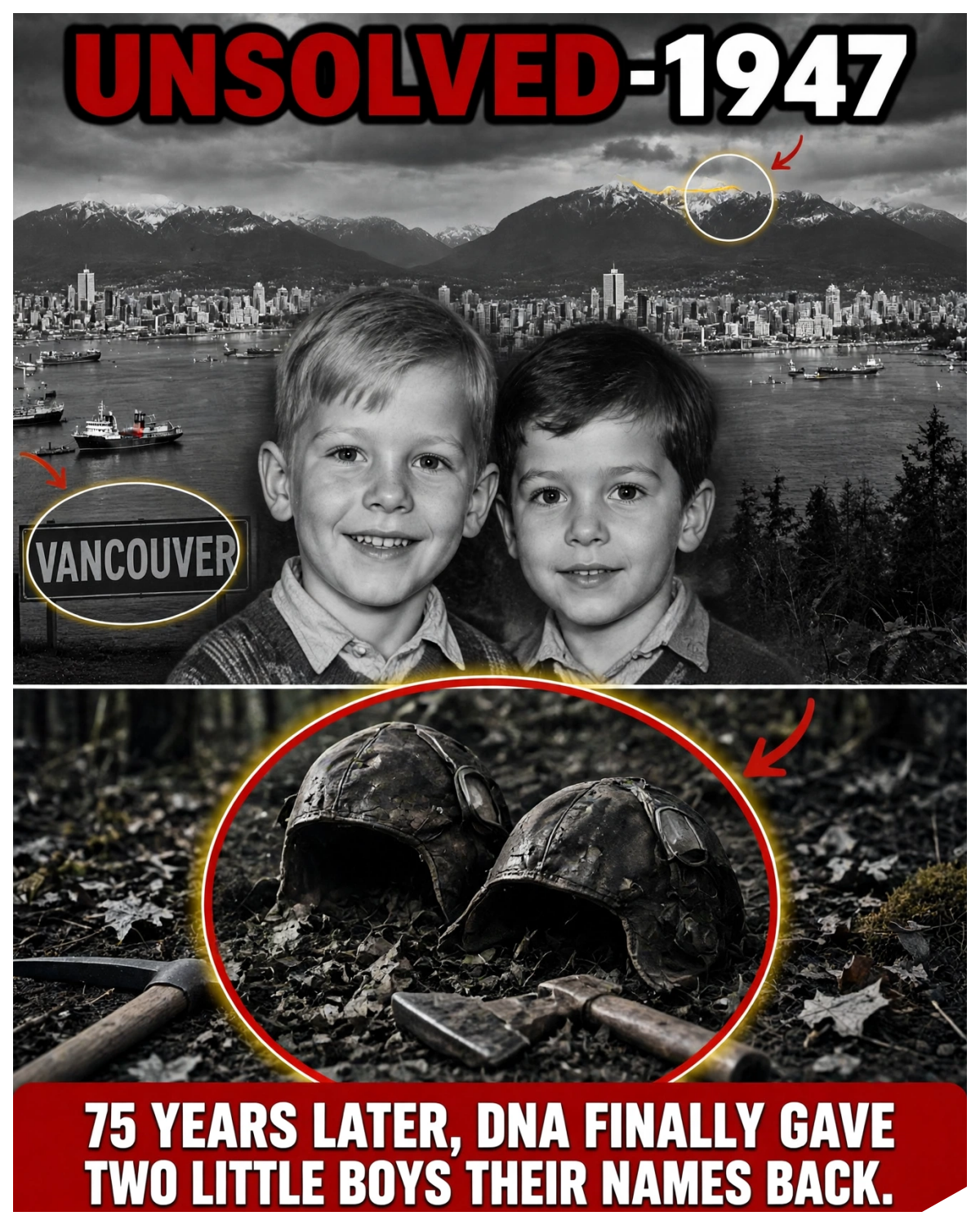
The kind of helmet a fighter pilot wore with the ear flaps and the chin [music] strap.
The kind a boy puts on to be somebody else for an afternoon.
There was more.
A woman’s fur coat laid over the bodies.
A lunchbox [music] with food still inside it, gone hard as stone.
A single woman’s shoe size 7 and 1/2 and a hatchet.
[music] That was January 14th, 1953.
The next day, a doctor came out to the site, looked at what was left of two children, and wrote down that one of them was a boy and one of them was a girl.
He was wrong.
Both of them were boys.
And that one sentence written at a scene in the wet by a man who was not a forensic pathologist would govern everything that happened next for 45 years.
Every tip, every school register, every appeal to the public.
All of it filtered through a brother and a sister who did not exist.
There are two clocks running in this story.
69 years from the morning a park worker stepped on a skull to the morning the Vancouver Police Department finally said these children’s names out loud.
And 75 years from the autumn they died.
This is not a story about who killed two little boys.
Nobody knows that the case is open and this video is not going to pretend otherwise.
This is the story of how a city lost two children completely, kept them nameless for most of a century, and what it finally took to give them back the only thing anyone could still give them.
And it starts long before the park.
If you are new here, this channel does one thing.
It takes cold cases apart properly all the way down to the paperwork.
Subscribe because the mistake you just watched somebody make is about to cost these two boys almost 70 years.
Now, Kitalano, 1940.
To understand how two children could vanish out of a Canadian city without a single person filing a report, you have to understand what Vancouver was like when the war [music] ended.
On January 26th, 1946, 35 veterans of the Second World War walked past the centuries at the Old Hotel Vancouver, a shuttered 600 room building downtown that was waiting for the wrecking ball, and they occupied it.
They had come home from Europe and found there was nowhere to live.
By 10:00 that night, there were a hundred people inside with their wives and their children.
The building was converted into a hostel and it housed somewhere between 1,00 and,200 people until 1948.
That [music] is what the housing market looked like for men the country had just given medals to.
Now consider a woman with three children and no husband on any document.
The first universal welfare check in Canadian history had started arriving in July of 1945.
The family allowance.
$5 a month for a child under six, $6 for a child between 6 and 9, $7 for a [music] child from 10 to 12.
That was the whole schedule.
Do the arithmetic for a mother with two small boys and a daughter, and then try to find a room in Vancouver [music] in 1947 for what is left over.
Her name was Eileen Bus.
She was born in Alberta and she was of both Matei and Russian heritage.
She had three children, all of them born in Vancouver.
And those children had at least two and possibly three different fathers, not one of whom has ever been identified.
Not by the police in 1953, not by the police in 1998, not by anybody working a genealogy database in 2020.
The oldest was Diane, born in July of 1937.
Then came Derek.
Derek Dalton was born on February 27th, 1940.
He was blonde with blue eyes.
There is a class photograph of him from Henry Hudson Elementary School in Kitalano taken around 1946 or 1947 and he is standing in the top row and he is smiling.
Then came David.
David Delton was born on June 24th, 1941.
He had dark hair and darker features, and he does not look much like his brother at all.
In the family album, he is usually the one being held.
All three of those children went to Henry Hudson Elementary in Kitalano.
Two of them are in the photographs.
One of them grew up.
Here is the detail that tells you the most about that household.
And it is not an inference or a guess.
It is a story the family handed down.
70 years later, Eileen’s great granddaughter Ally would repeat what she had been told about her great-g grandandmother’s poverty.
They used to climb out of the windows of the places they were renting so they would not have to pay because they were just that poor.
Sit with that as a routine.
Not once [music] in an emergency, a habit.
Three small children moving from room to room in a city that had no rooms in it going out the window.
And then sometime in 1947, two of those three names stop appearing anywhere at all.
No school record follows them.
No missing person’s report is filed.
No relative calls [music] a police station.
Diane keeps going to school.
She grows up.
She marries.
She has a daughter and eventually a granddaughter.
Her two little brothers simply [music] stop.
If you have just met two boys who nobody ever went looking for, hit the like button.
It costs you nothing [music] and it puts their names in front of people who have never heard them.
Now, 6 years later, a man clearing brush.
On January 14th, 1953, sometime during the day, a Vancouver Parks Board employee named Albert Tong was clearing brush in a remote corner of Stanley Park near Beaver Lake, well away from the seaw wall and the crowds.
He stepped on a patch of leaves and it made the wrong sound.
Something crunched.
He scraped the leaves back and found bone.
He went for help and investigators came out and began taking the site apart by hand.
Under the dirt and the leaves and the fallen branches, and under a decomposing woman’s fur coat, they found two children.
The bodies had been arranged, not dumped.
They were lying were lying in a straight line, the soles of their feet toward one another, their heads at opposite ends, and then they had been covered up.
Cause of death was blows to the head delivered with the hatchet that was lying [music] beside them.
That is the whole of what needs to be said about it, and it is the last time this [music] video will say it.
The rest of the scene is an inventory, and [music] every item in it matters.
The hatchet was a plain working tool of a pattern used by shingle weavers and by lathers, which is to say the sort of thing that hung in 10,000 sheds in British Columbia and could not be traced to anyone.
There was a lunchbox with food still in it, petrified.
There was a woman’s penny loafer, size 7 and 1/2, one shoe.
There were the remains of children’s clothing.
And this is the part to hold on to.
It was boys clothing, both sets of it.
And there were the two leather flying helmets, two of them children’s size, lying in the leaves with two children who had put them on to walk into a park.
Now, the forensics of 1953.
The bones and the artifacts were gathered up, put into cardboard boxes, and carried to the city morg.
Two photographs were taken of the scene, and the age of the scene, meaning the question of how long the bodies had been lying out there, was estimated by counting the layers of leaves that had fallen on top of them.
Roughly six layers meant roughly 6 years, [music] which put the murder somewhere around 1947.
That was the science that existed.
Nobody was cutting corners.
Today, a forensic botonist would give a far better answer.
And in 1953, there was simply not one to call.
What happened next is the strangest fact in this entire case, and it has nothing to do with police work.
The discovery was enormous [music] news.
Two murdered children in the most famous park in Western Canada.
[music] On the front page of every paper in the province, an entire city talking about nothing else for weeks.
And nobody came forward.
Not a parent, not a grandmother, not a neighbor, not a teacher, not a landlady.
Nobody stood up and said, “Those are mine.
Those are the two I have been looking for.”
No one had ever reported them missing.
No one ever would.
Because by the time the city started looking, the file already said something that was not true.
A doctor was called out to the site.
Not a forensic pathologist.
A doctor.
He examined what was left of two children and recorded his findings.
A boy roughly 5 to 7 years old and a [music] girl roughly 7 to 9.
He was doing his honest best and [music] it matters to explain why he was almost certain to be wrong.
Before DNA profiling, determining [music] the sex of a child from a skeleton was very close to guesswork.
The features a forensic anthropologist relies on.
The shape of the pelvis, the ridges [music] and angles of the skull do not develop until puberty.
Two 7-year-olds, one [music] male and one female, leave behind bones that look very nearly identical.
That doctor was not being careless.
He [music] was asked a question that the science of his era could not answer and he answered it anyway.
And then everybody built on top of [music] it.
A theory formed fast and hardened into fact.
A mother had taken her son and her daughter into Stanley Park for a picnic, killed them both with a [music] hatchet, and walked away unbburdened.
That was the story.
And when the police went to the public for help, they asked specifically [music] for anyone who had seen a woman in Stanley Park during 1947 with a young boy and a young girl.
Now, I want you to hold two things in your head at the same time.
[music] In the property room, in a cardboard box, sat the physical evidence from that scene.
Two sets of boys clothing and two boys flying helmets.
And on the paperwork, in the appeals, in the newspapers, and in the mind of every officer who touched this file for the next four and a half decades, there was a little girl.
Those helmets were never a mystery.
They were never a clue that needed decoding.
They were a plain statement of fact about who those children were, and they sat in a box in the same city for 45 years while the entire investigation looks straight past them.
There is one more thing worth flagging, and this seemed small at the time.
The murder year of 1947 came from counting leaves.
Decades later, the detective who reopened this case would say plainly that he thought that estimate might well be wrong, and that the boys might have been lying out there considerably longer.
A number produced by a man kneeling in wet foliage became [music] a fixed point on a timeline and every search from that day forward was anchored to it.
[music] So the hunt began and it was thorough and it was enormous and it was [music] aimed at two children who had never existed.
The scale of that effort is the thing that makes this case hurt.
Detectives went through thousands of school board records.
[music] They went through social services files.
They logged hundreds of tips.
They chased families across provinces and across borders.
And every single hour of that work was screened against a brother and a sister.
Which means that any call about two missing boys, any neighbor who half-remembered a woman with two little sons, any school clerk who noticed two boys’ names stop appearing on a register in 1947 went into the wrong pile or into no pile at all.
Then there is what happened to the children themselves.
And this is the part most retelling skip.
The remains stayed in the cardboard boxes they had been collected in.
Cardboard [music] is acidic.
Over the years, it ate into the evidence.
One of those boxes eventually made its way to the Vancouver Police Museum, where the bones of two murdered children were put on public display, and they were loaned out.
The skulls of a six-year-old and a 7-year-old went on exhibition [music] at the Pacific National Exhibition, the annual summer fair, where families go with their kids.
Sit with the shape of that.
In a case whose central and only real problem was that nobody knew who these children were, the children spent decades as an attraction.
And it was not only indignity, it was damage.
Because the remains were handled by so many people over so many years, the DNA inside them was contaminated.
When the technology finally arrived that could have named those boys in a matter of weeks, the material was compromised and the laboratory that tried it would have to try twice.
Then there is the mythology.
In 1953, a forensic anthropologist named Erna Engel Berstof produced likenesses of both children.
Reconstructions built up so that the public would have faces to recognize.
One of those faces was made as a girl because that is what the paperwork said.
The case picked up a name out of a fairy tale, The Babes in the Wood, and Stanley Park picked up a ghost story.
The story grew in the retelling the way these stories always do, and details attached themselves to it that had never appeared in any police report.
A woman seen running out of the bushes wailing with no coat and one shoe missing.
A picnic that no witness ever actually described.
Sightings that could not be fixed to any particular year.
By 2022, when the Vancouver Police Department finally stood up to make an announcement, the commanding officer of the major crime section chose to open with a warning about exactly that.
Significant folklore had surrounded the case for years, he said, and people needed to remember that these were real children.
And none of it, not one hour of the tips or the registers or the reconstructions or the televised reenactments was ever going to produce an answer because nobody who was questioned in this case had anything whatsoever to [music] do with it.
Meanwhile, two people who could have ended the entire thing in a single conversation were alive and living in British Columbia.
A sister who had been 10 years old in 1947 [music] and a mother who lived until 1996.
Neither of them was ever asked because nobody knew there was anybody to ask.
Then in 1996, the [music] case found the one person it needed.
Brian Honeyborn was born in 1947, [music] the same year the boys are believed to have died.
He grew up in Vancouver hearing the story the way every child in that city heard it.
That year he became the first detective sergeant sent from the Vancouver Police Department into the newly formed provincial unsolved homicide unit, a posting that came with an unusual privilege attached.
He was not carrying a case load of his own, so he could choose which files to work.
He chose this one.
His first step was to go and find the victims.
What he discovered was that they were in a display case.
He did not think that was appropriate.
So, in his own words, he went down there one day without any authority from any of his superiors, and he seized all of the remains.
He took them to Dr.
Davidu at the University of British Columbia’s Bureau of Legal Dentistry.
Wheat extracted DNA from the children’s teeth [music] and it came back with two facts that nobody working this case had ever had.
Both children were male.
They were brothers with the same mother and different fathers.
45 years of police work went in the bin in an afternoon.
[music] Honeyborn’s public assessment of that was about as flat as it could be.
Had they known at the time that they were both [music] boys, he said it might have made a world of difference.
He spent years chasing down what the correction had opened up.
A woman who had stayed at the New Haven Hotel with two boys and then disappeared.
A woman said to have been living with her father and two young sons near the lighthouse at Prospect Point.
A woman from Mission who hitchhiked into Stanley Park with two little boys.
And here is a detail that stays with you.
Those boys were wearing aviation helmets, too.
He ran every one of them to ground.
They all failed.
In several of them, the children turned out to be alive and well and middle-aged.
And then he did something that no procedure required of him.
He held the skulls back deliberately for a technology that did not exist yet.
And the rest of the remains he had cremated and buried at sea in a small ceremony with a police chaplain without telling his superiors about that either.
He gave two children he could not name a funeral if that landed the way it should have.
Hit like on this one.
[music] Now what he was waiting for took another 25 years to show up [music] and when it came it did not come from a police department at all.
The 1996 [music] profile was real and for the job that actually mattered, it was useless.
Here is the difference, and it is worth one paragraph because everything after this depends on it.
Traditional forensic DNA works like a fingerprint.
You pull a short profile off your evidence, you run it against a database of known offenders, [music] and you either get a match or you get nothing.
If your person is not in that database, the answer is nothing permanently.
Investigative genetic genealogy asks a completely different question.
Instead of a short profile built for onetoone comparison, [music] it reads hundreds of thousands of markers across the whole genome, [music] which is enough resolution to detect that two total strangers share a great [music] great grandparent.
You stop looking for your person.
You start looking for anybody at all who is related to your person.
And then you build the family tree downward until only one household is left standing.
None of that existed in 1996.
By 2018, it did.
And a Vancouver staff sergeant named Dale Weedman was publicly talking about putting the boys into consumer ancestry [music] databases.
In March of 2021, a Massachusetts firm called Red Grave Research [music] Forensic Services working for the Vancouver Police Department alongside the British Columbia Coroner [music] Service contacted the Paleo DNA Laboratory at Lakehead University in Thunder Bay, Ontario.
Lakehead’s lab specializes [music] in DNA that has been sitting out in the world for a very long time.
Their [music] previous work includes identifying a member of Franklin’s 1845 Arctic expedition [music] and the Titanic’s unknown child.
Red Grave sent them a tooth [music] and a piece of cranium from each boy and they deliberately sent no context at all.
The lab manager, [music] Steven Frat Pietro, was told only that it was a high-profile case and nothing else, so that nothing about the result could be [music] shaped by knowing whose bones these were.
The method, as he describes it, is brutally physical.
Sterilize the surface.
Crush the bone into powder.
Break the powder down chemically [music] until you are working with a solution.
Then isolate whatever DNA is still in there.
About a week’s work.
The first attempt failed.
[music] There was not enough material.
In August of 2021, Red Grave sent a larger piece of the older boy’s skull, and the second attempt worked.
Derek’s DNA went to a laboratory in Alabama for whole genome sequencing and the resulting file was uploaded to a public genealogy database called GED Match.
And this is where the case stops being a police story.
Because more than a year before any of that, back in 2020, a 26-year-old woman named Ally Brady had been turning the pages of a family photo album and found two little boys she had never heard of in her life, one blonde, one dark.
She asked her grandmother, Diane, who they were, and Diane told her they were her younger brothers, David and Derek.
When Alli’s mother Cindy pushed for more, Diane gave her the same two sentences she had been giving people for 70 years.
We don’t talk about that.
That’s in the past.
Diane had dementia by then.
Cindy took a swab from her anyway and sent it off to My Heritage.
Ally spat into a tube for 23 and me [music] and then uploaded herself to everything else she could find.
Ancestry, Ged Match, all of it.
She was hoping her great uncles were still alive somewhere.
Failing that, she was [music] hoping to find their children.
The detective, who would eventually make the phone call, summed up what that family had been up against in one [music] line.
Every time they asked, the only response they got was silence.
The absence of the boys was never discussed.
Red Graves team built the tree out from the DNA, and it resolved to the maternal grandparents of the older boy.
And from there down to one household in Kitalano.
And waiting at the far end of it, already searching, already asking, was Ally.
Earlier that February, a Vancouver homicide detective drove out to a suburb and knocked [music] on Cindy’s door.
February 15th, 2022.
Inspector Dale Weedman, commanding officer of the major crime section, and Detective Constable Ada Rodriguez, the lead investigator, released two names.
Derek Delton, born February 27th, 1940.
He was seven.
David Delton, born June 24th, 1941.
[music] He was six.
There was no stranger, no drifter, no maniac, loose in the park.
No monster out of the fairy tale the city had spent seven decades telling itself.
They were two brothers from Kitalano who went to Henry Hudson Elementary [music] School and one of their own relatives lived near the entrance to Stanley [music] Park.
They had a sister.
She was 10 years old when they died.
She grew up and married and had a daughter and a granddaughter and she kept their photographs in an album for the rest of her life.
And she never once said their names out loud.
Rodriguez was careful to say that the DNA match was the beginning of the work and not the end of it.
Locating family members, checking school records, confirming specific details until there was no possibility of error left.
And Weedman said something at that press conference that a lot of departments would not have said.
After seven decades, he said they had assumed the person who killed Derek and David was long dead.
At that stage, it was never about seeing anybody charged.
It was about giving these boys a name and finally telling their story.
Then the question the entire investigation had been built on.
The question that had organized 45 years of school registers and public appeals and reconstructed faces.
The question of who the little girl was finally got its answer.
There was never a little girl.
There were two brothers.
And from the second day onward, everyone had been searching for the wrong shape.
Identifying a victim is not the same thing as solving a murder.
And this is where an honest account has to slow down.
The Babes in the Woods case is unsolved.
It is still an open homicide file.
Nobody has ever been charged.
What the Vancouver Police Department has said publicly is that they believe the person responsible was probably a close relative of the boys, someone who died roughly 25 years before the announcement.
They declined to name that person.
This video is going to hold the same line because there is no conviction here.
No confession on any record, no charge, and [music] no official finding that identifies anybody.
What the family had always been told was that the boys had been [music] removed from the home by social services because their mother was too poor to keep them.
Detectives went looking for the records [music] of any such removal and could not find them.
That does not prove the story false.
It [music] means the paperwork that would settle it does not exist.
What the family says deserves to be heard in full.
Cindy does not believe it of her grandmother, [music] and she says so plainly.
She describes a gentle woman, a serious animal lover, somebody who babysat other people’s children.
[music] And she describes something else, which is harder to hear.
Her grandmother was very sad because something had happened, and Cindy never learned what it was because nobody in that family would talk about it.
The reporter who has worked this case longer than anyone outside the department has published her own objections and they are good ones.
Other relatives knew those boys existed.
Why did none of them help?
And where were the fathers, at least two men and possibly three, not one of whom has ever been identified?
Eileen Bus died in 1996 at the age of 78.
Whatever she knew, she took with her.
69 years of investigation produced two names and no answer.
It turns out that two names was the thing that mattered.
So, go back to the leaves.
This started with two leather flying helmets lying in a shallow depression in Stanley [music] Park.
For 69 years, those helmets were evidence.
They were an exhibit in a museum case.
For a while, they were part of an attraction at a summer [music] fair.
People looked at them and saw a puzzle.
They were never a puzzle.
In 1947, in a city full of men who had just come home from flying, [music] two small boys put on pilots helmets the way small boys do and walked into the biggest park they knew with a lunchbox.
That is all those helmets ever were.
Derek was 7 years old.
He was blonde.
He had blue eyes and there is a school photograph of him in the top row smiling.
David was six.
He had dark hair.
In almost every picture that survives of him, he is being held by his big sister.
They lived in Kitalano.
[music] They went to Henry Hudson Elementary.
Their mother was poor enough that [music] leaving through a window was a normal way to leave a house.
And they had a sister named Diane who loved them enough to keep their photographs for 70 years [snorts] and who could never bring herself to say why she had them.
Their great niece, the one who found them in that album and went [music] looking, put it about as well as it can be put.
It came to a devastating resolution.
But at least now they know what happened.
Their names are Derek Delton and David Delton, [music] and they deserve to be remembered for who they were, not just how their stories ended.
If this one stayed with you, subscribe and [music] send it to somebody.
This case was not cracked by a task force.
It was cracked by a young woman with a photo album and a saliva kit.
There are others out there exactly like it.
We will find them here.


