Of it.
But the pews at Olive Branch Church were full that Sunday morning.
The pulpit was empty.
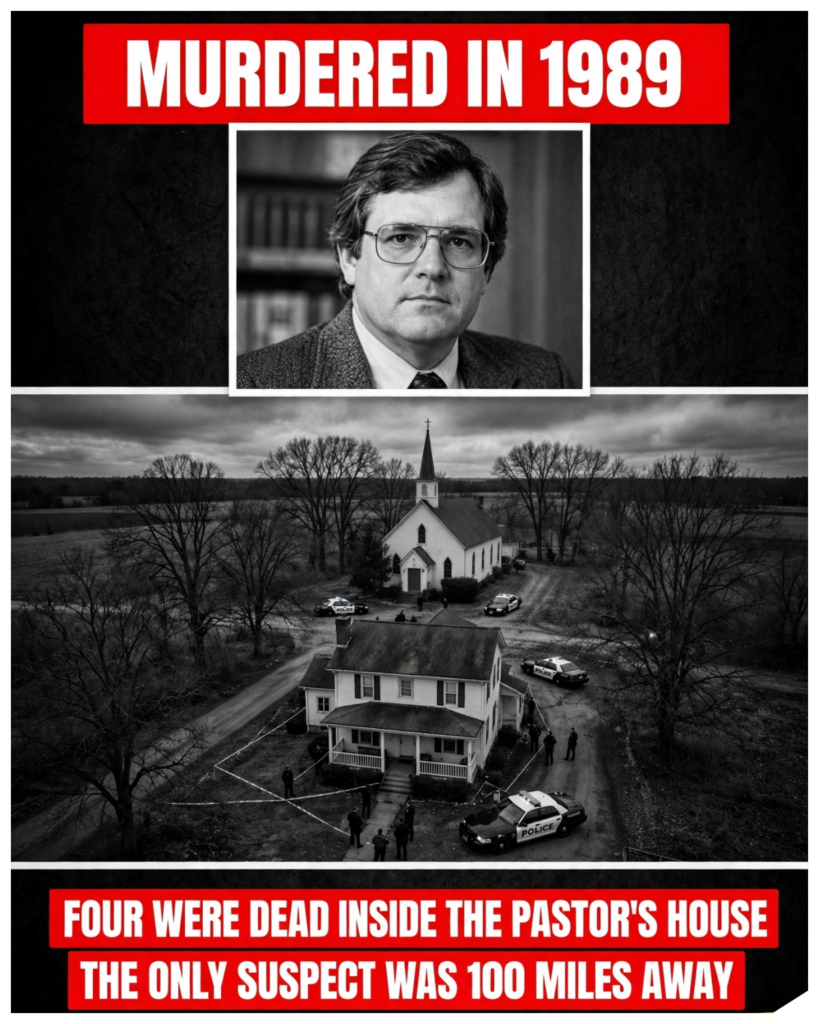
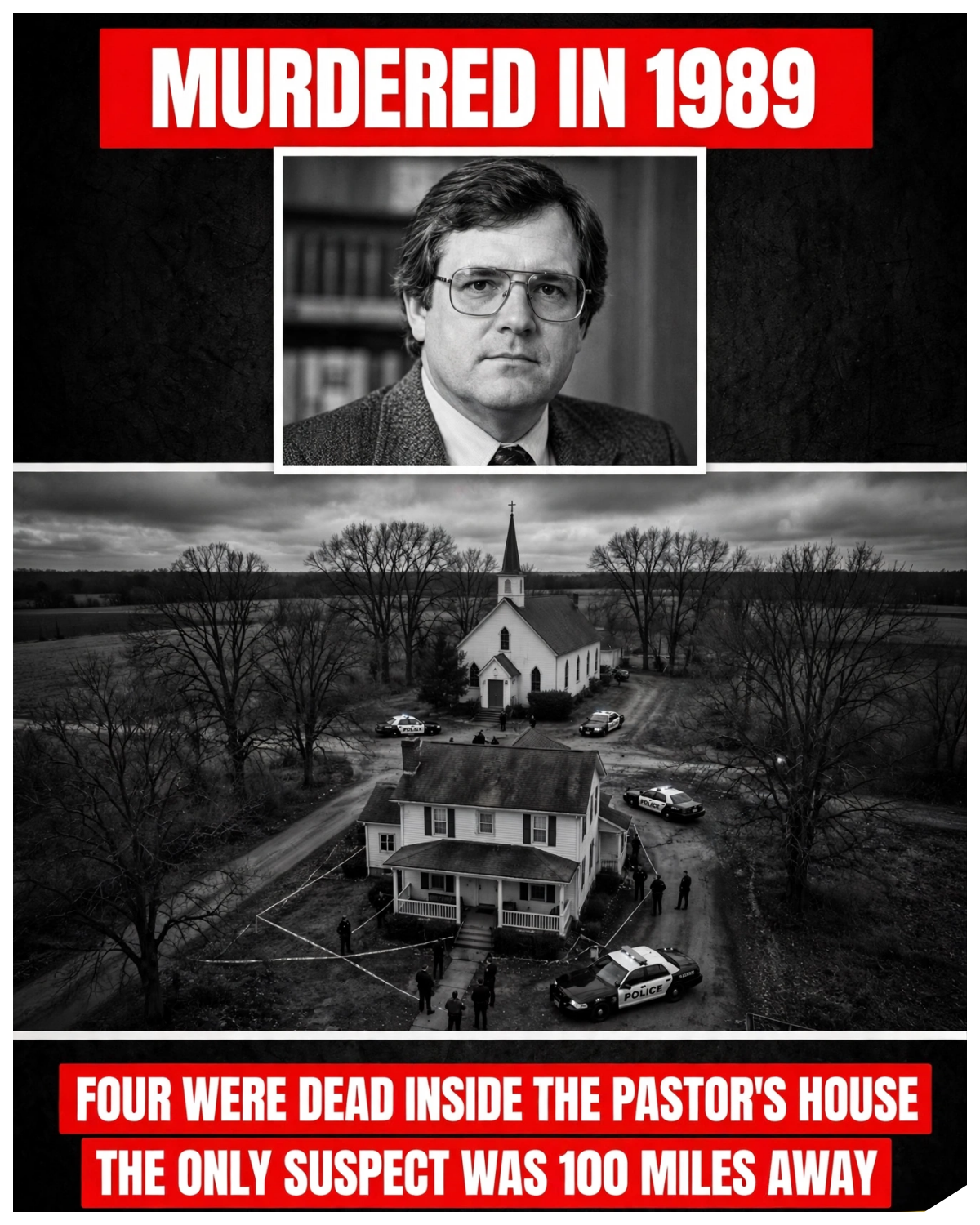
It was April 30th, 1989 in Lakeville, Indiana, a farm town of a few hundred people south of South Bend, the kind of place where the pastor’s house sits right beside the church and nobody needs to knock.
Reverend Bob P did not miss services.
So when the hour came and went with no Bob, no dawn, no two little girls in their Sunday dresses, the congregation did what small towns do.
They sent someone to check.
Will Tisdale, a church elder, walked across the grass to the parsonage.
The curtains were drawn.
Every door was locked.
In Lakeville in 1989, that alone was wrong.
He found the spare key and let himself in through a side door.
What he saw in the upstairs hallway, he would describe in a courtroom 17 years later.
What he saw at the foot of the basement stairs, he could only bring himself to look at for two or three steps.
Then he went to the phone and dialed 911.
By that afternoon, the question had already formed.
The one that would hang over this town through full presidencies, through a trial, through an appeal that overturned everything, and a high court that put it all back.
Four people were dead inside a locked house.
There was no weapon.
There was no witness.
There was no forensic evidence at all.
And the one person detectives believed could have been there in the 20 minutes that mattered was at that very moment 100 miles away at an amusement park in Illinois, finishing the best night of his senior year.
But to understand how a prom night became the longest running murder case in northern Indiana, you first have to understand who the pellies were and why a whole town trusted them.
Likeville in the spring of 1989 was the kind of place the rest of the country was already forgetting existed.
Ronald Reagan had left office 3 months earlier.
The VHS tape was king.
Every kitchen had an answering machine with a blinking red light and compact discs were still new enough that a teenager might cover a stack of them more than almost anything else.
US31 ran past the edge of town towards South Bend, past fields that smelled of turd earth and the first cut of hay.
Screen doors, church suppers, everyone knew whose truck was parked where.
Ov branch church stood at the heart of it and next door stood the parsonage, a modest two-story house with a basement where the youngest children slept.
The Pellies had come north from Florida a few years before.
Bob P had worked in banking down there before he answered a different kind of calling and by 1989 he was a pastor not yet 40 with a congregation that had taken him in as one of their own.
His family was a blunted one.
Bob brought two children into the marriage.
His son Jeff, 17, a senior at Lavell High School, and his daughter Jack, 14.
Dawn daughter three daughters, Jessica, nine, Janelle, 8, and Jolene, six.
Five children under one roof.
Three of them small girls who filled a house with the kind of noise that makes a parsonage feel like a home.
And there was a detail that said more about Bob than any sermon could.
On the Saturday of the Lavil Prom, the teenagers of Lakeville didn’t just go to their own parents to be admired.
They drove to the parsonage.
They wanted to show Pastor Bob the dress.
They wanted him to see the rented tux.
Prosecutors would later describe the house that afternoon as buzzing, a steady stream of kids in and out, posing for pictures.
That was the standing Bob P had in that town.
He was the adult the kids wanted to impress, which made what was happening inside his own house that spring all the more painful.
A few weeks before prom, Jeff had been caught stealing compact discs and some cash from Naida’s home.
The Indiana State police detective who handled that small town Duggler was a man named Mark Center and he would carry the name P for the rest of his career.
Bob did what a father in 1989 did.
He grounded his son hard.
Jeff could still attend the prom itself, but only if his father drove him there.
No dinner out beforehand.
No afterprom trip to Great America, the amusement park north of Chicago that every senior had been talking about for months.
For a 17-year-old with a girlfriend named Darla Adams and the Saturday night he’d been looking forward to all year.
It was the end of the world.
For Bob, it was discipline, and discipline was love.
By late afternoon on April 29th, the last of the prom kids were pulling out of the driveway.
The pictures were taken.
The house went to nobody who left that afternoon had any idea was the last time they’d see the Pelly’s alive.
Saturday, April 29th, 1989.
Court records lay the afternoon out almost minuteby minute because in the end the minutes were all anyone had through the early afternoon the parsonage was crowded with teenagers and cameras somewhere around 4:45 the last of those visitors left of a Bob and Dawn had plans of their own they were expected at the home of Crystal Easter Day a friend of the family to admire her prom dress before the evening began at roughly 5:00 Jeff Pley was at an AMO station in Lakeville in his own car asking to borrow a screwdriver because the engine was idling too high.
An employee helped him.
He drove off.
At 5:30, Bob and Dawn P did not arrive at the Easter Day home.
Records would later mark this as the first sign anything was wrong.
Nobody thought much of it.
Pastors run late.
Also, around 5:30, Jeff pulled up at a friend’s house where Dala and another couple were waiting.
He changed into his tuxedo.
He posed for pictures.
The two couples left for dinner, then the dance, then in defiance of everything his father had ordered, the overnight trip to Great America.
Back in Lakeville, as the evening went on, anyone who came by the parsonage found the same thing.
The curtains were drawn, the doors were locked, Jeff’s car was gone from the driveway.
They left.
The house sat like that all night.
Sunday morning.
The pews filled, the pulpit stayed empty.
Wield Tigsdale crossed the yard with the spare key.
Bob P was in the upstairs hallway.
Dawn, Janelle, and Jolene were at the foot of the basement stairs near the girl’s room.
All four had been shot at close range with a shotgun.
Tidsdale went two or three steps down.
That was enough.
He called it in.
Detective Mark Center of the Indiana State Police was one of the first investigators through the door.
Decades later, talking to CBS News, he would say that no one should have had to see what he saw that morning.
Then he did his job.
The job started with what wasn’t there.
In the family’s gun rack, a 20 gauge shotgun was missing.
It has never been found.
The doors had been locked.
The curtains had been pulled shut, which neighbors insisted the pellies never did.
And Bod’s body lay in a spot that to the detective’s eyes meant the shooter had come at him from a bedroom.
A room you couldn’t reach from outside the house.
Not a burglary, not a home invasion.
Someone who belonged there.
One more thing.
In the laundry area, there were clothes in the washing machine.
Investigators noted it and moved on.
17 years later, that washing machine would be argued over in a courtroom, and it would still be argued over 30 years after that.
Center was joined by Detective John Bish of the St.
Joseph County Police and the two of them began where every investigator begins with the people who weren’t home.
Three P children had survived by the accident of a weekend.
Ji, 14, was out of town.
Jessica, nine, had slept over at a nearby friend’s house, and Jeff was at Great America.
Illinois police found him there on Sunday in the middle of his after prom trip and held him until officers from Indiana arrived.
Jesus and Jessica’s alibis were checked and cleared quickly.
Jess was not so simple.
On May 1st, 1989, 2 days after the murders, investigators sat Jakey P down in front of a video camera.
He told them he’d left the house in the late afternoon, stopped at the gas station, gone to his friend’s house, gone to prom.
Dala would later tell ABC News that he’d mentioned a strange feeling that night, a sense that something bad had happened at home.
He denied having anything to do with it.
And here was the problem that would define the next 13 years.
The timeline was damning.
The evidence was nearly empty.
Damning.
Because the last visitors left around 4:45, Jeff was at the AMO around 5:00, and by 5:30, the house was locked and dark with his car gone.
Prosecutors would eventually argue the killings had to have happened between 5:00 and 5:20.
A window so small it fit only one person.
Jeff had motive.
Jeff had been grounded.
Jeff had been told his father would drive him to the dance.
And instead Jeff drove himself.
Empty because there was no weapon, no usable prints, no blood on Jeff, no blood in his car, no witness who saw or heard a thing.
Investigators sprayed the washing machine with Luminol, the chemical that glows in the presence of blood.
The result was inconclusive.
It could have been blood or it could have been the phosphates in 1989 laundry detergent.
Botic would later put it plainly, circumstantial evidence and a timeline and nothing else.
A very tough case to prove.
There was also a second thread and the detectives knew it.
Bob P had come to Indiana from a banking job in Florida, and there were questions about why he’d left.
A local saleswoman would tell investigators that in the days before the murders, Bob had spoken to her about a past connected to organized crime and a fear that it would come for his family.
Whether that was a frightened man’s warning or a stranger’s story, nobody ever ran it to ground.
It sat in the file.
The St.
Joseph County prosecutor’s office looked at what center and Botic had and made a decision.
No charges of amp Py 17 was free to go.
His father, his stepmother, and two little steps sisters were buried, and the three surviving children were scattered to relatives.
One of them years later would describe going away for a weekend and coming back to no family and no home.
Jeff went south to Florida.
The parsonage was cleaned.
Olive Branch Church found a new pastor and the town of Lakeville was left with the worst kind of silence.
The kind where everyone has already decided what happened and no one can prove it.
The years did what years do.
By 1992, 3 years had passed.
The police tape was long gone and the parsonage had a new family in it.
By 1995, Jeff P was in his 20s, building a life in Florida that looked from the outside entirely normal.
He married.
He had a son.
He became a computer consultant, good enough at it, to travel for work.
By 1999, a full decade had gone by.
Jessica, the 9-year-old who’d been at a sleepover, was now a young woman carrying a loss she had never been allowed to grow out of.
Jack had grown up, too.
Each sister holding the question in her own way.
The Lakeville kids who had posed for prom pictures in Bob’s yard were parents themselves now.
And when the subject came up at the diner or after church, it still came up in a whisper.
Mark Center and John Boage never closed the file.
That is not a figure of speech.
The case stayed open and both men kept turning it over.
The gun rack, the locked doors, the 20 minutes, as other cases came and went and their own hair went gray.
Potage would say years later that it was a very tough case to prosecute and he said it like a man who had spent a long time wishing it weren’t.
Every April 29th, the anniversary passed.
The congregation at Olive Branch remembered the pellies.
Somewhere, a shotgun that had never been found stayed never found.
And there was something quietly agonizing about this particular cold case that separates it from most of the stories on this channel.
There was no unknown stranger to hunt.
There was no DNA waiting in an evidence locker for a technology that hadn’t been invented yet.
The detectives believed they already knew who did it.
The only thing missing was a prosecutor willing to stand up in front of 12 people and say so.
Every case on this channel represents weeks of digging through court records, news archives, and interviews trying to do right by people who deserved better.
If you want us to keep uncovering the truth behind stories like this one, take a second to like this video, subscribe, and tell us in the comments where in the world you’re watching from.
Now, let’s get back to the Pellies.
Because in 2002, something changed in St.
Joseph County that had nothing to do with new evidence and everything to do with who was reading the file.
A new prosecutor had taken over the county office.
He pulled the P file, 13 years old by then, a box of reports, a videotape of a 17-year-old’s interview, crime scene photographs showing Bob Py’s glasses lying on the hallway floor.
And he read it the way a stranger reads it, not with the memory of what couldn’t be proved in 1989, with the eyes of someone deciding whether a jury in 2002 could be convinced.
He decided they could.
Here is the one piece of law you need to understand in plain language.
In Indiana, as in most states, there is no statute of limitations on murder.
A prosecutor can bring a charge the day after a killing or 13 years later or 50.
Nothing in the evidence had changed.
What had changed was the willingness to use it.
In the summer of 2002, Jeff P, now in his early 30s, a husband, a father, a professional, was passing through Los Angeles International Airport on his way home from a business trip.
He walked into a terminal full of ordinary travelers and officers were waiting for him.
He was arrested on four counts of murder on a charge from a town he had not lived in for more than a decade for a crime he had always said he didn’t commit.
In Lakeville, the phone calls went around the way they had in 1989.
Mark center heard.
John Boic heard.
For the people who had spent 13 years believing what the detectives believed, it felt like a door that had been painted shut was finally being pried open.
For the people who believed Jeff, it felt like a nightmare restarting.
And then, because this is a story about time as much as anything, the case stalled again.
Before trial, prosecutors wanted access to records from counseling the family received before the murders.
The defense fought it.
The question went up to the Indiana Court of Appeals as a midcase appeal.
And while the appeals court considered it, everything stopped.
The order was certified for appeal in April of 2003, the decision didn’t come down until June of 2005, more than 800 days, with Jeff P sitting in jail the entire time.
Of it.
By the time the case was finally set for trial, 1,430 days had passed since his arrest.
Nearly four years, his lawyers argued that his right to a speedy trial had been destroyed.
The trial court said no.
The case went forward.
The courtroom in South Bend was going to hear at last the 20 minutes that had haunted Lakeville for 17 years.
Summer 2006.
Frank Schffer, a deputy prosecutor for St.
Joseph County stood in front of a jury and built his case out of the only material he had.
The clock, he called the prom kids.
The ones who had posed in Bob’s yard were pushing 40 now, and one after another they testified to when they arrived at the parsonage that Saturday, and when they left, Schffer stitched their memories into a timeline.
Traffic in and out until roughly 5:00, then nothing.
Then a locked dart house by 5:30 with Jeff’s car gone.
The house, as he described it to the jury was shut up tight, and the only person who could have been inside it during that window, he said, was the defendant.
He laid out the gun rack with its empty slot, the 20 gauge that was never recovered.
The position of Bob’s body, which the state said showed the shooter had come from inside the home, from a bedroom no intruder could have reached.
The curtains, the pellies never closed.
Closed.
And the washing machine where prosecutors told the jury a pair of blue jeans had been found washed.
Jeans, the state argued Jeff had worn during the murders and thrown into the wash before he left for prom.
And he laid out the motive, which was the simplest thing in the room.
A teenager, humiliated, grounded, told his father would be driving him to his senior prom like a child.
A father who said no.
An argument, a shotgun.
And then the state argued three witnesses in the basement who could not be allowed to live.
Jeff’s defense attorney, Alan Balm, attacked all of it.
No forensic evidence tied Jeff to the scene.
Not then, not in the 17 years since, despite every effort.
No weapon, no blood.
Every friend who had been with Jeff that night described him as just one of the group laughing, having a good time.
Balm put the question to the jury directly.
Could a 17-year-old kill his family and then spend an entire evening having fun with his friends as if nothing had happened?
He called the idea preposterous.
The jury listened, then they went out.
When they came back, the verdict was guilty.
Four counts of murder.
In October of 2006, Jeff Deli was sent to the Indiana State Prison to begin a sentence of 160 years, 40 years for each life.
He was in his mid30s.
He maintained his innocence as he was led away, and he has maintained it every day since.
For the detectives, it was the end of a 17-year wait.
For the town of Lakeville, it was the closing of a door that had stood open since the spring of 1989.
For the surviving sisters, it was something far more complicated.
Because when the state says your brother killed your parents, there is no version of the verdict that gives you your family back.
The story might have ended there.
It didn’t.
In April of 2008, the Indiana Court of Appeals reversed the convictions two judges to one, ruling that the 1430day delay had violated Jeff’s right to a speedy trial and that his motion to dismiss should have been granted.
For a few months, the prom night murders were legally unsolved again.
Then the state appealed.
In February of 2009, the Indiana Supreme Court overturned the lower court, found the evidence sufficient, and reinstated every one of the four convictions.
Jeff P went back to the prison he had never actually left.
Picture Bob P on the afternoon of April 29th, 1989, standing in the yard of a small parsonage beside a small church in a small Indiana town while car after car pulls in and teenagers in rented tuxedos and borrowed heels climb out could be told they look wonderful.
He tells them he means it.
A camera clicks.
There are two little girls underfoot who think the dresses are the most beautiful things they’ve ever seen.
That is the P family at its best and it is the version worth keeping for Jessica P who goes by Jesse Toronto now the night of the sleepover never really ended.
She has spent her adult life as the sibling left to pick up the pieces and she has told that story on national television.
The case became a 48 hours investigation called Murder on Prom Night, which CBS was still reairing in the summer of 2025, 36 years after the murders.
And the fight over Jeff Py’s guilt has never stopped.
In December of 2019, his new attorneys, including a law professor who runs a wrongful conviction clinic at Indiana University, filed a petition for postconviction relief.
However, they argued his original lawyers had failed to chase leads that might have cleared him, including the Florida banking past and a file the FBI had kept on Bob P and that the jury had been told the genes in the washer were washed when the condition of those jeans was at best in dispute.
According to the familyrun site that advocates for him, both surviving sisters, have testified that Jeff had in fact been allowed to go to prom and the afterprom that weekend, the opposite of the motive the state presented.
A week-long hearing was held in 2022.
On April 28th, 2024, one day before the 35th anniversary of the murders, Judge Stephanie Steel denied the petition in a 91page order.
In August of 2025, the Indiana Court of Appeals affirmed.
In November of 2025, the Indiana Supreme Court declined to take the case.
And in April of 2026, his supporters, led by one of his own surviving sisters, filed a petition for a writ of habius corpus in federal court, taking the case out of Indiana’s hands for the first time.
So, here is what a jury of 12 decided, what the Indiana Supreme Court upheld, and what the state of Indiana has defended through every court it has.
That on a spring Saturday in 1989, a 17-year-old killed his family over a prom and went to the dance.
And here is what has also been true for 37 years.
That there has never been a weapon, a fingerprint, a drop of DNA, or a single witness to say so.
Most cold cases on this channel end with science.
This one ended with a clock and with a prosecutor’s decision to trust it.
Maybe that is justice.
Maybe justice is simply what we call the last verdict standing.
12 people believed the timeline.
One of the sisters who lost her parents that night has spent years fighting to free the brother convicted of it.
And four people who were loved by an entire town have been gone for longer than any of the two little girls were alive.
So, we’ll leave it with you.
Do you believe 20 minutes and a motive are enough to convict without a single piece of physical evidence?
What detail in this case unsettles you most?
The locked doors, the missing shotgun, the washing machine, or the 13 years it took to charge anyone at all.
And what does it say about the system that a case can be reversed, reinstated, and still be argued in federal court nearly four decades on?
Justice of one kind came for the P family after 17 years.
Whether it was the right kind is a question Indiana is still answering.
Stories like this are why this channel exists.
If you believe the truth is worth pursuing, no matter how long it takes, subscribe so you don’t miss the next case.
More solved cold cases are waiting in the description below.
Thank you for watching.


