60 meters up the south face of the most famous rock in America.
There is a column of stone that is not attached to anything.
It is 8 m long.
It weighs about 37 tons, roughly a loaded semi-trail.
It simply leans, propped against the tower like a plank against a shed wall, touching its neighbor at a single point near the top.
For as long as anyone had kept records, it never moved.
Then in June of 2005, climbers on the most popular route to the summit began reporting something that made the rangers go very quiet.
When they shifted their weight on top of it, the column rocked.
The United States Geological Survey sent two geologists up the wall to check.
They confirmed it.
37 tons of stone swinging back and forth about 5 mm twice every second.
And then they did something to the rock beneath it that sounds almost childish.
I’ll come back to what and why because that column turned out to be the first clue that this rock is not what the postcards say.
19 years later, in October 2024, two climbers hauled a seismometer up the same tower.
They set it on the bare summit with a dab of putty under each foot.
Then they put a bucket over it to keep the wind off and left it there for 21 hours.
When the results were published this year, they did not just describe what the tower is doing.
They described how it holds itself together.
And the answer is not the one you would guess from looking at it.
By the end of this, you’ll know what Devil’s Tower actually is, as far as anyone can honestly say.
You’ll know why one of its oldest names calls it a tree, why the ground around it leans the wrong way, and why a row of mountains an hour north of Brisbane is caught in the very same argument.
Start with the size because photographs lie about it.
The tower rises about 265 m from its base.
That is taller than the Rialto in Melbourne.
But it is not a needle.
It is roughly as wide as it is tall.
A blunt gray drum of rock standing alone above the pine forests of northeastern Wyoming, visible from enormous distances across the plains.
In 1906, Theodore Roosevelt made it the first national monument in the United States.
In 1977, Steven Spielberg landed a mother ship on it in Close Encounters of the Third Kind, and it has never fully escaped that film.
Today, around half a million people a year come to look at it, and most of them will tell you the same thing.
It’s an old volcano.
The hardened plug left inside a mountain that wore away.
That explanation is everywhere on signs, in textbooks, in the way people talk at the trail head.
The honest geological answer is harder to print on a postcard.
The honest answer is that after more than a century of study, nobody has proven how it formed.
And the reason why is the best part of this story.
Here is a small crack to begin with.
Everyone describes the towers columns as hexagons, six sides, like a honeycomb.
An early National Park Service guide said the columns are mostly fivesided.
A 2006 Geological Survey report said most are six-sided with some four or five.
Two government documents.
The most visible feature of the most visited rock in the region, and they can’t agree on how many sides it has.
That same old guide described the columns as bunched together like a bundle of matches.
Keep that image.
It turns out to matter far more than the writer could have known.
Now, the theory you have probably seen online, of everything people say about this place, nothing gets more nods than the idea that it’s the stump of a petrified tree, a giant one from some lost age turned to stone.
So, let’s take it seriously for a moment.
When wood petrifies, minerals replace it cell by cell.
The structure survives.
Growth rings survive.
Grain survives.
Break open a piece of Devil’s Tower and you find none of that.
You find pale crystals of felspar, some longer than a centimeter and a half, floating in a fine olive gray rock called phonolyte pfery.
Crystals like that only grow when molten rock cools slowly, deep and undisturbed.
No tree has ever made them.
The idea fails on the rock itself.
But here is what stays with me.
The strangest thing about the tree theory isn’t that it’s wrong.
It’s how old it is.
Remember that.
Because before we get to the science, you need to understand who has actually stood on top of this thing and what they found there.
On the 4th of July 1893, roughly a thousand people gathered at the base to watch two local ranchers, William Rogers and Willard Ripley, attempt the first ascent.
They had spent weeks hammering wooden pegs into a vertical crack and nailing boards across them.
A ladder more than 100 m long.
Rogers climbed it in about an hour.
At the top, he raised the American flag on a pole that was already waiting for him, which tells you the first ascent was not quite the first ascent.
Two years later, his wife Linny used the same ladder to become the first woman on the summit.
Pieces of it are still pinned to the rock today.
Then came October 1941.
A professional parachutist named George Hopkins jumped from a plane without permission to win a $50 bet.
He landed perfectly on the summit.
His rope did not.
It fell onto a ledge out of reach.
He was stuck.
Planes dropped him food, blankets, and supplies.
A newspaper hired a Goodyear blimp to pluck him off, which never arrived.
Over six days, some 7,000 people drove out to stare up at him.
Finally, a climber named Jack Durrence, one of the men who had pioneered the main route up the tower, led a team to the top and brought him down.
Hopkins came off that summit having gained weight.
Asked what he did up there all week.
He said he counted the boulders over and over and gave them all names he couldn’t repeat.
He was looking down at the most important evidence on the site.
The tower stands on a field of broken columns.
Some pieces are the size of fridges.
Some are as long as a school bus.
Every one of them was once part of the tower.
And yet, according to the park service, no one in recorded history has ever seen a massive column fall.
The last large chunk came down more than a century ago, which is why that leaning column on the south face matters.
[snorts] When the two geologists climbed up in 2005, they found the problem at its base.
The column rests on the sharp edge of the column below, like a heavy box balanced on the corner of a table.
Right along that line of contact, there was a patch of fresh, unweathered rock.
A flake had recently broken away under the strain.
Hairline cracks ran down from it.
So, here is the childish sounding thing they did.
They spray painted it.
They coated the supporting rock in paint so that if another flake ever broke off, the bare stone underneath would show.
A simple way to make a slow failure visible.
Their report is calm.
The column might stay where it is for years, even for hundreds of years.
But if it does fall, it will break into three pieces and hit the boulder field at speeds their report put at up to 120 km an hour.
I could find no published report that it has come down.
What the column proved is that this tower is not finished.
It is still shedding, still settling, still answering forces you cannot see.
What nobody knew back then was whether the whole tower was doing the same.
To understand why that question matters, you need to know how badly the experts have disagreed about what this rock even is.
In 1888, a geologist named Franklin Carpenter called it the neck of an extinct volcano.
In 1907, Nelson Dartton and Cleopus O’Hara argued for a lacalith, a blister of magma that pushed up underground and domed the rock layers above it without ever breaking the surface.
Others called it a stock, a plain plug of magma that cooled underground with no dramatic shape at all.
Three labels for one rock.
Then in 1956, the Geological Survey published a bulletin by Charles Robinson, who had walked the layers of red and gray sedimentary rock around the tower and measured how they lie.
Buried in it is one dry sentence.
Within about 6 to 900 m of the tower, the layers dip 3 to 5° toward it.
Farther out, they dip away toward it.
If Devil’s Tower were a lacalith, the magma should have shoved those layers upward.
They should tilt up and away from the center like a tablecloth draped over a fist.
Close to the tower, the ground does the opposite.
It sags inward.
As if a very long time ago, something beneath it gave way.
Robinson didn’t reach for anything exotic, he concluded that the body of magma was probably never much larger than the tower is today.
But that inward lean sat in his report for decades, waiting for an explanation that fit.
And this is where Australians should start paying close attention.
An hour north of Brisbane, the Glass House Mountains rise straight out of the Sunshine Coast Hinterland.
Beerwir Tyroaren.
Kunawin with its crooked neck.
Ask most Queenslanders what they are and you’ll hear two words.
Volcanic plugs.
Some of them even carry the same signature as Devil’s Tower.
Vertical columns of cooled rock, most famously the organ pipes on Berwire.
But read the Queensland Park’s wording closely.
It says molten rock filled small vents or intruded as bodies beneath the surface.
Vents or bodies beneath the surface.
That is not a minor detail.
That is the Devil’s Tower argument written quietly into an Australian park description.
Did the magma reach the open air or did it cool underground and never see the sky?
And the Glass House Mountains share another trait with their American cousin.
They fall apart.
Kunarin was closed to climbers in 1999 after a geological report.
The main track on Berwis closed in 2009 after a rock collapse across the path and stayed shut until 2016.
Columns crack, crusts loosen.
Nothing about these mountains is as permanent as it looks.
There is one more difference worth knowing.
The Glass House Mountains are around 25 to 27 million years old.
Devil’s Tower is almost twice that.
Though for a long time, the official age was wrong.
For decades, most books gave the tower an age of about 40 million years from a dating method that was sound for its era and blunt by modern standards.
In 2002, researchers presented results from a far sharper technique, measuring argon in individual crystals.
The answer was about 49 million years.
The catch is that this result appeared as a conference abstract, not a full journal paper.
So for years, the old number and the new one circulated side by side, sometimes from the same agency.
Today, the newer figure is the one the Geological Survey sites.
Put that number in Australian terms.
When this magma cooled, Australia was still joined to Antarctica.
The ocean between them hadn’t fully opened.
And yet, the tower itself has only been standing in the open for a sliver of that time.
The softer rock around it was stripped away within roughly the last 10 million years, most of it in the last 3 million.
Which means the evidence of how it formed was being washed down the Bell Forch River long before any human arrived to ask.
But people did arrive and long before any geologists measured a dip angle, they had already explained this rock.
The Lakota call it Matau Topila, Bear Lodge.
More than 20 tribes hold it sacred, and nearly all of their names for it involve a bear.
The best known stories tell of children chased by an enormous bear.
The rock rises beneath them, lifting them out of reach.
The bear claws at the sides as it tries to climb, leaving the long vertical grooves you can see today.
The children become stars.
Now, here is the Kaiwa version as told by the Kaiwa writer N.
Scott Mday who won the Pulit surprise in 1969.
In his telling, a boy turns into a bear and chases his seven sisters.
The girls come to the stump of a great tree.
The tree speaks to them and tells them to climb on.
The tree rises into the sky.
The bear reaches up and scores the bark all around with its claws.
The sisters become the stars of the big dipper.
The Kaiwa name for this place is soy.
It means rock tree.
Made was taken there as a baby of six months and given his name Soy Tali.
Rock tree boy.
He carried it his entire life.
So, the most popular theory on the internet, the petrified tree stump, is geologically wrong.
But people typing it into comment sections are without knowing it, retelling a story that is centuries old.
They’re looking at a rock and seeing the same tree the Kya saw.
So, how does a bear’s lodge become a devil’s tower?
In 1875, Colonel Richard Irving Dodge commanded the military escort for a government survey into the Black Hills, land that the 1868 treaty had promised to the Lakota.
Dodge wrote that the local name translated as bad god’s tower.
He shortened it to devil’s tower in print.
When Roosevelt’s proclamation was issued in 1906, the apostrophe went missing.
That is why the official name still has none.
Maps from the 1800s already show Bear Lodge.
Tribal leaders have pushed to restore that name for decades.
In June 2024, a federal advisory committee met in Rapid City and recommended the Secretary of the Interior rename the feature Bear Lodge, noting that more than 20 tribes find the current name offensive.
In February 2025, that committee was terminated.
Supporters of the current name argue it is more than a century old, tied to local identity and the tourism economy of a small county.
Opponents argue it began as a mistake and was never theirs to give.
The sign at the entrance hasn’t changed.
What has changed is how people climb it.
Since 1995, the Park Service has asked climbers to voluntarily stay off the tower every June, a month of ceremony for many tribes.
Climbers who objected took the policy to a federal appeals court.
In 1999, the court dismissed their case, and the voluntary closure still stands.
Australians know this argument intimately.
Oolaroo was closed to climbers in October 2019 permanently.
The summit track on Wumbin in northern New South Wales has been shut since March 2020.
The current closure runs to at least the middle of 2027 while consultation continues and it remains fiercely debated.
And at Devil’s Tower, the answer is a request, not a rule.
Three sacred mountains, three different answers to the same question.
Now, back to the rock because in 2015, someone finally offered an explanation for that inwardleaning ground.
Procop Zavvada, a geologist with the Czech Academy of Sciences in Prague, had spent years on a hill back home called Borin.
It is a phonolyte formation, the same unusual rock type, and in places it looks like a rounder forested cousin of Devil’s Tower.
At Borin, Zavvada’s team had pieced together a violent history.
Magma rose and hit groundwater.
The water flashed to steam and blasted a wide crater open at the surface.
Geologists call it a mar.
Then thick sluggish lava welled up and filled that crater like batter poured into a pan.
So they asked whether the same story might fit Wyoming.
They measured the alignment of tiny magnetic minerals frozen inside the tower’s rock, a record of which way the molten material was flowing when it locked in place.
They built physical models in the lab.
They ran thermal simulations of how a body that shape would cool.
And they looked hard at the base of the tower, where the columns flare outward before straightening into near vertical lines higher up.
That flare is exactly what you would expect if the lava had filled the narrow throat of a funnel-shaped crater.
A crater whose walls had collapsed inward would also leave the surrounding layers tilting toward the middle.
Robinson’s sentence from 1956 suddenly had a home.
Their conclusion published in the journal Geosphere was that Devil’s Tower may be the remnant of a thick slow lava flow imp placed into a broad explosion crater later buried and much later dug back out by erosion, not the inside of a volcano.
The filling of one.
There is a reason this matters for the columns, too.
In 2018, a University of Liverpool team led by Anthony Lamur and Yan Laval heated bassalt from Iceland’s Aafata Yukut volcano and let it cool under strain, watching for the moment it cracked.
Columns did not form while the rock was molten.
They formed after it had solidified between about 840 and 890°.
That was bassalt, not phonolyte.
So nobody has measured this tower’s cracking temperature directly.
But the principle carries.
Giant columns like these mean slow, steady [snorts] cooling in a large, still mass.
So case closed?
Not quite.
The same erosion that exposed the tower erased almost everything needed to prove how it formed.
The crater rim, the original ground surface, whatever once sat above.
The park service says as much in its own materials, which is why the most important new discovery didn’t come from reading the past at all.
It came from listening to the present.
The instrument under the bucket belonged to a study led by Jeffrey Moore, a geologist at the University of Utah working with Katherine Volinger and Yan Bjanek.
Bjanek works at the Institute of Geoysics of the Czech Academy of Sciences, the same institute in Prague that produced the crater theory.
Twice in a decade, the story of America’s first national monument was rewritten from Prague.
The setup was beautifully simple.
One seismometer on the summit guarded by that bucket.
Two more at the base for comparison.
Then 21 hours of recording the faint vibrations that run through the ground at all times.
Distant earthquakes, wind, and rolling through every station equally.
The slow pulse of the world’s oceans.
Wave energy hammering coastlines more than a thousand kilometers away.
The tower answered.
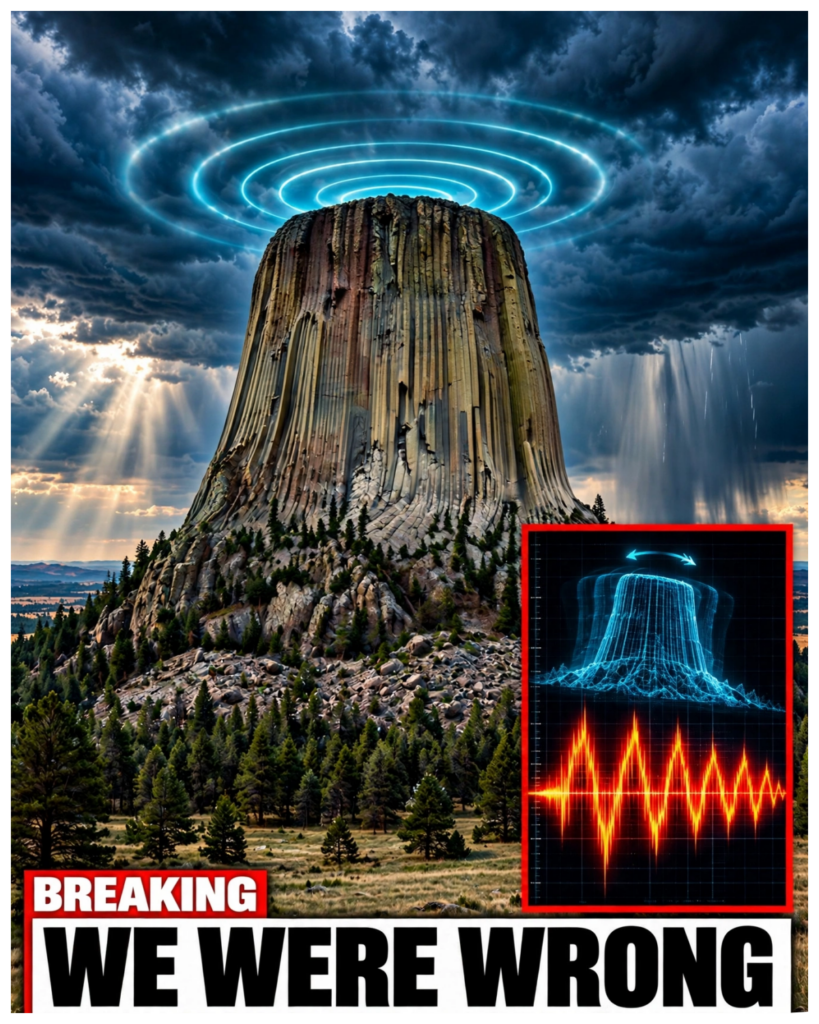
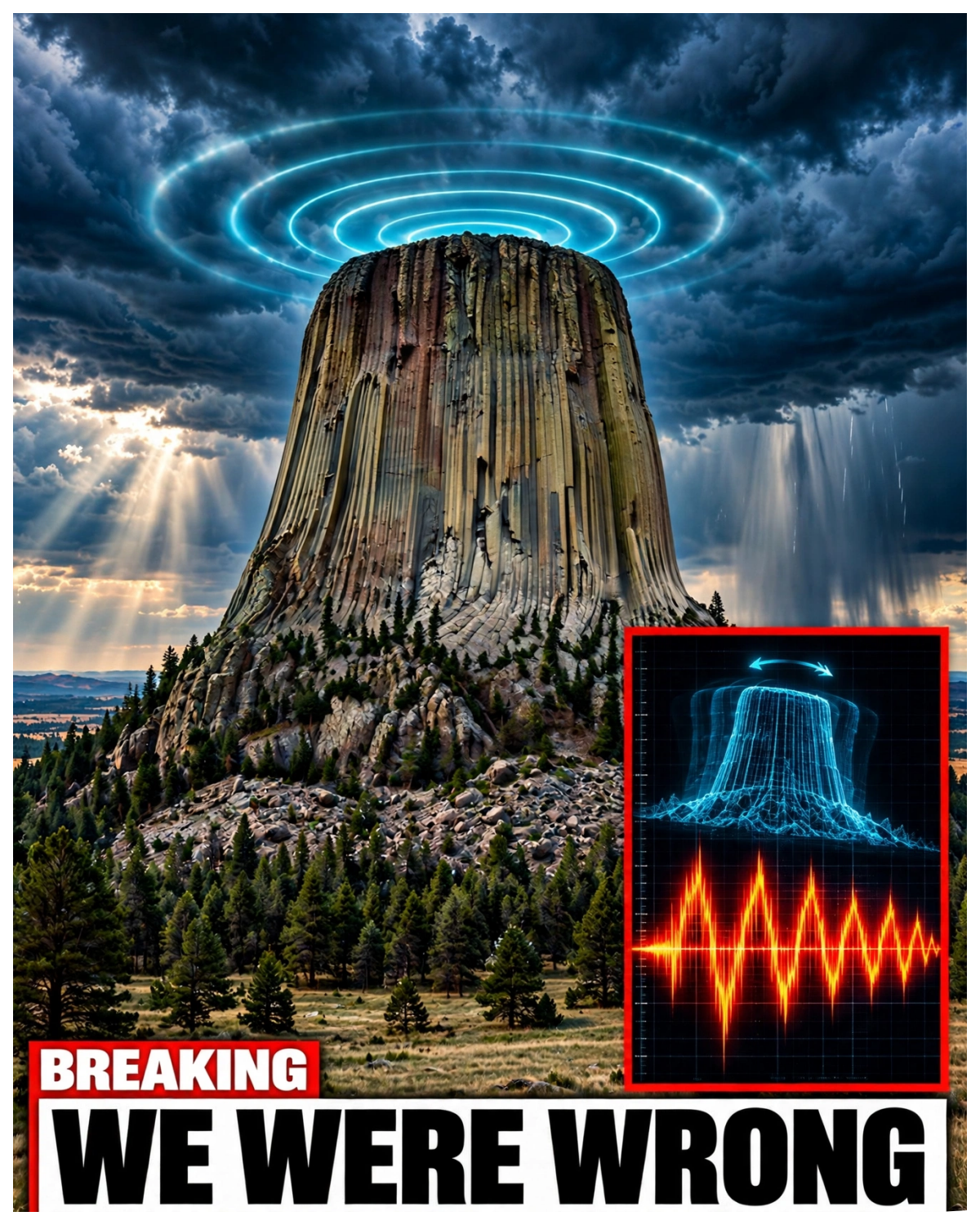
It resonates at about 1.1 and 1.2 cycles/s.
Two natural sways at right angles to each other.
The tower is slightly slimmer east to west, slightly thicker north to south.
So the two rhythms sit just apart like two notes a fraction off.
Their computer model predicted a third motion as well, a twist.
The whole tower rotating slightly about its own vertical axis at around two cycles a second.
It is the same family of movements engineers measure in skyscrapers.
The motion is tiny.
At its strongest, during a windy spell, the summit moved about half a thousandth of a millimeter, less than a hundth the width of a human hair.
On calm nights, 10 times less again.
But it never stops.
When the wind rises, the tower shakes harder.
When the air goes completely still, the planet keeps it moving.
Anyway, the team even turned the vibration into sound so you can hear the tower move.
And then came the result that stopped me.
To make their computer model of the tower sway at the right rhythm, the team had to tell it how stiff the tower is.
They tuned that stiffness until the model matched the real measurements.
Separately, they took a fresh boulder from the slope at the base, drilled cores from it, and crushed them in a lab to measure the stiffness of the rock itself.
The two numbers did not match.
The tower as a whole behaves about seven times softer than the stone it is made of.
Think about what that means.
Solid phonolyte is hard, dense, brutally strong, but the tower doesn’t behave like one solid block of it.
The researchers trace the difference to the joints, the cracks between the columns.
Their analysis suggests those joints are opened up, loosened through most of the tower’s mass, even deep inside.
That old line from the park service guide was closer to the truth than anyone realized.
A bundle of matches.
Devil’s Tower is not a frozen lump of stone.
It is a vast bundle of separate columns behaving together as one tall flexing body on the planes.
The leaning column on the south face wasn’t a strange exception.
It was a glimpse of what the whole tower is.
There is one more twist.
Despite those loose joints, the model only matched reality when the tower was treated as a single coherent body.
The authors noted that fits the idea of it forming as one large mass as the crater theory describes.
It does not prove that theory, but it is consistent with it.
And it came from the same institute in Prague.
The practical stakes are real.
Knowing how a rock tower vibrates helps predict how it would respond to a strong earthquake and which pieces might break loose first.
Which brings me to the towers most dedicated residents.
Peragan falcans were wiped out across much of North America in the middle of the last century when DDT thinned their eggshells until parents crushed their own eggs simply by sitting on them.
The species recovered in 2013.
Peragrins returned to Devil’s Tower and the park recorded the first documented peragrin nest on the rock.
They have nested there in most years since, choosing ledges in the top third of the tower, often switching to a different face from one year to the next.
Each spring, dozens of climbing roots close so the birds can raise their chicks in peace.
The fastest animal on Earth, raising its young on a rock that sways like a building.
Australians watched the same chemical hit our own birds.
In 1979, Penny and Jerry Olsen measured 472 Australian peragrin eggs collected since the 1880s.
After the late 1940s, when DDT arrived here, shells grew thinner by more than a third in the worst cases.
Victoria showed the greatest thinning of any state.
And today, Victoria has one of the most watched peragrin nests in the world.
Since 1991, a pair has nested on a ledge on the 35th floor of 367 Collins Street in Melbourne, CBD.
Now streamed live to fans every spring.
When a strong earthquake shook Melbourne, the Nest camera caught the male lifting off the ledge to investigate the shaking building.
According to peragrin researcher Victor Hurley of the Victorian Peragrin project.
Moments later, the female settled back onto her eggs.
Two falcons, two towers, both moving, both chosen.
Anyway, so what is Devil’s Tower actually?
Here is what we can say firmly.
It is not a petrified tree.
It is a body of phonolyte that cooled slowly about 49 million years ago, cracked into giant columns, and was dug out of the plains by erosion within the last few million years.
The ground around it leans in, not out.
Its name began with a solders’s translation, not with any tribe.
And it is not still.
It sways in two directions and twists every second of every day.
A loose bundle of stone behaving far softer than the rock it is made from.
Here is what nobody can prove.
Whether that magma cooled deep underground or pulled in a blasted crater near the old surface, the evidence that would settle it is gone.
If you forced me to choose, I would lean toward the crater.
It is the only explanation that accounts for both Robinson’s inward tilting ground and the flared columns at the base with a single mechanism.
But I would hold that view lightly and drop it the moment new evidence said otherwise.
And somewhere 60 m up the south face, 37 tons of stone still lean on a painted edge, waiting.
Robinson’s sentence from 1956 still holds.
The ground still leans toward the tower.
The bucket on the summit is long gone.
In spring, the peragrins will be back on the high ledges, and the rock beneath them will go on doing what it has done since the plains were first stripped away from it.
Swaying, twisting, settling by amounts far too small to feel.
Not a frozen monument, a structure still answering the planet every second.
Whatever we decide to call it, the wild is not gone.