For over 2,000 years, Petra’s treasury has towered over the Jordanian desert.
A rose red palace carved straight into a sandstone cliff, admired by millions and guarded as one of the world’s greatest wonders.
Camel caravans hauling incense and spices once streamed past its doors, carrying fortunes through the narrow canyon.
Archaeologists thought they knew every inch of it.
They were wrong.
In 2024, a sealed chamber hidden beneath its forcourt was finally opened.
What they found inside wasn’t just unexpected.
It was horrifying.
I’m Ambrose Wild, and everything you’re about to hear comes from the people who actually dug that chamber.
Their radar data, their interviews, and their own descriptions of what they saw.
The TV host who filmed the excavation said that in two centuries of archaeologists working at Petra, nothing like this had ever turned up.
And the most unsettling part of this story sits right under the feet of every tourist who has ever photographed that famous pink facade.
Picture the walk-in first.
To reach the treasury, you squeeze through the sick, a twisting gorge about 1.2 km long with sandstone walls so tall the sky shrinks to a ribbon above your head.
Then the canyon opens and there it is.
A facade 39.5 m tall carved out of a single block of cliff with Corinthian columns, a freeze of winged griffins and the goddess Isis standing at its center.
The people who made it were the Navatians, Arab nomads who got rich moving frankincense and myrr across the desert and who ran their own kingdom from this valley until Rome annexed it in 106 AD.
The locals never called it a tomb, though.
They called it the kasnet, the treasury, because of a bedin legend that a pharaoh had stashed his gold inside the stone ern at the very top.
People believed that story enough to shoot at it.
Rifle fire blamed on Bedawin treasure hunters hoping to crack it open left bullet holes in that urn that you can still see from the ground today.
The joke was on the shooters because the urn is solid sandstone.
There was never anything inside it to spill out.
So what was the building actually for?
Jordan’s own Petra authority calls it a moselum and many archaeologists think it was made for King Artus IV who ruled from 9 BC to 40 AD.
There’s an awkward problem with that theory.
Nobody has ever found a single skeleton inside the treasury itself.
The grandest tomb in Petra came up empty.
There is one eerie detail at its doorway though.
At the top of the entrance steps, small circular holes are cut into the stone floor, and the same authority says they were most likely used for sacrifices.
That’s stranger than it sounds, because this valley is packed with graves.
Hundreds of tombs are cut into the cliffs around it, which is why people call Petra a city of the dead.
And ever since antiquity, one ancient writer has made historians deeply uncomfortable about how those tombs were really used.
The Greek geographer Strabo, writing in the same era the Nabotian kings were ruling here, claimed these people regarded corpses the same way they regarded dung.
In his words, they bury even their kings beside dung heaps.
Now, hold that line up against the treasury and see if it makes any sense to you.
Why would a people who didn’t care about corpses spend a fortune carving palaces for them?
Scholars have argued about that sentence for decades, and some think Strabo misunderstood a custom of exposing bodies before final burial.
The only way to really settle it is to find a Nabotian burial that nobody has touched and look at what the Nabotians actually did with their own people.
That turned out to be almost impossible.
When the Swiss explorer Johan Ludvig Burkhart reached Petra on August 22nd, 1812, he had to disguise himself as a Muslim traveler called Shik Ibrahim and claimed he’d come to sacrifice a goat at the tomb of Aaron just to get his guides to lead him through the gorge.
Walking past the cliffs, he noted that no two of the tombs he saw were alike.
In the two centuries of exploration that followed, tomb after tomb in this valley turned up empty or wrecked.
The real reason those tombs were empty was far more ordinary.
For thousands of years, Petra sat on a desert trading crossroads and travelers crossing that brutal heat ducked into the cool carved rooms for shade.
Pierce Paul Craman, the archaeologist from the American Center of Research, who would eventually lead the dig at the Treasury, says that habit is why untouched burials in Petra are so rare.
Anything left in an open tomb got moved, picked through, or carried off.
So, the best hope was a tomb nobody could walk into.
And the one place that might hide a tomb like that was also the most sensitive patch of ground in the whole country.
The forcourt in front of the Treasury is basically Jordan’s front door.
Hundreds of thousands of tourists a year stand on that sand, ride camels across it, and take their photos from it.
Digging there means fencing off the most valuable view in the kingdom, a few steps from a 2,000-year-old facade that nobody can repair if something goes wrong.
And it had been tried once before.
In 2003, archaeologists from Jordan’s Department of Antiquities excavated in front of the treasury and found two tombs hidden below its left side.
Craman says those tombs held partial skeletons, but the data was never published, so today nobody outside that team can say how many people were buried there.
The diggers also picked up hints of another tomb nearby.
Then the money ran out and the excavation was shut down.
For the next 20 years, the right side of the forcourt just sat there.
One of the most trampled, unanswered questions in archaeology.
There was another reason to think twice before digging here.
The treasury sits at the bottom of a giant funnel.
The hills above the seek drain about 55 km of rainfall toward that gorge.
In 1963, a flash flood tore through the seek and killed 22 French tourists and their Jordanian guide.
The Nabotans had already beaten that problem with diversion tunnels.
And after the disaster, Jordan built a dam and reopened one of those ancient tunnels to steer the water away.
Since 2014, a siren system has warned visitors when flood water starts rising toward the canyon.
Even so, flood debris still piles up around the treasury, burying the old ground a little deeper each time.
So, that’s where things stood.
The researchers had a strong hunch.
A 20-year-old lead and no permission to put a shovel in the ground.
To get one, they had to prove something was down there before anyone broke the surface.
That proof came from ground penetrating radar.
The idea is simpler than it sounds.
The machine sends short pulses of radio energy down into the ground and listens for the echoes.
Packed sediment and solid rock send the signal back one way and an empty space like a buried room sends it back very differently.
Map enough of those echoes across the sand, and you get a rough picture of what’s underneath without moving a single grain.
The man reading those echoes was Richard Bates, a professor of geohysics at the University of St.
Andrews in Scotland, and the team had a smart plan for where to point the radar.
The Treasury’s facade is close to a perfect mirror image down its center line.
So, if the builders had cut tombs below the left side of the monument, it made sense to ask whether the right side was hiding a twin.
Earlier in 2024, the scans came back and the two sides matched.
The features on the right lined up with the ones on the left where those 2003 tombs had been found.
Bates read the strongest signals as voids, empty pockets in the ground beneath the forcourt.
That was the evidence the team needed because funding and permits for any digging at the treasury had been hard to come by.
With it.
They got permission from the Jordanian government to dig in a project jointly directed with Jordan’s antiquities chief and the head of the Petra tourism authority.
Stop and think about what that radar screen was showing.
A hollow shape under the most famous sand in Jordan in the exact spot where generations of tourists have stood to frame their pictures.
Whatever was in there had been a few steps from that crowd the entire time.
Kriezmann then picked up the phone and called Josh Gates, the host of Discovery Channels Expedition Unknown, and told him he thought they had something.
That phone call is the reason cameras were rolling for what happened next.
That August, with a film crew on site, the team started digging at the Treasury.
The rest of the world wouldn’t hear a word about what they found until that October when the episode aired.
But a radar void is only a shape on a monitor.
It can’t tell you whether a chamber collapsed, filled with mud, or was stripped bare centuries ago by someone with a lamp and a sack.
And in Petra, the odds said this room would look like almost every other tomb in that valley, empty and picked clean.
Digging at the foot of the treasury isn’t like digging in an empty field.
The ground under that courtyard is a record of floods.
Winter after winter of silt and gravel washed down through the sick and dropped right at the treasury’s feet.
That sounds like bad news for archaeologists, but it worked in their favor.
The same mud that makes the forcourt so hard to excavate is what kept people out of whatever lay beneath it.
Remember those travelers who used Petra’s tombs as rest stops?
They could only disturb what they could reach.
A chamber sealed under layer after layer of flood debris would have been out of reach for every shade seeker, grave robber, and treasure hunter who ever passed through.
That includes the men with the rifles.
They were firing at a solid stone urn near the top of the facade while the real burial lay underneath the ground they were standing on.
Then the team broke through.
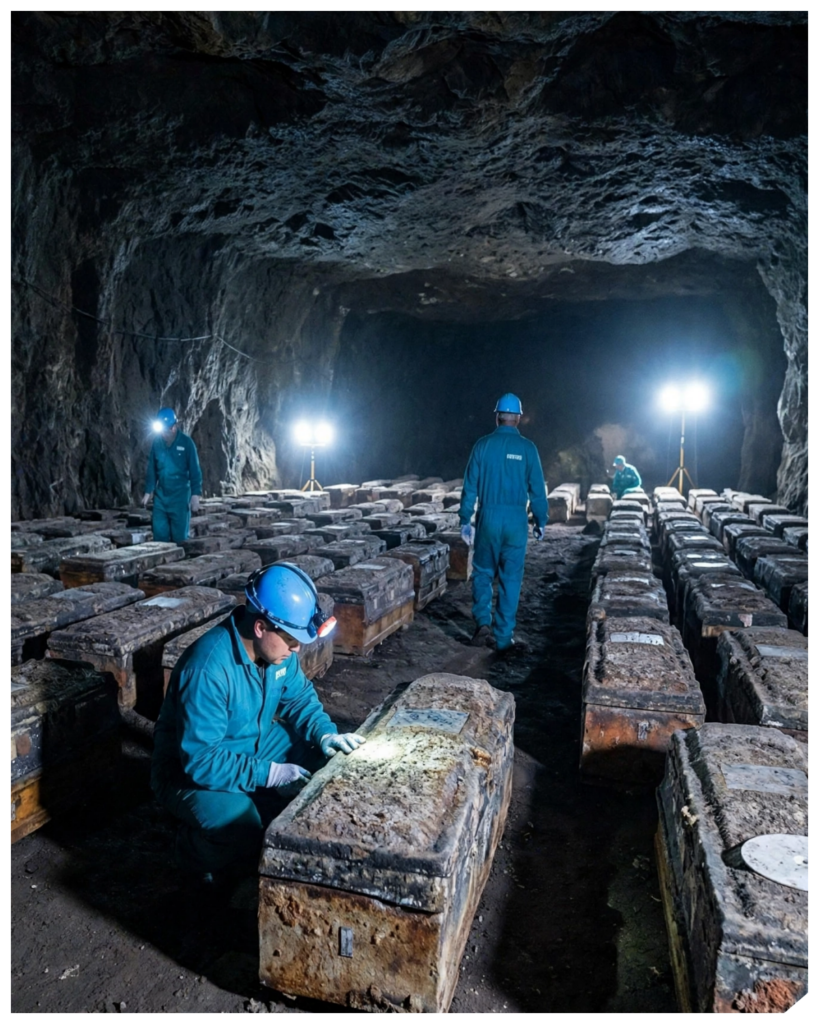
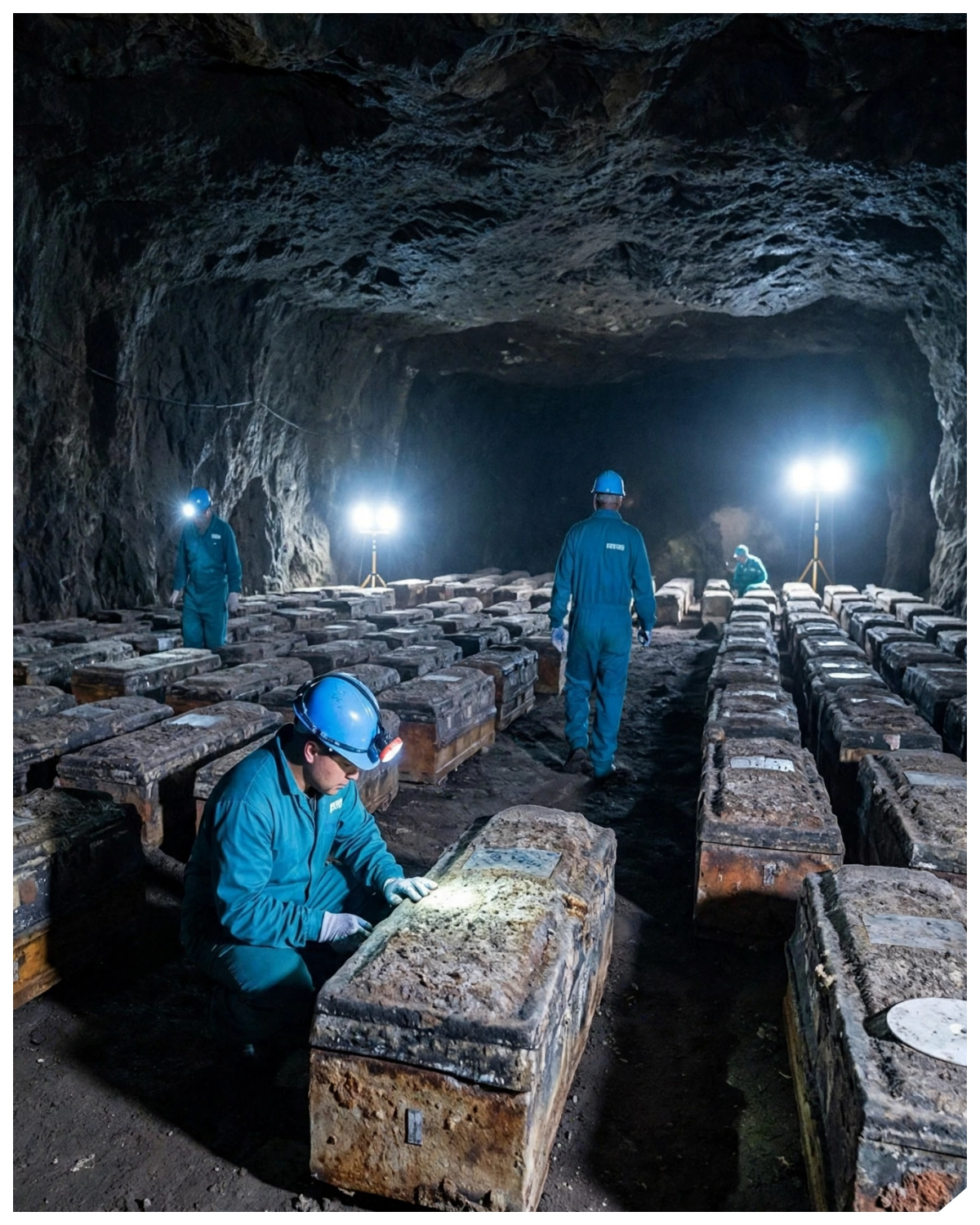
Based on Bates’s estimate, the chamber measures about 5.5 m on each side and about 3 m high, roughly the floor of a double garage cut into the rock below the forcourt.
According to the New York Times, that the space was also divided by a set of walls, a layout nobody had seen before at the Treasury.
Preliminary dating places it somewhere between the 1st century BC and the 1st century AD, right in the middle of the Nabotian kingdom.
The same report says the team believes this tomb may be older than the treasury itself.
If that holds up, the most photographed monument in Jordan was carved directly above people who were already buried here.
That’s the moment the stakes were highest.
Tombs in Petra almost never come up intact.
If flood water had churned through this room, or an earthquake had cracked it open, or a looter had tunnneled in at any point since the first century, the team would find what everyone else had found, scattered bones and broken pottery.
Two decades of waiting, the goodwill of the Jordanian authorities, and a rare permit were all riding on one hole in one of the most famous courtyards in the Middle East.
So when the first light went down into that dark room under the forcourt, nobody watching knew if they were about to see a discovery or an empty closet.
What they saw was people.
At least 12 human skeletons lay inside the chamber along with grave goods made of bronze, iron, and ceramic.
And what stopped the team cold was the way the bones were lying.
They were articulated, meaning the skeletons were still in one piece.
Skull, spine, ribs, arms, and legs in the positions they were in when these bodies were laid down.
Creaseman called it exceedingly rare.
Nobody had dragged them around.
Nobody had poured through them looking for jewelry.
They had been left exactly the way their families left them.
They weren’t all adults either.
The remains include men, women, and children.
Kriezman’s team says this may be the largest collection of human remains ever found in one place in Petra.
Bates told NPR that if you look across every other tomb in the Petra area, only a few have ever contained human remains at all, and those were fragments.
This one held 12 complete bodies.
Then came the detail that went around the world.
One of the skeletons was found holding a ceramic vessel shaped like a cup, and to the film crew, it looks startlingly like the Holy Grail from Indiana Jones and The Last Crusade.
That’s the 1989 movie that made the Treasury famous in the first place.
The one where Harrison Ford rides up to this exact facade and walks inside to find the cup of Christ.
Krieman was quick to cool that down.
He told Al Jazzer that seen in daylight, it’s an ordinary ceramic vessel, the kind of thing you’d expect to find in Petra.
That actually makes it more moving.
Someone in first century Petra laid an everyday clay vessel in the hands of the person they were burying and it stayed there for two millennia.
Compare that with Strao’s description of royal drinking parties in this kingdom where every guest drank from a different golden cup up to 11 rounds.
Whoever this was, they went into the ground holding plain clay.
And here’s a twist for the movie fans.
The temple Indiana Jones walks into was never inside Petra at all.
Those interior scenes were filmed on a sound stage at El Street Studios in England.
So for 35 years, audiences have imagined a secret sanctuary behind that doorway, while the real secret was lying a short distance away under the sand in front of it.
So far, this sounds like the best possible outcome.
An untouched Nabotian tomb, a direct challenge to Strao’s insult about the dead and a grail moment for the cameras.
But the closer the team looked at those bones, the darker the picture became.
Start with what was missing.
Nabatian burials usually come with belongings worn on the body, cloth wrappings, necklaces, and strings of beads.
In this tomb, almost all of that was gone.
Nobody had stolen it because nobody had been inside.
Gates said the team suspects the humidity and the flood water seeping into the chamber destroyed the textiles and the jewelry over centuries in the dark.
And the damage didn’t stop at the cloth.
According to Creusman, the skeletons, while intact, turned out to be in far more delicate shape than anyone expected.
Some of them were covered in mold.
The sandstone Petra is carved from is porous, and it traps moisture like a sponge.
Every winter, the same kind of flood water that swept away those French tourists in 1963 has been soaking into the rock around this chamber century after century.
And that water is very much still coming.
In December 2022, brown torrent poured down the cliffs around the treasury and forced the evacuation of 1,700 tourists with the sick itself running like a river.
So, picture it properly.
12 people, some of them children, lying exactly where they were placed, in total darkness, while the stone around them sweats.
Above them, the ground keeps creeping higher with every flood.
And on top of that ground, every single day, crowds stand shoulderto-shoulder, taking selfies in front of a building named after a treasure that never existed.
That’s what makes this tomb so disturbing.
Their families buried them with care with bronze and iron and pottery at the most prestigious address in the city.
Gates pointed out that this spot is the main entrance to Petra which made it some of the most valuable real estate the Nabotans had.
So much for Strao and his dung heaps.
Then over the centuries the city emptied out.
The floods buried the doorway and the busiest tourist spot in Jordan grew right over their heads.
Now, if you’ve watched other videos about this tomb, you may have heard about a second sealed room full of violently killed bodies, jars of blood, and a government coverup.
I went looking for the source of those claims.
In the interviews I could find from the excavation team in outlets like CNN, NPR, and Alazer, nobody describes anything like that.
The real story is grim enough without it.
These people made it through looters, flash floods, and 20 centuries of travelers searching for shade only to be slowly eaten by water and mold beneath one of the world’s busiest landmarks.
And there’s one more detail that should stick with you.
Bates says the geoysics shows indications of other tombs in that same area.
The New York Times quoted Creaseman making the same point that all these visitors walk past and there’s much more right under their feet.
The patch of sand where you’d wait for a camel ride may be a cemetery and almost nobody standing on it has any idea.
Which leaves the question the whole dig was really about.
Who were these 12 people and why were they given the doorstep of the treasury?
The team has a plan to find out.
They want to date the skeletons and the grave goods precisely and to extract DNA to see whether these people were related to each other.
If they turn out to be one family, this chamber is a family vault sitting at the gate of their capital.
If they’re unrelated, it raises a much stranger question about who decided these particular people belong together in one room.
Bones can tell you how a person lived, too.
Analysis of teeth and bone can reveal what someone ate, and the wear on a skeleton can show whether they spent their life doing hard physical work.
Cesman says those are among the things they hope to learn and that matters because of a real puzzle about Navatian society.
Ancient sources describe it as unusually equal with kings closer to ordinary people than in most kingdoms of the time.
Strabo [clears throat] himself wrote that at those royal drinking parties, the king sometimes served his own guests.
So far, Nabatian royal burials don’t look very different from ordinary ones, which makes it hard to say whether this tomb belonged to royalty or to a wealthy family with an incredible location.
That answer could finally crack the mystery of the building above.
Gates said that learning who these people were should help unlock part of the story of the treasury.
If they turn out to be close to the royal family, the case that the treasury was the moraleum of Artus IV gets stronger.
If they were ordinary citizens buried there before the facade existed, the treasury may have been carved right on top of an older cemetery.
Criasman told the Washington Post, “This work will shed light on when and how the treasury itself was built.”
He also said the material from the dig could tell us about the early history of Petra and possibly where the Nebatians themselves came from, a question historians still argue about.
The ancient accounts of the Nebatians that survive come mostly from outsiders like Strao.
So evidence from their own bodies would finally let them answer for themselves.
Here’s the catch, and it’s the darkest part of the whole story.
All of that costs money, and the next step comes down to funding.
Bates told NPR, “The goal is to raise enough to properly exume at least one of the bodies and study it in full and eventually all of them.”
Then he admitted that nobody knows when that’s going to happen.
As far as I can find, no results from those tests have been published yet.
Meanwhile, the same moisture that hid these people for so long keeps working on their bones.
So the next time you see that famous photo of the treasury glowing at the end of the sick, look at the sand in the foreground instead of the columns.
For more than 200 years, explorers came to this spot and stared upward at the ern, at the carvings, at a legend about a pharaoh’s gold.
The thing worth finding was lying a short distance beneath their boots the whole time.
12 Nabotian men, women and children, laid out with their cups and their bronze at the front door of a city that forgot them, still waiting for someone to find out who they were.
I’m Ambrose Wild.
If real discoveries told straight with the evidence on the table are your kind of story, stick around.
There are plenty more buried secrets waiting out there, and I’ll be bringing you the true version of every one of them right here on this
