July second, 1937.
Seven forty-two in the morning.
Somewhere over the Pacific… a woman’s voice crackles through on a ship’s radio.
“We must be on you… but cannot see you.
Fuel is running LOW.”
One hour later, Amelia Earhart sends her last message.
And then… nothing.
For eighty-nine YEARS… nobody has found her plane.
But right now — THIS week — a team is standing on a tiny island in the middle of the Pacific… staring at something in a lagoon.
Something a man spotted… on a satellite image.
Something that seems to have been lying in the same spot… since 1938.
They think… it might be her plane.
In 1937, Amelia Earhart was the most famous pilot on Earth.
The first woman to fly SOLO across the Atlantic.
And now she wanted the biggest flight of all: around the WHOLE world… along the equator!
Her plane was a Lockheed Electra 10-E.
Silver.
Two engines.
She called it her… flying laboratory.
It was paid for by a university — Purdue, in Indiana.
And after the flight, it was supposed to go back there.
With her was navigator Fred Noonan.
By the end of June, they had flown about twenty-two THOUSAND miles.
They landed in Lae, New Guinea.
Only seven thousand miles to go!
But the next leg… was the hardest.
Two thousand five hundred miles of open ocean… to Howland Island.
A flat strip of sand.
About two miles long.
In the middle of NOTHING.
Waiting there: the US Coast Guard cutter Itasca.
Its job was to guide her in… by radio.
On the morning of July second, the radio operators on the Itasca hear her.
Her voice is getting louder.
She must be CLOSE!
Seven forty-two.
“We must be on you, but cannot see you.
Fuel is running low.
Been unable to reach you by radio.
We are flying at one thousand feet.”
They can hear her.
But she can’t hear THEM.
At eight forty-three comes her last message.
They are flying along a line.
One five seven… three three seven.
A direction.
But no starting point.
And then… the radio goes quiet.
The United States launches the biggest search for a lost aircraft in its history.
Ships.
Planes.
An aircraft carrier.
For sixteen days.
They find… nothing.
The official answer: the Electra ran out of fuel… and sank.
But not everyone believes that.
Take that line.
Draw it on a map.
Follow it south-east, past Howland… and it runs close to a tiny, empty atoll.
Back then it was called Gardner Island.
Today: Nikumaroro.
And here is where it gets… strange.
In the days after she vanished, radio operators across the Pacific picked up signals.
Morse code — with her plane’s call sign.
And people in the US, in Canada, in the Pacific, said they heard a woman’s voice… asking for help.
Years later, the research group TIGHAR went through a hundred and twenty of these reports.
They rated fifty-seven… as credible.
A plane at the bottom of the ocean can’t send a radio signal.
A plane sitting on a reef… could.
Then, in 1940, a British colonial officer on Nikumaroro found something.
Human bones.
A doctor in Fiji measured them and said: a man.
Short and stocky.
And then the bones… DISAPPEARED.
In 2018, a forensic anthropologist ran the old measurements again.
His result: the bones were a closer match to Earhart than NINETY-NINE percent of people in a large comparison group!
Other scientists disagree.
And without the bones… nobody can prove it either way.
Now jump to 2020.
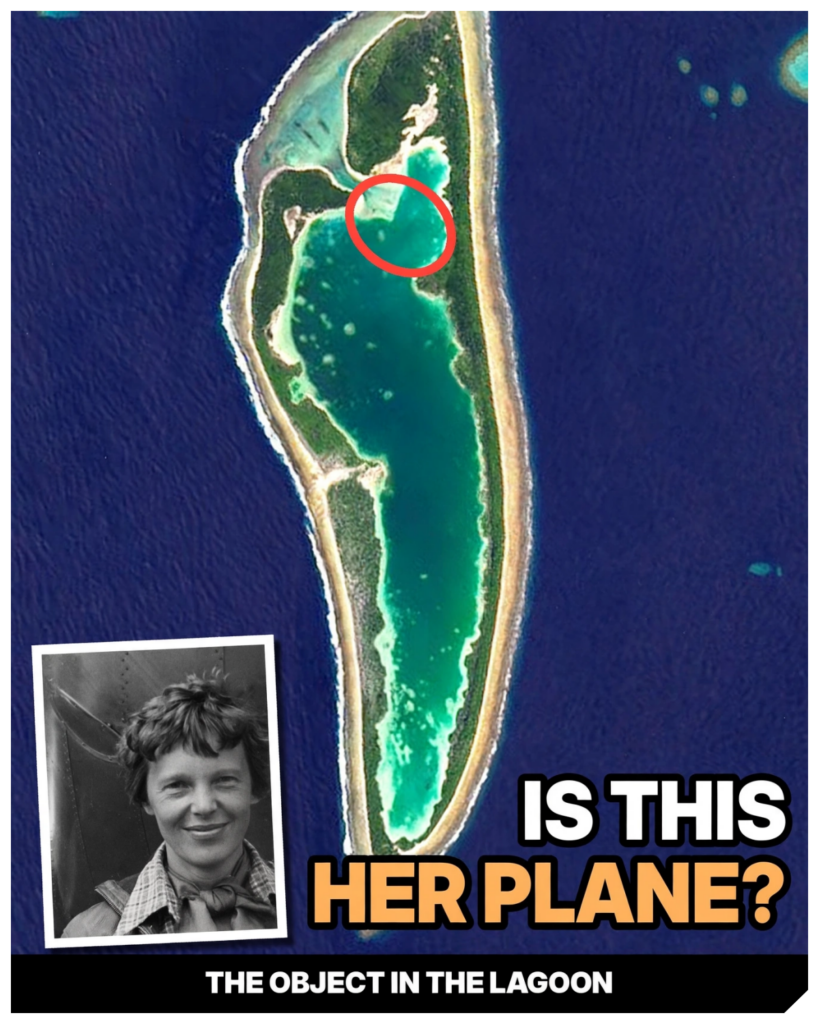
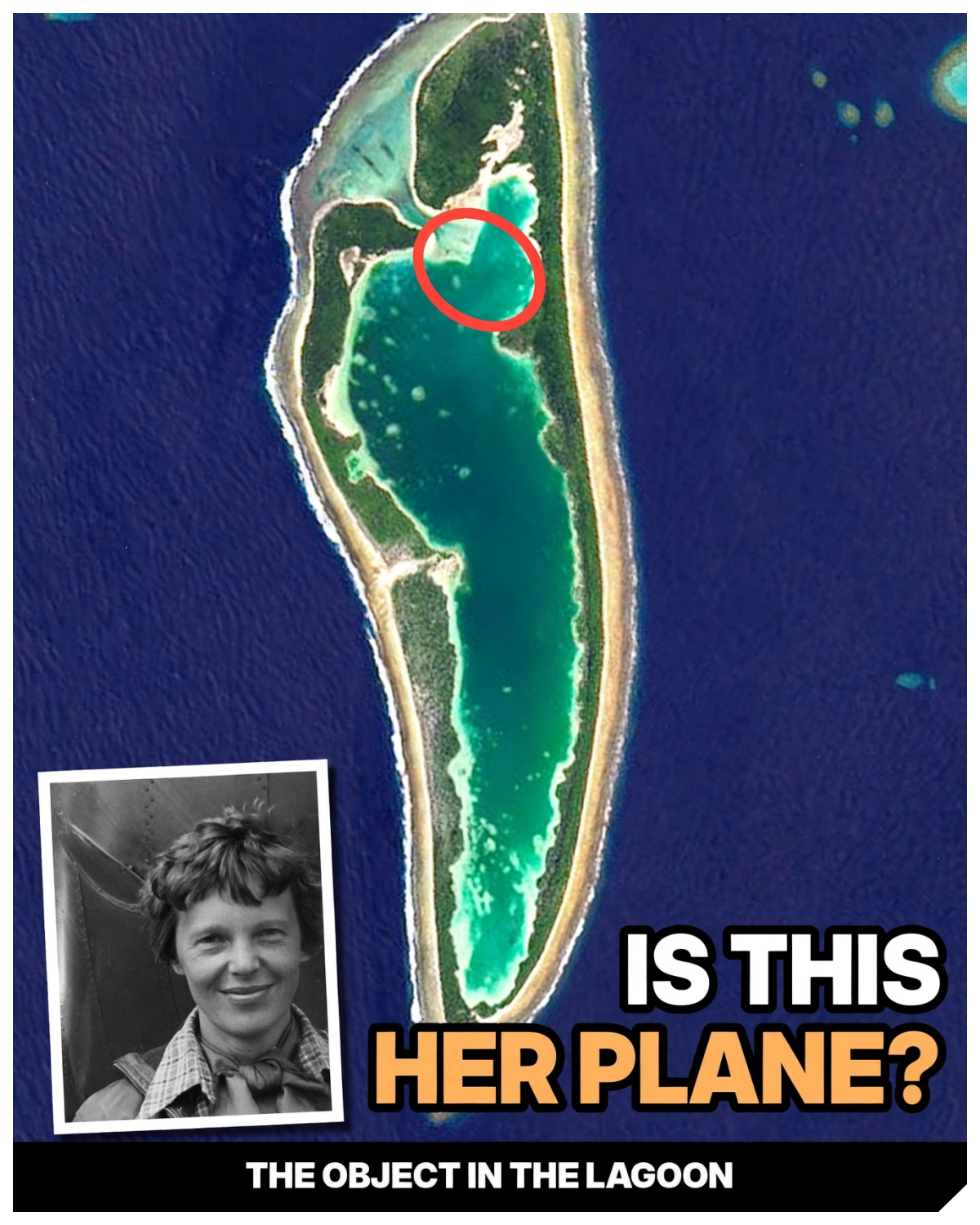
A man named Michael Ashmore is looking at satellite pictures of Nikumaroro… on Apple Maps.
In the lagoon, in shallow water, he sees a shape.
Dark.
Long.
And it seems to reflect light… like METAL.
Researchers call it the Taraia Object.
Then they go through older images.
Satellites, 2015.
A drone, 2017.
A helicopter video, 2001.
Same spot.
And then aerial photos taken by the New Zealand military… in 1938.
One year after she disappeared.
They seem to show something… in the same place.
The Archaeological Legacy Institute says the shape is EXACTLY the right size for the Electra’s body and tail.
Their theory: she landed on the reef.
The tide took the plane.
And it drifted through a channel… into the lagoon.
Could it be something else?
Wreckage from a British freighter that ran aground there in 1929.
A fallen tree.
The team says those don’t fit.
But for years… nobody went to look.
Until NOW.
October 2026.
Seventeen people — archaeologists, divers, filmmakers, and three representatives of Kiribati — sail eight hundred and thirty nautical miles from Tarawa to Nikumaroro.
Some of them flew out from Purdue… from an airport terminal named after Amelia Earhart herself.
On October fourteenth, they start the underwater survey.
A magnetometer, to detect metal.
Side-scan sonar, to map the lagoon floor.
And then… the weather turns.
Squalls.
Strong winds.
High seas.
For three days in a row, it is too dangerous to even take the boats to the island.
So they stay longer.
The plan: push a probe into the sand… then wash the sediment away with a water dredge.
Until someone can finally see what’s underneath.
The expedition leader, Rick Pettigrew, keeps it short: “This is a complex scientific process.”
If it IS the Electra, Purdue wants to return next year to dig it out.
Eighty-nine years after she took off… her plane might finally be going home.


