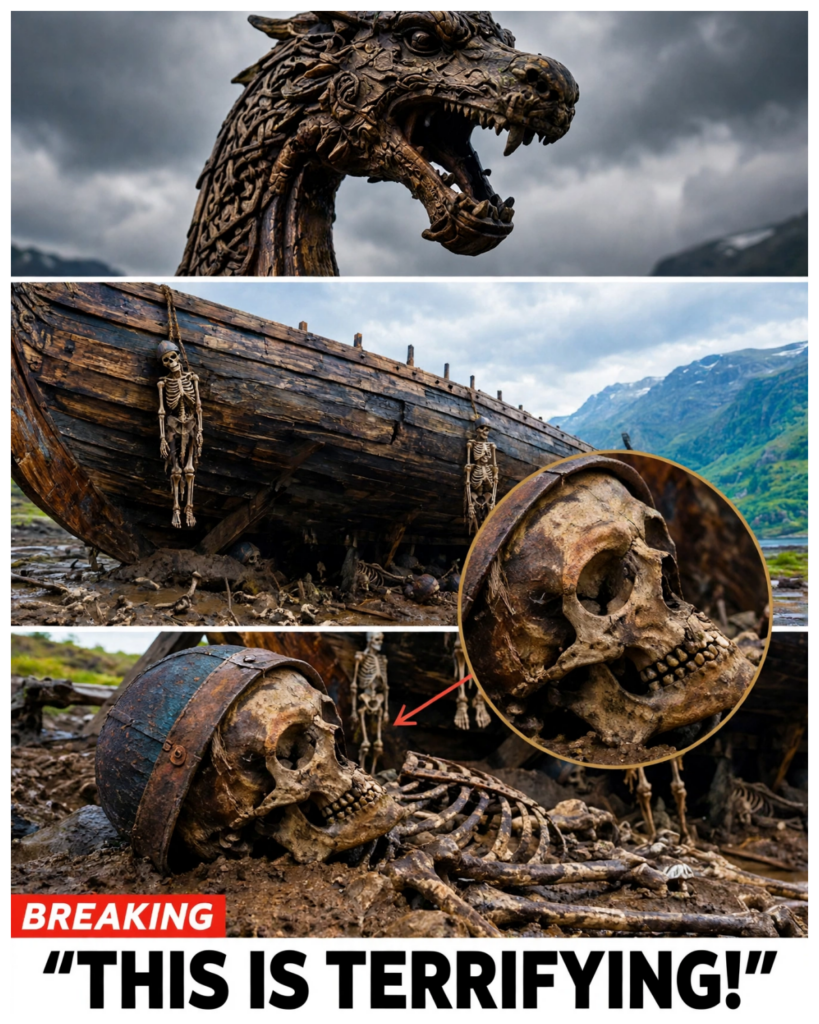
Even in a community where death is commonplace amongst children, amongst old people, dealing with a massive bunch of corpses is a once in a lifetime experience.
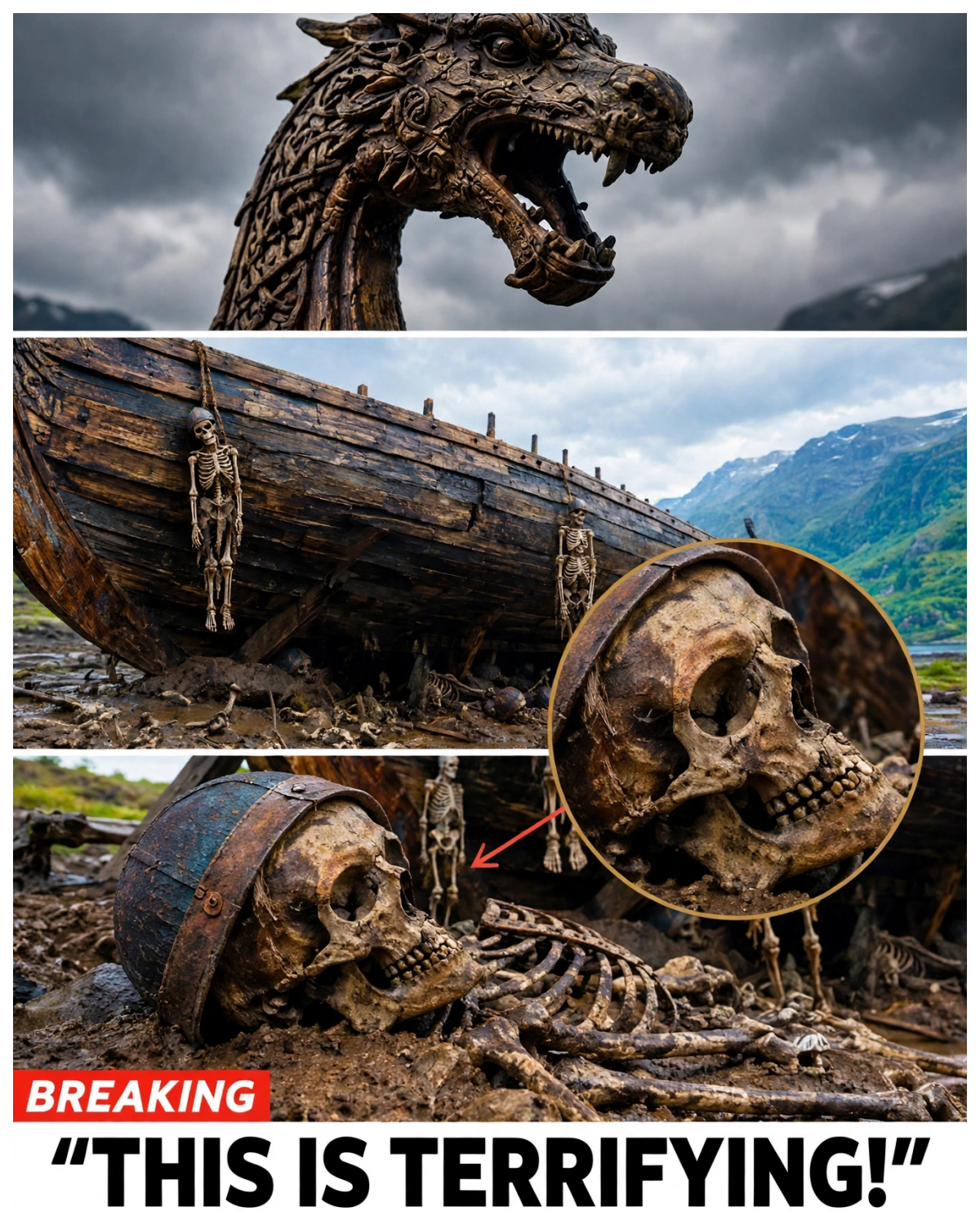
41 warriors, two buried ships, and a massacre that remained hidden for more than 1,200 years.
On a small Estonian island, archaeologists uncovered a chilling scene.
Bodies stacked four deep, bones marked by brutal sword wounds, and shattered weapons scattered among the dead.
But the most disturbing discovery came from their DNA.
Four of these warriors were brothers, apparently killed in the same violent encounter.
Even more surprising, this happened decades before the famous Viking raids began.
So, who were these men?
What deadly confrontation brought them to this island?
And why were they given such an extraordinary burial?
Join us as we uncover the evidence behind one of the earliest mysteries of the Viking age.
And subscribe for more incredible discoveries that reveal history’s hidden stories.
A discovery in an ordinary village.
The discovery began not with a treasure hunt, but with ordinary building work.
In 2008, workers at Salme on Sarama Island exposed iron objects and human remains.
Among the finds were rivets, small fasteners that taken together could outline the planks of a boat long after its timber had disappeared.
A single rivet says little.
Hundreds in a recognizable pattern can preserve the ghost of a hull.
This was the first indication that the bones belonged to a story about seafaring, not merely a forgotten cemetery.
Salme is a small settlement on Sarama, an island off the western coast of Estonia.
Today it can seem an unlikely setting for a story that reaches into the violent politics of the early medieval Baltic.
But its location matters.
Sodma lies beside seaw routes connecting Scandinavia with the eastern Baltic.
Anyone sailing between coastal communities, trading stations or political centers could have encountered its shores.
In the 8th century, waterways were not obstacles separating people.
They were corridors through which people, goods, ideas, and armed expeditions moved.
The first signs of the burial appeared during construction in 2008.
Workers exposed human remains and unfamiliar objects, including sword fragments and iron rivets.
Archaeologists recognized that the rivets might mark the outline of a wooden vessel.
Wood had largely decayed, but the metal fasteners preserved clues to the boat’s shape.
Excavation of the first burial revealed seven individuals associated with a smaller craft.
The ground was already disturbed, making some details difficult to reconstruct.
Still, the combination of bodies, weapons, and boat fittings was unmistakably important.
Then the story grew.
Work conducted between 2010 and 2012 uncovered a second, larger ship burial nearby.
This one contained 34 complete or partial skeletons arranged in a way that suggested deliberate burial rather than accidental death aboard a vessel.
Together, the two sites accounted for at least 41 people.
The discovery was remarkable not merely for its scale, but because ship burials usually involved a single prominent person or a much smaller number of individuals.
Here, an entire group had been placed with their ships.
Archaeologists faced a difficult task.
A burial site is not a photograph of the event that caused it.
It is the result of choices made after death, followed by centuries of disturbance, decay, soil movement, and modern activity.
Every bone and object must be considered in relation to where it was found.
Even the ships had to be reconstructed largely from rivets and traces left in the soil.
What emerged was not a complete eyewitness account, but a series of physical clues pointing toward a violent encounter and an unusually deliberate farewell.
The first question was straightforward.
How old were these burials?
Weapon styles, ornamentation, and scientific dating placed them around AD 750.
That date changes how we understand the story.
The famous Viking raid on Lindesvarn in England occurred in 793, decades later.
The men at Salma therefore belong to a period just before the conventional opening of the Viking age.
Their grave shows that Scandinavian maritime expeditions, including armed encounters far from home, were already taking place before the events that dominate popular Viking history.
Two ships, two different burials.
The smaller vessel known as Salme 1 was approximately 11.5 m long and probably propelled by orars.
Researchers identified evidence consistent with six pairs of oars.
It was a craft suited to moving people along coasts and through relatively sheltered waters.
Its preservation was poor because construction activity had disturbed part of the site.
Seven men were found in association with it along with fragments of swords, spearheads, arrowheads, knives, an axe, combs, and gaming equipment.
The remains did not all lie in neat rows.
Some bodies appear to have been positioned differently from those in the larger burial.
Sal 2 told another story.
This second ship was larger and its surviving construction traces have been discussed as evidence for an early sailing vessel in the Baltic region.
Researchers have examined the keel and arrangement of rivets to understand its design.
Because the timber itself was not preserved as an intact hull, any reconstruction involves interpretation.
Nevertheless, the vessel was a substantial craft, and the people who buried its dead used the space with extraordinary care.
The bodies in Salme 2 were laid out in several layers, reaching four deep in places.
Studies suggest the vessels were about 100 m from the shore when buried.
They were partly covered with and soil while later marine deposits accumulated above them.
Storms, waves, and ice helped conceal the scene beneath layers of sediment.
We cannot say with certainty who performed the burial.
Surviving members of the expedition are one possibility.
Local people are another.
The care given to the bodies might indicate comrades honoring their dead, but it does not prove that explanation.
The contrast is striking either way.
The injuries speak of violence.
The placement speaks of deliberate human decisions after the violence ended.
Between those two facts lies the central mystery of Salame.
The wounds that changed the story.
At first glance, a ship burial filled with weapons might suggest a ceremonial funeral for warriors who died at different times.
The skeletons made that interpretation difficult.
Several men showed injuries inflicted by sharp blades around the time of death.
Archaeologists call these permortem injuries, damage occurring when bone still has the properties of living or recently dead tissue.
Such wounds are distinct from fractures caused centuries later by soil pressure or excavation.
In the larger ship, researchers documented clear blade trauma on multiple individuals.
One man, designated SII4 in the archaeological study, had an especially disturbing pattern of injuries.
There were cuts to the right upper arm, damage to the skull, and wounds to the vertebrae.
The report describes evidence consistent with decapitation.
This was not an abstract story of ancient warfare.
It was a record of blows delivered to a real person’s body.
Another man had injuries to an arm and a leg.
Others carried damage consistent with edged weapons.
Some bones were missing or poorly preserved.
So, the absence of visible trauma does not mean a person died peacefully.
Soft tissue injuries, blood loss, and wounds to organs could kill without leaving recognizable marks on the surviving skeleton.
Archaeology can reveal some acts of violence with great precision while leaving others almost invisible.
The ships and shields offered another kind of evidence.
Numerous arrowheads were found, including examples embedded in the wood or associated with shields.
This suggests missiles were used during the conflict.
The combination of projectile evidence and close-range blade injuries indicates a fight that may have involved more than one phase or type of combat.
It does not allow us to reconstruct every movement or determine which side attacked first.
Consider the difference between a wound and a narrative.
A cut across an arm might be consistent with a defensive movement, but it cannot tell us exactly what the man saw.
A skull injury reveals a violent strike, not the identity or motives of the attacker.
An arrowhead in a ship may indicate that the vessel was under attack.
Yet, it does not establish whether the fight occurred at sea, at the shoreline, or after landing.
Each clue narrows the possibilities without supplying a complete sequence.
That uncertainty is essential to the documentary.
It would be easy to invent an ambush, a betrayal, or a desperate last stand.
None is established by the excavations.
What is established is that an armed group from across the Baltic suffered lethal violence and that at least some of the dead received a carefully structured burial.
The real mystery becomes more compelling when we respect what the bones can and cannot say.
The weapons of men with status.
The objects buried with the dead help explain why Salme attracted such attention.
Researchers reported around 40 swords across the two graves.
Some were single-edged, others were double-edged.
Several had richly decorated fittings, including gilded bronze and ornamental details associated with Scandinavian elite material culture.
In early medieval Northern Europe, a sword was not merely a practical tool.
Highquality blades and elaborate hilts required specialized labor and access to valuable materials.
They could also communicate a warrior’s status and connections.
Archaeologists also identified numerous arrowheads with some apparently connected to the violent event and others likely included as burial offerings.
The distinction matters.
An arrow head in a grave is not automatically proof that it struck a body.
Its location relative to the ship, shields, and bones can make one explanation more likely than another.
The same caution applies to damaged shield bosses.
Objects may record both the violence before death and the ritual decisions afterward.
Many swords were damaged or broken.
Some may have been harmed in combat, while others may have been deliberately altered during burial.
The exact reason for every broken weapon cannot be recovered.
Yet, the scale of the assemblage is extraordinary.
These men did not travel with only basic equipment.
The swords suggest a group with access to substantial resources, whether through aristocratic households, military followings, wealthy families, or a mixture of these networks.
Shields were another major part of the scene.
Their wooden parts have largely disappeared, but iron shield bosses survived.
A boss protected the hand behind the shield’s central grip.
15 such bosses were recorded in the assembly.
Archaeologists also found many arrowheads, comparatively few spears, and other equipment.
These objects give a sense of how the men were armed without allowing us to identify a standardized military unit in the modern sense.
The craftsmanship points west across the Baltic.
Sword fittings, scabbard remnants, and other objects have close parallels in Scandinavia, particularly regions connected with East Central Sweden.
This does not mean every item was manufactured in a single workshop or that all the men came from one village.
Objects traveled through exchange, gifts, inheritance, and warfare.
Their styles, however, are important when combined with scientific evidence from human remains.
There is also a social question hidden inside the weapons.
If these men were raiders, why carry so many prestigious possessions?
If they were an escort for important travelers, why were so many heavily armed?
Those possibilities are not mutually exclusive.
In the 8th century Baltic, political influence, trading journeys, personal alliances, and armed force could overlap.
The category of Viking can make this world seem simpler than it was.
The Salmad belonged to a society in which status and violence were closely connected, but the purpose of their final journey is still debated.
One grave held a particularly ornate sword hilt near a man whose remains were also associated with an animal offering.
Such finds tempt us to declare him a commander or king.
That would go beyond the evidence.
An impressive object can signal status, but its precise owner’s identity is unknown.
Archaeologists can describe hierarchy and wealth more confidently than they can name the leader of an expedition lost more than 12 centuries ago.
The gaming pieces beside the dead.
Among the most memorable discoveries were gaming pieces and dice.
Hundreds of pieces were recovered across the burial complex, including examples made from bone, whale bone, and walrus ivory.
One publication counted 326 gaming pieces in the assemblage.
These objects open a window into the lives of the men that weapons alone cannot provide.
They remind us that the travelers were not fighting every hour of every day.
They spent time aboard vessels, waited for weather, shared space, and likely played games whose rules are not fully recoverable from these particular finds.
Board games in early medieval Northern Europe could be more than idle entertainment.
They might involve strategy, prestige, and social interaction.
A beautifully made set could be a valuable possession.
Yet, we should resist the temptation to assume the men were literally playing a final game when they were attacked.
The pieces were found in burial contexts where objects may have been placed intentionally after death.
Their position reflects choices as well as the belongings of the living.
One man in the larger ship had a full set of pieces and three dice placed in his lap, perhaps originally contained in a cloth bag that has not survived.
Another had a gaming piece near his mouth.
Such precise details are unusually intimate.
We know almost nothing about the men’s spoken language, personalities, or daily routines, but we can still see where someone chose to place a small object during burial.
The meaning of the pieces in the burial remains open.
They could have been possessions offered to the dead, symbols of status, or elements of a particularerary practice.
Archaeologists can analyze material, shape, manufacture, and placement, but intention is harder to prove.
The most careful interpretation is also the most affecting.
After the battle, people placed objects associated with the lives of the dead among their bodies, and those objects remained when almost everything else disappeared.
Animals, combs, and the ritual of burial.
The Selma graves contained far more than weapons.
Archaeologists recovered animal bones, including domestic animals and birds of prey.
Studies identified remains of a gosh hawk and a sparrow hawk.
The headless remains of two hawks have been interpreted as possibleerary sacrifices.
Birds of prey carried associations with hunting and high status activities in parts of early medieval Europe, although the exact significance of the Salma examples cannot be established beyond doubt.
Animal bones may represent several activities.
Some could relate to food consumed during a funeral gathering.
Others might have been placed with the dead as offerings or provisions.
Distinguishing a meal from a ritual deposit is not always straightforward.
The same animal species can appear in both contexts, and preservation is uneven.
Archaeologists therefore interpret the animal remains alongside their location and the rest of the burial assemblage.
Antler combs are another revealing category.
At least a dozen single-sided combs were studied in detail with many parallels to 8th century examples from the Malerin region of Sweden.
Researchers used techniques including analysis of ancient proteins and DNA to identify the animal material used in some combs.
Elk and reindeer antler were both represented.
Reindeer material points to connections reaching beyond the immediate landscape of central Sweden, whether through exchange or movement of goods.
The burial’s respectful arrangement has led scholars to discuss its ritual significance.
Bodies were placed with shields, weapons, and personal belongings.
Some objects may have been intentionally damaged.
Cloth may once have covered parts of the burial, perhaps material associated with a sail.
Yet, the specific prayers, gestures, or beliefs involved are lost.
We should not assign the scene a complete religious ceremony based only on surviving objects.
What we can say is that burial was work.
Moving dozens of bodies, arranging them in layers, handling weapons, and covering two vessels demanded organized effort.
It was an act performed by the living under circumstances we cannot reconstruct.
The men who carried out that work knew something about the dead that modern investigators may never discover.
Where did the 41 men come from?
The burial took place in Estonia, but the objects looked Scandinavian.
Could science test whether the men themselves had grown up somewhere else?
Researchers turned to teeth.
Tooth enamel forms during childhood and retains chemical signals influenced by the environment in which a person lived while the enamel developed.
Among the most useful are ratios of strontium isotopes which vary with local geology and enter the body through food and water.
Isotopes are best understood as probability rather than a passport.
Two regions may share overlapping chemical signatures and a person can spend childhood in more than one place.
Researchers strengthened the interpretation by combining isotopic results with the Scandinavian styles of weapons and burial practice.
Together, those independent lines of evidence make the Swedish connection persuasive.
They still leave open the root of the voyage, the precise point of departure, and the purpose of the expedition.
By comparing enamel values with environmental patterns around the Baltic, researchers found that most of the sampled individuals were unlikely to have grown up in the Salma area.
Their signatures were consistent with parts of east central Sweden, particularly the Malarin region.
A later study examining the burials more broadly, supported this general picture, while identifying several individuals whose values could fit Gautland or other locations.
The evidence suggests an expedition assembled from people with regional connections rather than a purely local Estonian burial.
This geographical connection is significant.
The Malaran region contained important communities and elite centers in the centuries before the Viking age.
Water routes connected settlements around the lake and onward to the Baltic.
People from this region had the means and incentives to travel.
The Salma burial shows one such movement ending disastrously on the far side of the sea.
But the reason for the journey remains unknown.
Was it an armed raid, a diplomatic mission with a substantial escort?
A voyage involving trade, political negotiations, or a contest for influence.
Scholars have proposed different possibilities.
The richness of the weapons has encouraged interpretations involving elite warriors.
While the character of the journey remains uncertain, calling the men Vikings is convenient for a modern audience, but they died before the conventional Viking age chronology began.
The most important conclusion is not that scientists have solved the expedition.
It is that the dead were travelers.
They crossed the Baltic and reached a coast where some or all of them were killed.
Their final burial preserved a connection between two shores long before written narratives described the better known Scandinavian raids farther west.
Four brothers in one grave.
Archaeology can reveal where objects came from and how bones were injured.
Ancient DNA adds a different kind of evidence, biological relationships between people buried together.
Genetic research on Viking era populations identified close relatives among individuals from the Salma burial, including four brothers.
This is one of the most extraordinary human details in the entire discovery.
A mass grave can look anonymous when viewed from above.
Archaeologists assign numbers to skeletons because names have been lost, but those numbers can conceal families.
The identification of brothers means that at least some of the men were not merely companions recruited from the same region.
They belonged to the same immediate family and died within the same violent episode or were buried together as part of that episode.
Kinship also helps historians think about how armed groups were organized.
In early medieval societies, military followings could be built through family ties, personal loyalty, obligations to leaders, and alliances between households.
The presence of brothers fits a world where warfare and family networks overlapped.
It does not mean the entire group was related or that kinship was the only reason the men traveled together.
Ancient DNA cannot tell us their names, ambitions, or memories.
It can establish biological connections with a precision that older generations of archaeologists could scarcely imagine.
In the Selma graves, that precision gives the number 41 a new meaning.
These were not simply 41 casualties.
Among them were men whose lives had begun in the same family and whose remains were placed together on a foreign shore.
What actually happened on the shore?
Now the evidence can be assembled.
Around AD 750, two Scandinavian vessels reached the vicinity of Sodma.
At least 41 men ended up buried in them.
Many carried weapons associated with high status warriors.
Several bodies showed fatal or potentially fatal blade injuries.
Arrowheads were recovered from the burial context, including evidence of impacts on the ships and shields.
The men were buried with equipment and personal objects, and the larger grave was arranged with considerable care.
Those are the foundations.
Everything beyond them requires interpretation.
A common possibility is that the visitors encountered hostile forces and suffered a major defeat, but the precise location of the fighting is not known.
It could have involved an attack on the vessels, a clash after landing, or a sequence of confrontations.
The surviving evidence cannot establish the number of opponents or whether local groups, rival Scandinavians, or another force was responsible.
The burial also raises the problem of survivors.
If members of the expedition escaped, they may have buried their companions before leaving.
If they did not, perhaps other people carried out the funeral.
A careful burial does not automatically imply friendship between barriers and dead.
Political obligations, respect for prestigious enemies, negotiations, or local customs could all shape the treatment of casualties.
No single explanation is proved.
A raiding expedition is another plausible model.
Scandinavian seaborn violence did not suddenly begin in 793.
Salma is part of the evidence for an earlier maritime world in which armed men traveled widely.
Yet, a group with swords and shields was not necessarily on a raid at the moment it was attacked.
The grave proves that these travelers were armed and died violently, not what mission they had accepted before setting sail.
Perhaps the most important missing piece is the other side of the conflict.
The graves contain the visiting dead, but no securely identified opposing force.
We cannot count enemy casualties, identify a victorious commander, or trace the political consequences.
The story ends at the graves because that is where the evidence survives.
What the evidence still cannot answer.
A good historical mystery has an ending that respects the surviving record.
Salme does not have a recovered battle plan or a written confession.
The names of the dead are unknown.
So are the names of the people who fought them.
The precise cause of the confrontation, the order of events, and the motives behind the burial remain open questions.
These gaps should not be filled with certainty simply because a dramatic explanation would sound satisfying.
The number 41 is itself best understood as a minimum established by the excavations.
At least 41 complete or partial skeletons were identified in the two burials.
Damage from construction and the complicated preservation of the site mean archaeologists work with an incomplete record.
The larger ship included 34 complete or partial skeletons and reports also discuss an isolated skull.
Counting ancient individuals is a technical task, not just a matter of looking at photographs.
Nor do all injuries tell the same story.
Some wounds are unmistakable evidence of violence around death.
Others may be ambiguous or absent because vulnerable tissue has disappeared.
A skull injury cannot identify a weapon with complete confidence in every case.
The condition of the bones limits how much can be said about the final moments of any individual.
For that reason, statements about exactly how every man died would be misleading.
These uncertainties do not weaken the discovery.
They are the reason it remains worth studying.
New methods may reveal more about diet, mobility, family connections, weapon manufacture, and the sequence of burial.
Each result will need to be tested against the wider archaeological context.
What the site already offers is extraordinary.
An unusually concentrated record of violence, travel, wealth, kinship, and burial at a turning point in northern European history.
What the ships left behind.
For more than 12 centuries, the ground at Salme held two ships and the remains of 41 people.
Their story did not survive as a saga with named heroes and a tidy ending.
It survived in rivets, bone, iron, and the deliberate placement of the dead.
The most extraordinary finding is not that violence happened in the Baltic before 793.
It is that the same grave preserves evidence of brutality, kinship, wealth, and care.
The men were not simply casualties counted after a battle.
They were individuals whose final journey crossed the sea and ended on a foreign shore.
We may never know who won the encounter, but the excavation has already changed how historians understand the world that produced the Viking age.
More than 12 centuries ago, a group of men crossed the Baltic Sea and never returned home.
Their ships became graves on the coast of Sodma.
Their swords were laid beside them.
Their shields covered parts of the burial and gaming pieces rested among the dead.
Some had suffered brutal wounds.
Others left no clear injury on the bones that survived.
Scientific evidence suggests that many came from the Swedish side of the Baltic.
DNA reveals that four were brothers.
Yet, no surviving record tells us the names of the travelers or the people who killed them.
In 2008, ordinary construction work uncovered the first traces of that forgotten event.
Today, the men remain nameless, but they are no longer invisible.
Their bones reveal violence.
Their teeth point across the sea.
Their possessions suggest lives of rank, travel, and companionship.
Their family ties remind us that one grave could contain the loss of an entire household.
And the two ships leave us with a question that archaeology may never answer completely.
What happened on that Estonian shore that made 41 men vanish from the world they knew?
Thanks for watching.


