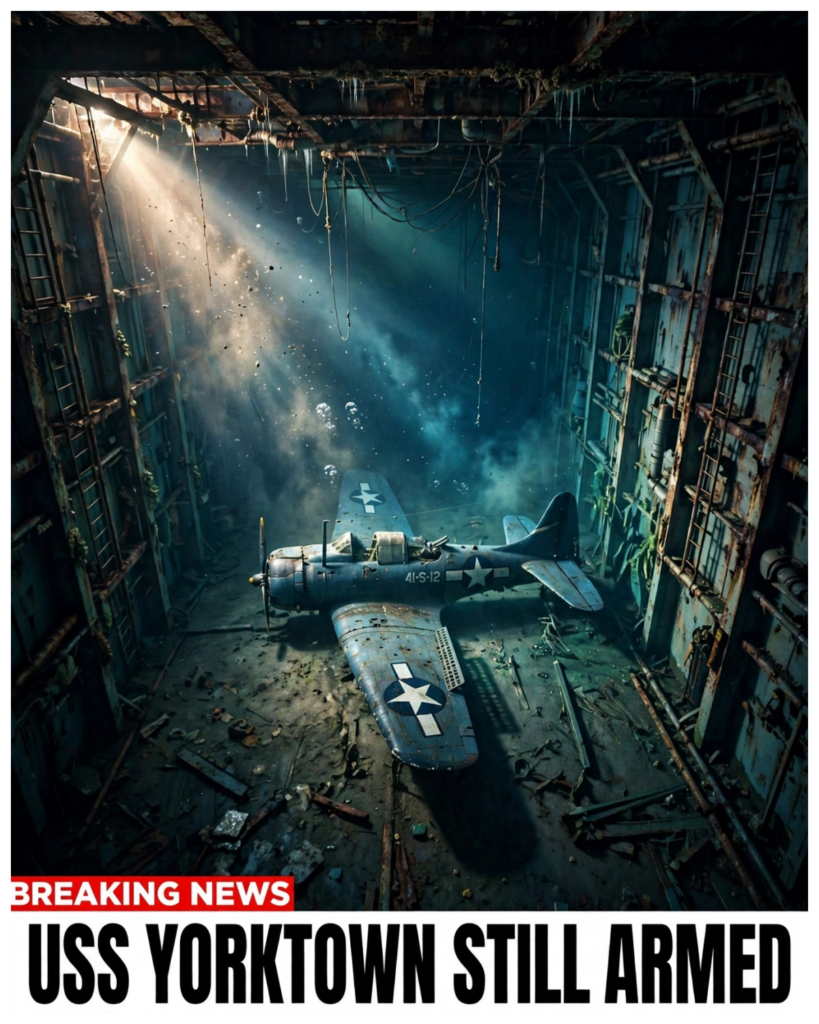
More than three miles under the Pacific, a robot submersible slipped inside one of the best known carriers in American history.
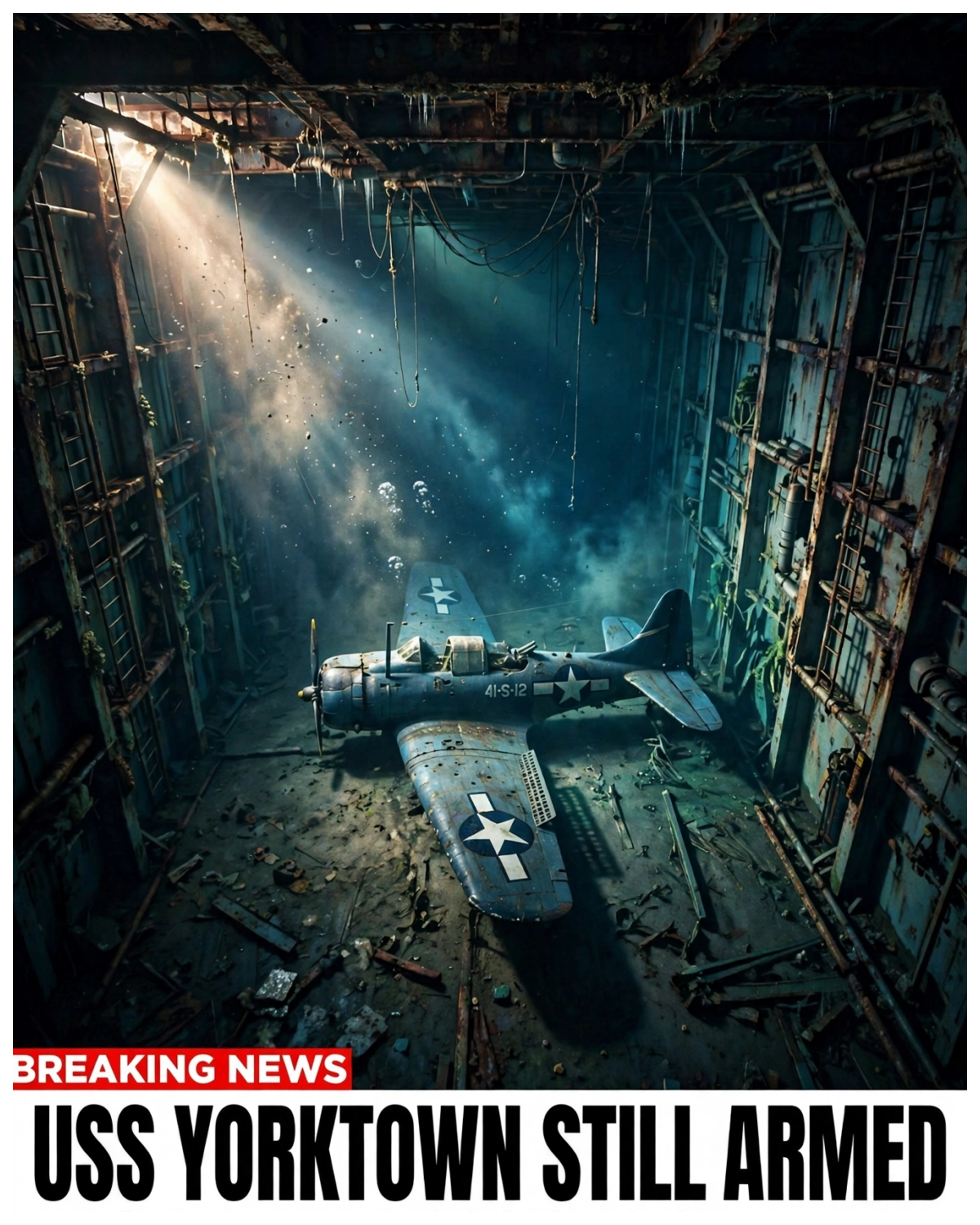
What its lights picked up in the dark didn’t add up.
Sitting in the hanger was a car.
Not far away lay a dive bomber with its bomb still in the cradle.
And on the wall of an elevator shaft, a giant painted map nobody thought could have lasted.
The USS Yorktown went down in 1942.
But 83 years later, she’s still giving up secrets.
I’m Ambrose Wild and the car is even stranger than it sounds.
In her final days, while a salvage crew fought to keep this ship upright, they cut heavy guns loose and let them drop into the sea to take weight off her.
The car stayed right where it was.
Almost everything the cameras found down there traces back to the last month this carrier spent above water.
So, that’s where this story starts.
It was the 8th of May, 1942, and the Battle of the Coral Sea was on.
That morning, Japanese planes came for the Yorktown.
She was a big ship, 809 ft long, commissioned at Norfolk, Virginia back in 1937, and Captain Elliot Buckmaster threw all of her into hard turns and dodged eight torpedoes.
But there were bombs coming down, too.
A single bomb weighing about 550 lbs hit the middle of the flight deck, punched down through four decks, and exploded deep inside the ship.
The damage was serious.
That one bomb killed or badly wounded 66 men.
It blew up above the forward engine room and destroyed six compartments, knocked out the lights across three decks, took out the radar and the refrigeration, and damaged the gears that worked the number two elevator.
Remember that elevator?
It also put the super heater boilers out of action, which meant the ship couldn’t reach her full speed anymore.
Then there were the near misses.
Up to a dozen bombs landed close enough to split the hull under the waterline.
One seam in her plating opened up along about 24 ft.
Fuel tanks ruptured and as the Yorktown limped away, she left an oil slick behind her about 10 mi long.
She could still hold about 20 knots and she made it back to Pearl Harbor on May 27, a day ahead of schedule after a voyage of 18 days.
On the outside, she didn’t look too bad.
Her damage control crews had patched the hole in the flight deck so neatly you could barely see it.
Underneath she was a mess, and Nimitz already knew it.
Buckm’s damage report had been flown ahead and reached him on May 25, 2 days before the ship came in.
Rear Admiral Aubry Fitch, who had been aboard during the battle, figured she needed about 90 days in the yard.
The shipyard’s own estimate was 3 months.
In plain terms, the yard was about to be asked to do three months of work in three days.
But Admiral Chester Nimttz didn’t have three months.
He barely had three days.
A team of Navy codereers at Pearl Harbor, known as Station Hypo and working under Commander Joseph Roshapor, had pieced together enough of the Japanese radio traffic to know where the next blow was going to land.
The Japanese were coming for Midway, an atal far out in the Pacific, and they were expected on June 4.
Nimttz had two carriers ready, the Enterprise and the Hornet.
He wanted a third, and the Yorktown would sail as the core of Task Force 17 under Rear Admiral Frank Jack Fletcher.
So, Nimttz went down into the dry dock to look at the hull himself.
And then he gave his order.
We must have this ship back in 3 days.
Captain Claude Gillette, who ran the yard, said it could be done, but only with a huge effort.
A hull repair expert, Lieutenant Commander HJstag, agreed to the deadline.
The clock started on the morning of May 28 when the Yorktown floated into dry dock number one, a dock the Navy still uses at Pearl Harbor today.
Nimttz waved the safety rule that normally gave crews a full day to purge fuel fumes from a ship’s tanks before anyone started cutting and welding.
The water was still draining out of the dock when the workers went in.
More than 1,400 of them worked around the clock.
There was so much welding going on that Leslie Hicks, the president of Hawaiian Electric, arranged rolling blackouts across Honolulu to keep enough power flowing to the yard.
There was no time to fix each split seam one at a time, so the crews welded a huge steel plate over the whole damaged section of hull and moved on to the next job.
They didn’t fix everything.
The damaged boilers stayed damaged.
But early on May 30, the Yorktown sailed out of Pearl Harbor to meet the other two carriers, and she still had shipyard workers aboard, finishing jobs as she went.
And somewhere in her hanger, through all of that, a black Ford station wagon was parked.
Hold on to that because it’s going to matter later.
5 days after she sailed, the Yorktown was at Midway.
Early on June 4, her dive bombers hit the Japanese carrier Soru and set it on fire.
Dive bombers from the Enterprise went after the car.
For a few hours that morning, the Americans had the upper hand.
But there was another Japanese carrier out there, the Hiru, and it still had planes to throw.
Hiu launched 18 dive bombers, the type the Americans called VS, and they went straight for the Yorktown.
Her radar picked them up a little before 1:30 in the afternoon.
Three bombs hit her.
One landed behind the number two elevator.
Another came down the ship’s funnel and exploded in the uptakes, the big ducks that carry smoke away from the boilers.
The third struck near the number one elevator.
Fires broke out below decks.
Paint on the inside of the stacks caught fire and peeled off in burning flakes, starting new fires wherever it fell.
Most of her boilers went out, and by 240, the Yorktown had slowed to a dead stop in the water.
There’s one more detail from that attack that’s easy to miss.
That morning, the Yorktown had taken aboard two battle damaged dive bombers from the Enterprise.
They had attacked the car, taken damage, and come down on the Yorktown instead of their own carrier.
When those three bombs hit, the two Enterprise planes were caught in the fires.
Keep them in mind, one of them is still down there, and it has a story the records didn’t fully give up until 2025.
Her crew fought the fires.
That was only the first attack.
A second strike from the Hyru arrived later in the afternoon.
This time, torpedo bombers from Hyru’s B5N squadron.
Two torpedoes slammed into her port side about 30 seconds apart.
The first one at around 420, both hit below the waterline, and the 24 ft seam that had been welded shut in Pearl Harbor most likely split open again with its rivets sheared off.
The Yorktown lost power and started to roll over to port and the list got worse until her deck was tilted 26°.
Captain Buckmaster believed she was about to capsize and he gave the order to abandon ship.
Think about that for a second.
A carrier that had been patched together in 3 days was now lying dead in the water and leaning hard and her crew were going over the side into the ocean.
A 50 caliber machine gun at the offboat well on her port side was fired to get the attention of the destroyers.
So they’d come and pick up the men in the water.
That exact gun is still on the wreck today.
And then the Yorktown did something nobody expected.
She didn’t sink.
She drifted through the night, still leaning, still afloat.
The next day, she was still there.
So the Navy decided to try and save her.
On the morning of June 6th, a salvage team went back aboard.
It was led by her executive officer, Commander Dixie Kefir, and it was made up of 29 officers and 141 men.
A fleet tug called the Vario, summoned from Pearl and Hermes Reef, got a line on her and started towing.
The destroyer Haman under Lieutenant Commander Arnold TR pulled up right alongside her starboard side near the stern and supplied power and pumps so the water could start coming out.
The salvage crew began cutting heavy guns loose and dumping them overboard to bring her back toward level.
For a few hours, it was working.
By the middle of the afternoon, the list had come down by about 2°.
That doesn’t sound like much, but it was the first sign the work was paying off, and the men aboard had a real reason to think they might bring her home.
They didn’t know a Japanese submarine, I 168, had slipped past the destroyers guarding the carrier.
At around 3:36 in the afternoon, it fired four torpedoes.
One hit the Hamana midship and broke her back and she sank.
Her wreck lies in the same protected waters today.
Two more hit the Yorktown at the turn of the BGE, low on her starboard side.
The fourth missed, passing a stern.
Even then, the Yorktown hung on.
She stayed afloat through another night.
Then at around 5:30 the next morning, June 7, observers saw her list start to increase quickly.
She rolled onto her port side.
At 7:01 that morning, she turned upside down and slid under stern first into about 3,000 fathoms of water.
That’s around 3 mi deep.
In all, 141 of her men were killed.
The battle she’d been patched up to fight was won.
Midway turned the momentum of the war in the Pacific and the Yorktown played a big part in that win.
But the carrier herself was gone and for the next 56 years nobody knew exactly where she lay at that depth.
There is no sunlight at all and the pressure is crushing.
For most of the 20th century, there was simply no way to go and look.
That changed in May 1998 when the oceanographer Robert Ballard led a joint expedition with the US Navy and the National Geographic Society to search for her near Midway.
On May 19, his team found the Yorktown sitting upright on the seafloor in remarkably good condition.
After 56 years in the dark, much of her paint and equipment could still be seen.
There was something else about the way she settled.
She came to rest, leaning to starboard.
So the port side, where the Hu’s torpedoes hit her, is hidden against the bottom.
The wounds that crippled her are the one part of the story the cameras can’t see.
What Ballard’s team couldn’t do was get inside.
They could only peer into parts of the ship, and they caught a glimpse of something painted in one of the elevator shafts before they had to leave it.
Over the next two decades, other expeditions went hunting for the rest of that war.
In 2018, the research ship Petrell found the USS Lexington, the carrier that had fought alongside the Yorktown at the Coral Sea and was lost there with wellpreserved aircraft lying near the wreck.
In 2019, a petrol expedition sponsored by Paul Allen found the Japanese carriers Akagi and Kaga, the same Kaga those Enterprise bombers had attacked.
Before either of those, in September 1999, a team from Nauticos and the Naval Oceanographic Office had already found the first proof of Kaga, a piece of one of her gun galleries.
On the 9th of September 2023, the Ocean Exploration Trust brought the exploration vessel Nautilus out to Midway and surveyed the Yorktown with a robot called Atalanta.
They documented all three known wrecks from the battle.
And when the cameras peaked into the Yorktown’s hanger, they caught what looked like an aircraft wing.
That same year, the Navy formally designated the wreck a site of extraordinary character.
She’s a protected military grave, managed by the Naval History and Heritage Command, which means nothing gets touched and nothing gets taken.
So, in April 2025, a team from Noah Ocean Exploration came back to try something new as part of an expedition called Beyond the Blue.
The Noah ship Okanos Explorer sat on the surface about 1,000 miles northwest of Honolulu inside Papa Hano Mokqua Marine National Monument.
Over the side went two remotely operated vehicles, Deep Discoverer and Serios.
Deep Discoverer is a machine about 10 ft long, 6 ft wide, and more than 8 ft tall.
Flown from the ship by pilots from the Global Foundation for Ocean Exploration.
It carried lights.
Sonar and a highdefinition Zeus plus camera.
And it streamed 4K video live from more than 3 mi down so historians on shore and anyone else who wanted to could watch every second.
On April 1920, the team made two dives on the Yorktown.
They were the first dives ever to explore her hanger deck, and they were what Noah calls non-disturbance dives, which means look closely and touch nothing.
The pilots took deep discoverer in through the shaft of elevator number three and looked around.
And the people watching the feed at home weren’t just spectators.
One of them would end up answering a question the experts hadn’t.
The science team followed along by teleresence watching the same live picture from shore.
Michael Brennan of the ocean archaeology firm SERCH who had led the 2023 mission and Phil Hartmmy who leads marine archaeology for Noah Ocean exploration were among the lead scientists ashore.
The naval historian Chuck Habaline was on the line too and when the robot passed that 50 caliber gun on the port side he told the story of how it had been fired to call the destroyers to the men in the water.
The whole cruise lasted 28 days, but the two days on the Yorktown were the ones that made headlines.
The first surprise came while the team was looking into the back end of the hangar from the port side.
In the gloom, they could just make out a faint outline, and it was the shape of a car.
The next day, the pilots brought Deep Discoverer back for a closer look.
Over those two days, the reactions on the feed ran from that is amazing to this is history in the making.
What they found was a black station wagon.
Experts on shore tentatively pegged it as a Ford Super Deluxe Woody from 1,00 940 or 1,941 going off the flared fenders, the split windshield, the rag top, the chrome trim, and a spare tire.
After eight decades at the bottom of the ocean, it’s in rough shape.
The tires have rotted away and the roof has given way.
But the shape is unmistakable.
And on the front there’s a plate.
It reads ship service.
Then a word that can’t be made out and then navy.
The researchers called it a surprise automobile.
And Noah said a car like this could have served all kinds of roles aboard.
Anything from the ship’s command to its supply work.
So what is a civilian station wagon doing in the hanger of a carrier that was heading into a fight like Midway?
Space aboard a carrier was tight and everything aboard was supposed to earn its place.
So why give up room in the hanger for a car?
There are a few ideas.
Noah has suggested the car may have been used by a senior officer, someone like Fletcher or Captain Buckmaster himself for official business when the ship was in foreign ports.
The Navy plate fits that idea.
Mlache News reported another possibility that it was put aboard for the repairs after the damage at the Coral Sea.
Or it may have come aboard during those three frantic days in Pearl Harbor and in all the rush, nobody got around to taking it off before she sailed.
And here’s what makes it such a puzzle.
Noah’s team pointed out that nobody can explain why the car was still in the hanger after the 48 hour turnaround in the dry dock.
Nobody can explain why it never went over the side when the salvage crew was dumping guns into the sea to stop her rolling over.
A station wagon would seem like an obvious thing to get rid of.
Yet, there it sits, right where somebody left it in 1942.
And no, I’m not making that up.
Noah even asked anyone with better information to come forward and help identify it.
And one of the questions on its own list is simple and a little haunting.
Did this car mean something special to the crew?
A wreck like this keeps the big events, the bombs and the torpedoes.
It also keeps the small decisions like a car somebody meant to unload or throw overboard and never got around to.
And the car wasn’t even the most surprising thing the robot found in that hanger.
Pay attention to the planes because one of them didn’t belong to the Yorktown at all.
At the back of the hanger in the starboard corner near elevator number three, Deep Discoverer found the wreckage of at least three Douglas SBD Dauntless dive bombers.
These are the first aircraft ever found underwater on the Midway battlefield.
The Dauntless was a twoman plane, a pilot up front and a gunner behind him, and it worked as a scout as well as a dive bomber.
At Midway, Dauntless crews from the American carriers helped sink four Japanese carriers.
The Dauntless turned into one of the key aircraft of the whole Pacific War.
One of the three planes in the Yorktown’s hanger is lying upside down, and it’s still armed.
There’s a bomb sitting in its release cradle under the belly of the plane, exactly where it was loaded more than 80 years ago.
The team thinks it may be the plane mentioned in the ship’s afteraction report, which describes one Yorktown plane fueled and armed with a 1,000 lb bomb.
Noah’s own notes float a different candidate, a plane known as Black 17, and describe the bomb as a 500 pounder.
So, even the experts don’t fully agree on which plane this is.
What nobody disputes is that the bomb was never dropped.
It’s still hanging there today.
The team also found a spare dauntless wing still marked with a pre-war Roundle, the older style of national insignia.
They confirmed a Grumman Wildcat fighter wing that had first been spotted in 2023, and they found a set of what looked like spare wings from a Douglas TBD Devastator torpedo bomber.
Russ Matthews of the Airc Heritage Foundation was one of the researchers who helped work out what all these pieces were.
But the plane that got the most attention was another Dauntless with B5 painted on its side and a five on the upper right wing.
B5 wasn’t a Yorktown marking.
It belonged to bombing squadron 6 from the Enterprise.
Researchers matched it to Bureau number 4581, an SBD3.
This is one of the two Enterprise planes from the morning of June 4, the ones that came down on the Yorktown after attacking the car.
Then the Japanese bomb set it on fire and when the Yorktown went down 3 days later, it went down with her.
So, who was flying it?
This is the turn nobody on that ship could have planned.
One of the people watching the live stream was a man named Thomas Moore.
His grandfather, James M.
Moore, had served aboard the Yorktown.
Moore did his own digging and linked the B5 marking to a naval reserve pilot, a lieutenant junior grade named Roberts.
Noah’s records name the crew as Roberts and his gunner, aviation machinist’s mate, firstclass William Steinman, and Roberts’s name is on the Yorktown survivor muster roll.
That’s the part that changes how this plane feels.
When you look at a wrecked dive bomber on the seabed, it’s natural to think the man who flew it never came back.
Roberts did come back.
He took his damaged plane through a battle, put it down on somebody else’s carrier, and lived to be counted among that carrier’s survivors.
The plane he left behind sat in the dark for 83 years until the grandson of one of his shipmates saw it on a screen and put a name to it.
This wreck is the grave of a lot of men, and it’s also a record of some of the men who got out.
There was one more find in that hanger, and the people watching that day weren’t ready for how well it had held up.
Up in the shaft of elevator number two, the same elevator the Coral Sea bomb had damaged.
The robot’s lights fell across a painted map of the world.
It covers the starboard wall of the shaft about 42 ft wide and 12 ft tall.
And it has a title painted on it, a chart of the cruises of the USS Yorktown.
It tracks the voyages the ship had made painted by hand right onto the steel.
Ballard’s team had only glimpsed part of it, and a few old photos showed bits of it in the background.
In one of those photos taken on the 10th of April, 1942, while the Yorktown was out in the Coral Sea, the ship’s band is playing in front of it during a party the crew called the Yorktown Jamberee.
That was less than a month before the bomb came down through her flight deck.
Now, there it was again, rusted in places, but largely intact, 83 years after she sank.
One of the researchers watching the feed said it straight out.
I am absolutely flabbergasted by the state of preservation of this.
Noah said the motifs on the map showed the pride that Yorktown sailors had for their ship.
The mural was imaged on the first dive, April 19, and Hartmier later took more than eight hours of the dive footage, pulled 504 still frames out of it, and stitched them into a 3D model of the mural, then posted it online so anyone can look at the whole thing at once.
That map tells you something the car and the planes can’t.
Before she was a target, the Yorktown was where thousands of men lived.
They slept aboard her, ate aboard her, worked aboard her, and played music in her elevator shaft.
And when there was a spare moment, somebody climbed up into that shaft with a paintbrush and recorded every place they’d been together.
It’s easy to think of a warship as a machine.
The men who painted that wall thought of it as home.
That’s what makes the footage so strange to watch.
Nothing about the Yorktown feels like a museum piece.
She looks paused, almost as if her crew might come back down the ladders at any moment.
When those sailors went over the side in June 1942, they probably assumed nobody would ever see her again.
For 56 years, nobody did.
Now, a robot drifts through her hanger with its lights on, and the things they left behind are still exactly where they were.
James Delgado and the team who wrote up the dives for Naval History Magazine described the hanger this way.
Wisps of sediment mimicked drifting smoke to create an almost battlelike atmosphere.
At another point, they wrote, “It was as if time itself was blurred.”
And the rest of the dive turned up more of that same frozen moment.
There’s a 20 mm anti-aircraft gun, a 5-in gun barrel, and a 1.1in gun still on its mount.
There are the cut shields where heavy guns were removed and dumped to fight the list.
There’s a firefighting gauge made by American Lef France and an airplane cart still standing upright in the hanger.
Tubeworms have grown on the hull.
Anemmones crowd the starboard side and the cameras even caught a bright red jellyfish nearby that might turn out to be a species nobody has described before.
The reason all of this is turning up now comes down to the machines.
Each generation of them has gone a little further.
In 1998, a team could look at the outside of the Yorktown.
In 2023, a robot could peek through her openings.
In 2025, one could fly into her hanger with lights strong enough and cameras sharp enough to read the plate on a car.
Noah said the dives answered some old questions and raised new mysteries for historians and scientists.
And that’s exactly how it played out.
And there’s still plenty she hasn’t explained.
Nobody knows for sure who drove that Ford, why it was aboard, or why it survived when the guns didn’t.
And all of this came from just two dives.
The wreck is the final resting place for hundreds of servicemen.
So, it stays exactly as it is.
And every answer has to come from cameras, old records, and people like Thomas Moore matching a number on a wing to a name on a muster roll.
Her name didn’t stay on the bottom, either.
The Navy gave it to a new carrier that was supposed to be called Bonhom Richard.
And that second Yorktown now sits as a museum ship at Patriots Point in South Carolina.
When the first Yorktown rolled over that morning in June 1942, a black station wagon with a Navy plate went down with her, parked in the hanger where somebody left it after 3 days of welding in Pearl Harbor.
It didn’t add up then, and it still doesn’t.
But the car, the bomber with its bomb still loaded, the plane from the Enterprise, and the map her crew painted together show you what this ship was in the final month of her life.
She was a rushed repair job, a fighting carrier, a refuge for a pilot who wasn’t hers, and a home.
I’m Ambrose Wild and if you want more stories like this one where the bottom of the ocean is still rewriting what we thought we knew, stick around because there are plenty more wrecks to explore and I’ll keep taking you down to


