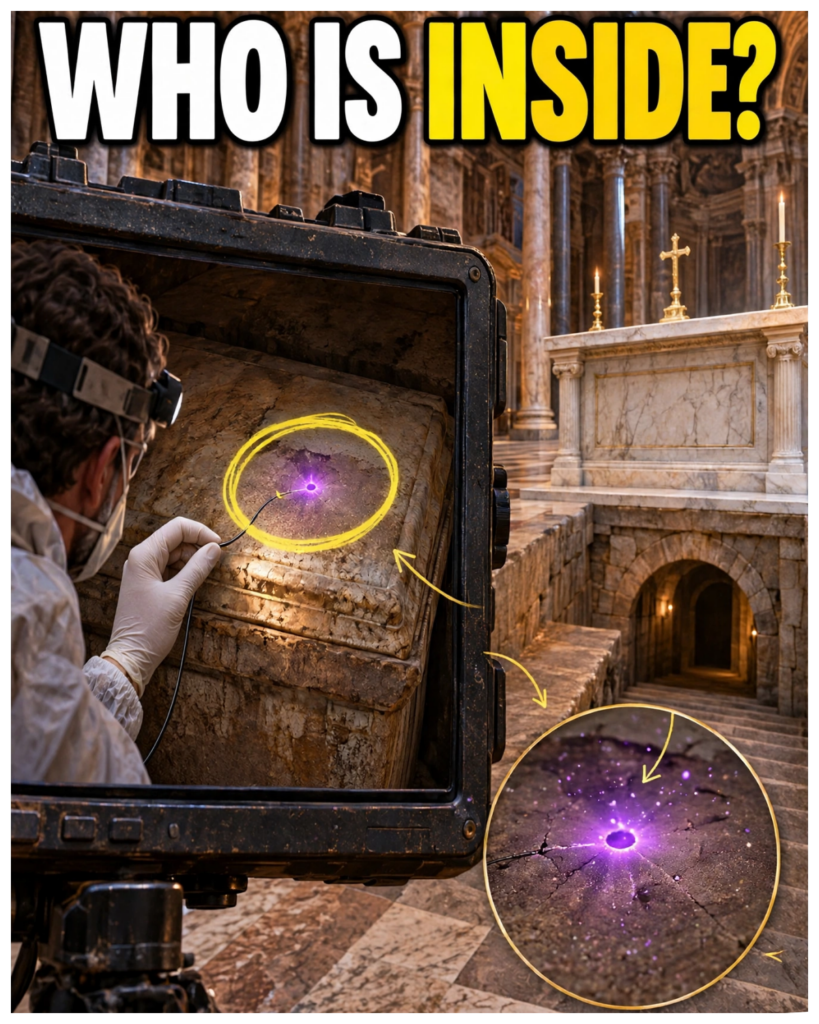
They drilled into an ancient tomb beneath an altar in Rome.
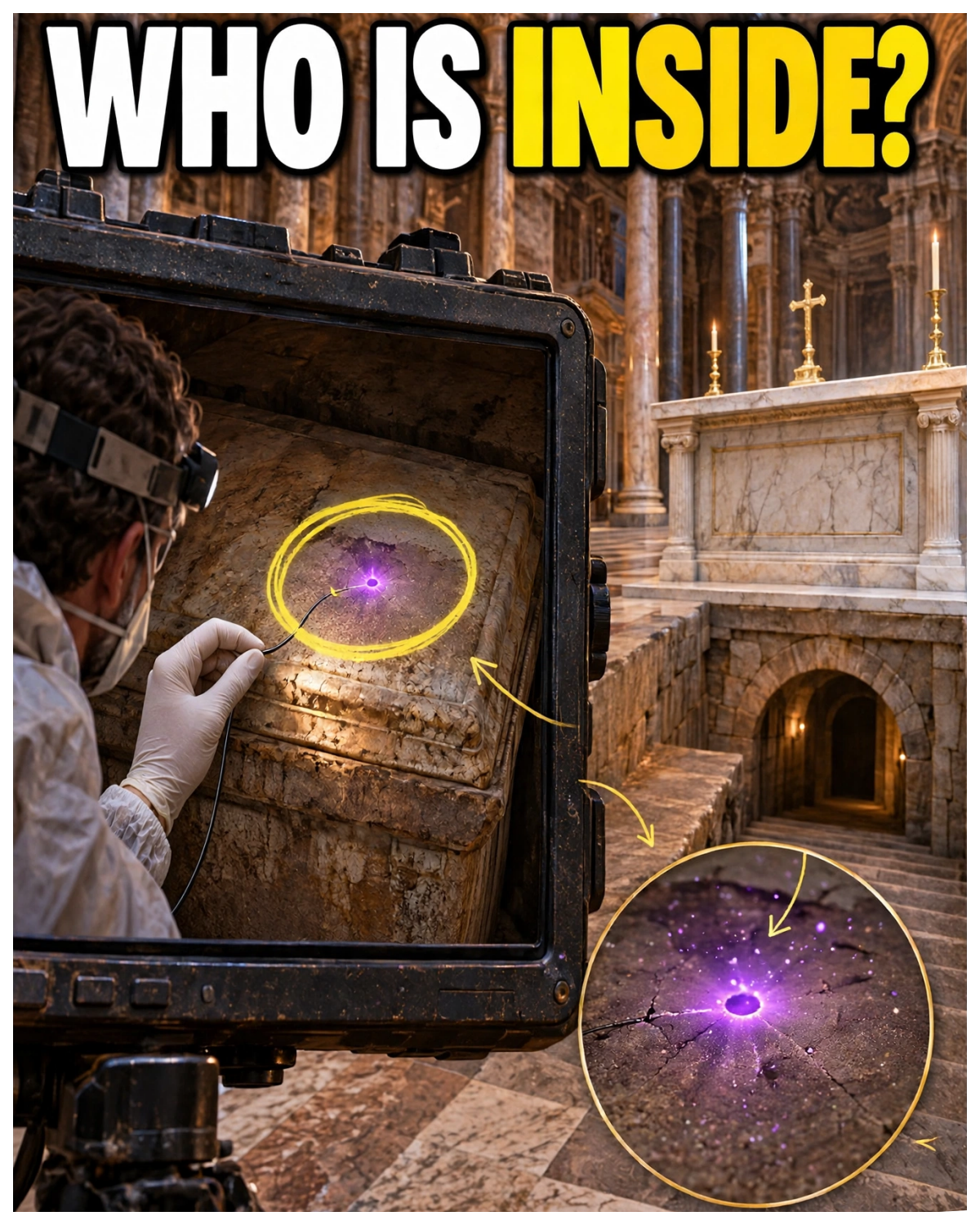
The Bible’s greatest apostle may still be inside Rome.
The year 2009.
Inside one of the largest churches in the world beneath the main altar in a narrow space cut into the old foundations.
A small team of Vatican specialists works beside a block of stone.
It is a sarcophagus, a stone coffin, massive [music] and very, very old.
No one in modern times had ever seen inside it.
Now a thin drill touches the stone.
Slowly, carefully, it bores a tiny hole.
A small probe slides through the opening and disappears into the darkness of the coffin.
And when the results came back, the Pope himself stood before the world and made an announcement.
The evidence, he said, seemed to confirm what Christians had believed for almost 2,000 years.
That inside this stone box lie the remains of the Apostle Paul.
Paul, the man whose name stands on 13 of the 27 books of the New Testament.
The man who carried the message of Jesus across land and sea through riots, shipwrecks, beatings, and prisons.
The man many called the greatest apostle who ever lived.
What did that probe touch in the dark?
What colors did it bring back to the light?
And how could anyone know after 2,000 years whose bones these really are?
To answer that, we cannot start at the tomb.
We have to follow the trail that leads to it.
A trail of stones, inscriptions, courtrooms, and prison cells scattered across the Roman world.
[music] Places that archaeologists have pulled out of the earth one by one.
Places that, by every normal rule of history, should have vanished long ago.
And each one of them, as you will see, matches the pages of the Bible.
But first, one question every viewer asks the moment they hear this story.
Wasn’t Paul beheaded?
Yes, that is what the oldest Christian tradition tells us.
Paul was a Roman citizen, and the law of Rome did not allow a citizen to be crucified.
The punishment for a citizen was the sword.
According to that tradition, sometime in the middle of the 60s during the reign of the emperor Nero, Paul was led outside the walls of Rome and executed.
But an execution was not the end of the story.
Someone took his body.
Someone buried it.
And the place where they buried it was never forgotten.
Around the year 200, a Christian writer in Rome named gas wrote a short confident sentence.
The historian Eusebius copied it into his history of the church and that is how it survives today.
Gaas wrote that he could show anyone the monuments of the apostles.
If you go to the Vatican, he said, or to the road to Austia, you will find the monuments of those who founded this church.
And from the earliest times, Christians have identified the road to Austia as the place of Paul, the road to Austia, the Via Oens, the old highway that ran from Rome down to the sea.
Less than 150 years after Paul died, the Christians of Rome were already pointing to one specific spot on one specific road and saying, “This is where he lies.”
And then something remarkable happened.
The empire that killed Paul changed sides.
In the early 300s, the emperor Constantine ended the persecution of Christians.
And on that exact spot, beside the road to Austia, he built a small church over the grave.
Only a few decades later, around the year 386, three emperors ruling together decided that a small church was not enough.
They ordered a vast basilica, one of the greatest buildings of the ancient world, with rows of columns stretching like a forest of stone.
And they made a striking decision.
To make room for the larger church, they turned the entire design around so that the building faced the other way.
But the grave did not move.
The new altar was placed exactly over the same spot.
They did not move the apostle to fit the building.
They moved the building to fit the apostle.
For,400 years, pilgrims walked through that forest of columns.
Kings knelt there.
Ordinary farmers and widows knelt there.
Under the altar, a marble slab covered the place of the grave.
And carved into that slab in letters that can still be read today were three Latin words.
Paulo, aposttolo, mart, to Paul, apostle, martyr.
And in that marble slab, there were holes, one round, two square.
Scholars believe pilgrims used them to lower small pieces of cloth down toward the grave so that the cloth could touch the place of the apostle.
Then they would pull it back up and carry it home [music] to churches that would never see Rome.
Then came the night of July 15th, 1823.
A fire broke out in the roof of the basilica.
[music] Workers had been repairing it, and the flames caught the ancient wooden beams.
By morning, most of the great church that had stood for 14 centuries was a ruin of blackened columns and collapsed walls.
But the fire did not reach what lay beneath the floor.
The altar area was cleared.
The church was rebuilt over the following decades, and in 1854, it was consecrated again.
The grave [music] stayed where it was, hidden, covered, untouched, and there the story could have ended.
A pious tradition, a marble slab, and a mystery that no one would ever be allowed to open until a Vatican archaeologist named Giorgio Filipe started asking a simple question.
What exactly is under that slab?
Between 2002 and 2006, Philippe and his team began excavating beneath the altar.
They worked in tight spaces under one of the most sacred spots in the Christian world, removing layer after layer of later construction.
And at the end of 2006, they announced what they had found.
A sarcophagus exactly where the tradition had always said the apostle lay [music] sitting below the marble slab with the words to Paul Apostle Martyr aligned with the remains of the small church of Constantine.
The coffin dates according to the archaeologists to at least the late 300s the time of the great basilica when the remains were placed in it with great honor.
For the first time in modern history, human eyes could see the stone box itself.
The Vatican opened a small window so pilgrims could look at one side of it.
But no one opened the lid.
Why not?
Because some things are not opened lightly.
To lift that lid would be to disturb what Christians around the world consider one of the holiest graves on earth.
So instead, 3 years later, they chose a different path.
They would not open it.
They would look inside without opening it.
And that is what happened in 2009 with the drill, the tiny hole, and the probe sliding into the dark.
We will come back to that moment.
We will see exactly what they found, and we will look honestly at what it proves and what it does not.
But to understand why those few fragments matter so much, we need to know the man.
Because if this really is Paul, then the bones in that box once walked thousands of miles across the Roman world.
And the places he walked are still there.
Some of them were found by archaeologists only in the last century or so.
Some of them are carved with names that appear in the Bible.
And one of them, a dark room beneath the palace of a king, was revealed only very recently.
He was not always a hero of the faith.
He was born in Tarsus, a busy city in what is today southern Turkey.
His Hebrew name was Saul.
He was trained in Jerusalem under one of the most respected teachers of the law, a man named Galio.
And by his own words, he was more zealous than most young men of his generation.
So zealous that when the followers of Jesus began to spread through Jerusalem, Saul hunted them.
The book of Acts says he went from house to house dragging men and women off to prison.
When a young believer named Steven was stoned to death, Saul stood there and watched, guarding the coats of the men who threw the stones.
Then on the road to Damascus, everything changed.
A light from heaven brighter than the noonday sun threw him to the ground.
A voice called his name, Saul.
Saul, why persecutest thou me?
And when Saul asked who was speaking, the answer broke him.
I am Jesus whom thou persecutest.
The hunter became the hunted.
The man who had imprisoned Christians would spend years of his life in prison for being one.
And from that day on he set out on journeys that would cover, by some estimates more than 10,000 m on foot, on ships, through mountains full of robbers and seas full of storms.
For a long time, many critics treated the book of Acts, which tells these journeys, as a pious story written long after the fact.
They said, the details were invented, the names of officials, the titles, the places.
Surely, they said, an ancient writer could not have gotten all of that right.
Then the stone started talking.
The first stop on our trail is the island of Cyprus.
Acts 13 tells us that Paul and his companion Barnabas crossed the island to the city of Papathos.
There they met the Roman governor of Cyprus, a man the Bible calls Sergius Paulus and describes as quote a prudent man.
The governor called for Paul because he wanted to hear the word of God.
And by the end of the chapter, Sergius Paulus believed.
For centuries, that name existed only on the page of Acts.
Then in Rome, an inscription was found that lists the officials who were in charge of the banks of the river Tyber during the reign of the emperor Claudius.
That is the same emperor who ruled when Paul made this journey.
And on that list is a man named Lucius Sergius Paulus.
Was this the same man?
[music] Some historians believe it was or that he belonged to the same powerful family.
And there is a detail that makes scholars lean forward.
Early in the 20th century, the archaeologist William Ramsay found inscriptions in the region of Pacidian Antioch in the heart of modern Turkey linked to the family of the Sergi Powi who owned land there.
Now, open your Bible to the very next verses of Acts 13.
Where does Paul go immediately after meeting the governor of Cyprus?
He sails to the mainland and travels straight up into the mountains to Pacidian Antioch.
The Bible does not say why he chose that difficult road, but some scholars think the answer may be written in those stones.
A grateful governor may have given the apostle a letter of introduction to his own family’s land.
Remember this pattern.
It will happen again and again.
Paul crossed into Europe and the first city where he stayed gave him a taste of what was coming.
Philippi was a proud Roman colony in northern Greece and archaeologists from France and Greece have uncovered much of it.
Its forum, its theater, its paved main road, the Via Ignatia, the great Roman highway that Paul walked on.
Today, the ruins of Philippi are a UNESCO world heritage site.
In Philippi, [music] Paul and his companion Silas were dragged before the city magistrates, stripped and beaten with rods.
Then they were thrown into the inner prison with their feet locked in the stocks.
Visitors to Philippi today are shown a small underground chamber that local tradition calls the prison of Paul.
Archaeologists are cautious.
The structure may have been a sistern or a small shrine.
And there is no proof it was the jail.
But the story the Bible tells about that night does not depend on finding the exact room.
Because at midnight in the dark with their backs torn open and their feet in the stocks, Paul and Silas did something no one expected.
They sang.
Acts 16 says they prayed and sang praises unto God and the prisoners heard them.
Then came an earthquake.
The foundation shook.
Every door flew open and every chain fell loose.
The jailer, sure that his prisoners had escaped, drew his sword to take his own life.
[music] And Paul cried out with a loud voice, “do thyself no harm, for we are all here.”
That night, the jailer and his whole family believed, “Hold on to that picture.
A man singing in a dark prison, because it is the same man we will meet again years later beneath the palace of a king.”
From Philippi, he went on to Thessalonica and was chased out of that city, too.
He stood on the rocky hill of the Aropagus in Athens, a hill that tourists still climb today, and spoke to the philosophers about an unknown god.
And then he arrived in Corinth.
Corinth was the New York of its day, rich, crowded, loud, and wild.
A city of sailors and merchants sitting on a narrow strip of land between two seas.
And Paul stayed there for a year and a half, making tents with a couple named Aquila and Priscilla and building a church.
Now the trail becomes extraordinary.
Acts 18 says that while Paul was in Corinth, a new Roman governor arrived for the province of Aaya.
His name was Gallo.
And the Jewish leaders who opposed Paul seized their chance.
They dragged him before the new governor to the judgment seat and accused him.
Gallo listened for a moment and then threw the case out.
If it were a matter of crime, he said, I would hear you, but this is a question of words and names and your own law.
Look to it yourselves.
And he drove them from the judgment seat.
Gallo, the judgment [music] seat.
Two details, and archaeology has found both.
Let’s start with Gallo.
At the beginning of the 20th century, French archaeologists excavating at Delelfi in Greece found several broken fragments of stone.
When the pieces were put together, they turned out to be part of a letter written by the emperor, Claudius himself, and carved into stone for public display.
In that letter, the emperor refers to quote, “Junius Gallo, my friend and proconsul.”
The same Gallo, the same title the Bible gives him.
And because the letter mentions a specific moment in Claudius’s reign, historians can date it.
It points to the years 51- 52 after Christ.
Do you see what that means?
Few discoveries do what this one stone does.
It pins a scene from the book of Acts to a date on the calendar.
Scholars around the world, believers and skeptics alike, use the Gallo inscription as the anchor for the entire timeline of Paul’s life.
When you read in a textbook that Paul was in Corenth around the year 50 or 51, that date comes from this stone.
And we know something else about this man from history.
Gallio was the brother of Senica, one of the most famous philosophers of Rome, a man of the highest circles of the empire, standing for a moment face to face with a tent maker from Tarsus and refusing to condemn him.
Now the judgment seat in the Greek of the New Testament, the word is bema, a raised platform where officials sat to hear cases and speak to the crowd.
Since the late 1800s, archaeologists of the American School of Classical Studies at Athens have been excavating the ancient city of Corinth.
[music] And right in the center of the old marketplace, the Forum, they uncovered a tall stone platform, a speaker stand raised above the open square where a Roman official could sit and face the people, the Beimma of Corinth.
You can stand in front of it today.
The stones are worn.
The marble facing is mostly gone, but the platform is still there in the heart of the city, exactly where a governor would have heard a case like Paul’s.
And many visitors never notice this detail.
Centuries later, Christians built a small church right on top of that platform.
Many believe they built it there to remember the day Paul stood accused on this spot and walked away free.
One more stone in Corenth.
At the end of his letter to the Romans written while he was in Corenth, Paul sends greetings from several believers.
One of them is a man named Iraus and Paul gives him a title.
In the King James version, it reads Eraus, the chamberlain of the city.
In modern translations, Eraus, the city treasurer.
In other words, a public official, a man with a position.
In 1929, archaeologists working near the theater of Corinth uncovered a section of stone pavement.
Cut into it in large Latin letters that were once filled with bronze, was a sentence.
Eraus, in return for his office, laid this pavement at his own expense.
Eraus, [music] a public official of Corinth, paying for a street out of his own pocket.
Now, honesty matters here because some scholars debate this one.
Some think the pavement was laid a little later than Paul’s time and that it may be a different Iraus.
Others argue the dating fits and that a city of Corinth’s size would not have had many wealthy officials with this rare name.
The question remains open.
A governor in Cyprus, a proconsul in Corinth, [music] a judgment seat, an officials pavement.
Each one a detail that a careless storyteller would get wrong.
Each one found in stone.
But Paul’s journey was about to grow darker, much darker, because the next city on his road would erupt into one of the most dangerous riots in the New Testament, Ephesus.
On the western coast of what is today Turkey, Ephesus was one of the largest cities of the Roman Empire.
And it was famous for one thing above all.
It was home to the great temple of the goddess the Romans called Diana.
One of the wonders of the ancient world.
An entire economy was built around that temple.
Pilgrims, priests, festivals, [music] and an army of craftsmen who sold small silver shrines of the goddess.
Paul stayed in Ephesus for about 3 years.
And he preached a simple message.
Gods made with hands are not gods.
So many people believed that the silver trade was in danger.
Acts chapter 19 tells us that a silver smith named Demetrius gathered the craftsmen together and warned them that their business was at risk.
The crowd exploded.
They seized two of Paul’s companions and rushed with one accord into the theater.
And for about 2 hours, thousands of voices shouted the same words over and over.
Great is Diana of the Ephesians.
Paul wanted to walk into that theater and face the crowd.
His friends would not let him.
They knew what would happen.
And that theater still stands.
Archaeologists from Austria have been excavating Ephesus since the 1890s, and the great theater has been uncovered and restored.
It rises against the side of a hill, [music] row upon row of stone seats.
Experts estimate it could hold about 24,000 people.
Close your eyes for a moment and picture it full.
24,000 people, red-faced and furious, their voices echoing off the stone for 2 hours.
That is not a small disturbance in a village square.
That is the scale of the event that Luke, the author of Acts, describes.
And when you stand on those seats today, you understand why Paul’s friends begged him to stay away.
The temple of Diana, by the way, the wonder of the world that the crowd was defending.
Today only a single column stands in a swampy field.
The theater where they screamed against the gospel still stands.
And the message they tried to silence has spread to every nation on earth.
From Ephesus, Paul’s journeys led him back toward Jerusalem.
And everywhere along the way, believers warned him, “Don’t go.”
A prophet named Agabus took Paul’s belt, tied his own hands and feet with it, and [music] said, “So shall the Jews at Jerusalem bind the man that owneth this girdle?”
Paul’s answer is one of the most moving lines in the whole book.
What mean ye to weep and to break mine heart?
[music] For I am ready not to be bound only, but also to die at Jerusalem for the name of the Lord Jesus.”
He went anyway, and it happened just as they said.
In the temple courts, a crowd recognized him, accused him falsely, and nearly beat him to death.
Roman soldiers rushed in and dragged him away in chains.
Then the commander learned of a plot.
More than 40 men had sworn an oath not to eat or drink until they had killed Paul.
So in the middle of the night, the Romans moved their prisoner.
200 soldiers, 70 horsemen, and 200 spearmen escorted one man in chains down out of the hills toward the coast.
Their destination was Cesaria.
And this is where we arrive at the dark room.
Cesaria was a city built by King Herod the Great.
The same Herod who according to the Gospel of Matthew ordered the killing of the infants of Bethlehem.
Herod was a builder of astonishing ambition.
And at Cesaria, he created a city out of nothing on the open coast, an artificial harbor pushed out into the Mediterranean, a theater, a hippodromeome for chariot races, and on a rocky point of land jutting into the sea, his own palace.
It was a palace with a view of the waves on three sides, and in its lower courtyard, a large swimming pool cut into the rock surrounded by the sea.
Later when Rome took direct control of Judea, the Roman governors of Judea made this palace their home.
This is where they lived.
This is where they judged.
And it is the building the Bible names when Paul arrives.
Acts 23:35.
The governor commanded him to be kept in Herod’s judgment hall.
The Greek word is ptorium.
The governor’s headquarters, the palace of Herod.
Archaeologists have been uncovering this palace for decades.
Israeli and international teams have mapped its rooms, its courtyards, its great pool, its halls for receiving guests.
And Cesaria has already given the world one of the most famous discoveries in biblical archaeology.
In 1961, Italian archaeologists working in the theater of Cesaria turned over a stone that had been reused in a later building.
On its face was a Latin inscription that included a name, Pontius Pilatus, Pontius Pilate, the governor who sentenced Jesus.
It was the first time his name had ever been found carved in stone from his own lifetime.
Pilate had ruled from this very city.
So when the Bible says the Roman governors held court in Herod’s palace at Cesaria, the stones agree.
But what about Paul?
Where in this palace was he kept?
In recent years, archaeologists of the Israel Nature and Parks Authority have drawn attention to a space beneath the palace grounds.
It was built as a sistern, a large underground tank designed to hold the fresh water a palace needs to survive on a dry coast.
But at some point, the water stopped coming.
Once the great aqueducts were bringing fresh water into the city, a sistern like this was no longer needed.
And the Roman authorities turned it into something else.
A prison, a stone room underground, dark, closed, and close to the sea where the air would likely have been heavy and humid.
The archaeologists say it was larger than the part visitors can see today with a second chamber of the same size and that dozens of prisoners could have been held there at one time and inside they found writing an inscription from a later period left by someone who had been there just a few words Lord help Precopia we do not know who Proopia was a prisoner perhaps or someone who loved a prisoner But in that dark room, someone wrote a prayer on the wall, and it waited there for centuries until archaeologists read it again.
Was this the room where Paul was kept?
Many believe it may be.
It was the prison of the governor’s palace, the very building the Bible names.
But we must be honest because the Bible gives us one more detail.
Acts 24 23 says the governor ordered that Paul be guarded but that he should have some liberty and that his friends should be allowed to visit and care for him.
So Paul may have been held in this sistern or in another part of the palace under a lighter guard.
The text does not tell us which room.
What it does tell us is how long he stayed.
[music] 2 years.
Two full years in the palace of Herod.
Why so long?
Paul had done nothing wrong.
The charges against him were confused and weak.
Any fair governor would have released him.
The Bible gives the answer and it is not flattering to Rome.
The governor was a man named Felix.
The Roman historian Tacitus wrote that Felix used the power of a king with the mind of a slave through every kind of cruelty and lust.
And Acts 24 26 says this.
He hoped also that money should have been given him of Paul that he might loose him.
Wherefore he sent for him the oftener and communed with him.
He was waiting for a bribe.
Paul never paid it.
The man who once sang at midnight in the prison of Philippi was waiting in the dark again.
And once again he did not stay silent.
Instead, every time Felix called him, Paul talked to him about God.
One day, Felix came with his wife, Drusilla, and Paul spoke to them about righteousness, about self-control, and about the judgment to come.
And the Bible says something astonishing.
Felix trembled.
The most powerful man in the province trembled before his own prisoner, and then he sent him away.
Go thy way for this time.
When I have a convenient season, I will call for thee.
That convenient season never came.
After two years, Felix was replaced, and he left Paul in chains to please his enemies.
The new governor, Fesus, heard the case again, and when it became clear that Paul would never get a fair trial in that land, he used the one right that a Roman citizen had.
He spoke four words that changed the course of his life.
I appeal unto Caesar.
But before Paul was sent to Rome, one last scene took place in Herod’s palace.
King Herod Agria II, great grandson of the Herod who built this palace, came to visit with his sister Bernice, and the Bible says they entered the audience hall with great pomp, surrounded by military commanders and the leading men of the city.
The prisoner was brought in.
Picture it.
Royal robes, gold, soldiers, and in the middle of it all, one man with chains on his wrists.
Paul told them his whole story, the light on the road to Damascus, the voice of Jesus.
And then he turned to the king and asked him directly, “King Agria, believest thou the prophets?
I know that thou believest.”
And Agria answered with one of the most haunting sentences in scripture.
Almost thou persuadest me to be a Christian.
Almost.
Paul did not let it go.
He said, I would to God that not only thou, but also all that hear me this day were both almost and altogether such as I am except these bonds, except these chains.
After the hearing, Agria turned to Fesus and admitted the truth.
This man might have been set at liberty if he had not appealed unto Caesar.
[music] He was innocent.
Everyone in the room knew it.
And he was sent to Rome anyway.
The voyage was a disaster.
A storm the Bible calls uricidon drove the ship across the sea for 14 days.
No sun, no stars, every hope lost.
And in the middle of the storm, Paul stood up among the terrified sailors and said, “Be of good cheer, for there shall be no loss of any man’s life among you.”
The ship broke apart on the island of Malta, and every one of the 276 people on board reached the shore alive.
And at last, Paul arrived in Rome.
Acts tells us he lived there for two whole years in his own rented house, chained to a soldier, receiving everyone who came to him [music] and preaching the kingdom of God with all confidence.
No man forbidding him.
That is where the book of Acts ends.
Suddenly, without telling us what happened next, but Paul’s own letters and the oldest Christian writers tell us the rest.
During those years in Rome, Paul kept writing letters to the churches he loved.
And in one of them, the letter to the Philippians, which many scholars believe he wrote from Rome, there is a small line that tells us how far the gospel had reached.
At the very end, Paul sends greetings from the believers in Rome, and he adds, “Chiefly, they that are of Caesar’s household.
The prisoner in chains had brothers and sisters among the emperor’s own servants.
The oldest Christian writers say that Paul was eventually released and that he traveled again.
But later during the terrible persecution under Nero, he was arrested a second time.
[music] And this time there was no rented house.
His last letter, the second letter to Timothy, was written from that final imprisonment.
It is one of the most personal pages in the entire Bible.
Paul is old now.
Winter is coming.
He asks Timothy to bring the cloak he left behind in the city of Trrowass and his books and especially the parchments.
He writes that at his first hearing, no one stood with him.
Everyone abandoned him.
And then in the middle of all that loneliness, he writes these words, “For I am now ready to be offered, and the time of my departure is at hand.
I have fought a good fight.
I have finished my course.
I have kept the faith.
Henceforth there is laid up for me a crown of righteousness, which the Lord, the righteous judge, shall give me at that day, and not to me only, but unto all them also that love his appearing at that day.
Paul was not looking at the executioner.
He was looking past him to the day Jesus returns.
According to the ancient tradition, they led him out of the city along the road toward the sea.
Not far from that road, at a place later called Tontane, the three fountains, a soldier raised his sword.
And then, the tradition says believers came for the body [music] and buried it in a cemetery beside the road to Oia, a simple grave among other graves.
The grave that gas would point to around the year 200.
The grave that Constantine would cover with a church.
The grave that three emperors would honor with one of the largest basilas ever built, twisting the whole building just to keep the altar above it.
The grave that survived the great fire of 1823.
The grave where in [music] 2009 a drill touched the stone.
So now let’s go back to that moment.
Let’s go back under the altar.
The hole is drilled.
The probe slides in.
It moves slowly through the darkness inside the coffin.
And it begins to bring back pieces of what is inside.
Fabric.
A piece of precious linen dyed purple and decorated with gold.
Purple.
In the Roman world, purple dye was one of the most expensive substances on Earth.
It came from tiny sea snails, thousands of them for a single garment.
Purple was the color of emperors and kings.
You did not wrap just anyone in purple and gold.
Whoever placed these remains in this coffin believed they were honoring someone of supreme importance.
A piece of blue linen, small grains of red incense, incense placed with the dead as an act of reverence, as if the whole grave were a kind of offering, [music] and bones, tiny fragments of human bone.
The Vatican sent these fragments to be tested by carbon 14 dating, a scientific method that measures the age of organic material.
The specialists who ran the tests did not know what they were testing.
The result came back.
The bones belonged to a person who lived in the first or 2nd century after Christ.
On June 28th, 2009, at the close of a special year dedicated to the Apostle Paul, Pope Benedict I 16th announced these findings publicly in the very Basilica where the coffin lies, and he said that the results seem to confirm the unanimous and undisputed tradition that these are the mortal remains of the Apostle Paul.
The headlines went around the world.
Now, let’s be careful.
Let’s be fair, because you deserve the full truth and not a story that collapses the moment someone checks it.
What has been proven?
A stone coffin exists beneath the altar, exactly where the tradition said it would be.
It lies under a slab that calls its occupant Paul, apostle and martyr.
It sits on the site of Constantine’s church and on the road to Austia where Christians already placed Paul’s grave around the year 200.
Inside there are human bones from the first or second century [music] wrapped in purple and gold and honored with incense.
What has not been proven that the bones belong to Paul himself.
There is no inscription inside the coffin with his name.
There is no way to test his DNA because we have nothing of his to compare it with.
The carbon dating tells us the age of the bones.
It cannot tell us the name of the man.
So the honest answer is this.
Every piece of evidence we have points in the same direction.
The age fits, the place fits, the honor fits.
The tradition is one of the oldest and most consistent of any Christian grave.
And not a single piece of evidence points anywhere else.
Is he inside?
[music] He may very well be.
And here is something that surprises many people who study this story.
Paul himself would not have cared.
Listen to what he wrote about his own body in his second letter to the Corinthians.
We have this treasure in earthn vessels, clay jars, ordinary pots.
That was how he saw his body, not as a relic, just a fragile container for something far more precious.
And listen to how he described himself in his first letter to the Corinthians.
For I am the least of the apostles, that I’m not me to be called an apostle because I persecuted the church of God.
But by the grace of God, I am what I am.
The man the world calls the greatest apostle called himself the least.
He never forgot the coats at his feet the day Steven died.
He never forgot the families he had torn apart.
And that is exactly why his story is so powerful.
Because if the grace of God could take the man who hunted Christians and turn him into the one who would carry the name of Jesus to the ends of the earth, then there is no one beyond the reach of that grace.
Not you, not anyone you love.
Look back at the trail.
A governor in Cyprus, a proconsul in Corenth, a theater [music] in Ephesus, a palace in Cesaria where a prisoner made a governor tremble, and a stone coffin beneath an altar in Rome.
Critics once said the book of Acts was a legend.
The ground has spent the last century answering them one stone at a time.
But the greatest evidence of Paul’s life is not under an altar in Rome.
It is the fact that you are hearing his words today, 2,000 years later, in languages he never heard of, in countries he never knew existed.
The emperor who executed him is remembered as a tyrant.
The man he executed is remembered as one of the greatest servants of God who ever lived.
Paul’s bones, whoever’s bones they are, are waiting, not in the darkness forever.
Paul knew exactly what he was waiting for.
[music] He wrote it to the believers in Thessalonica.
For the Lord himself shall descend from heaven with a shout, with the voice of the archangel, and with the trump of God, and the dead in Christ shall rise first.
That is why the stone coffin under the altar is not the end of the story.
For Paul, it is only a waiting room.
He finished his course.
He kept the faith.
And somewhere beneath that altar or wherever he truly rests, the man who called himself the least of the apostles is waiting for the morning of that day.
And he said the same crown is waiting for all who love his appearing.
Now I’d like to hear from you.
Of all the discoveries on Paul’s trail, the Gallo stone, the judgment [music] seat, the theater of Ephesus, the prison beneath Herod’s palace, or the coffin under the altar.
[music] Which one strengthened your faith the most?
Tell me in the comments.
And if you want to keep walking with us through the real places of the Bible, subscribe to Cities Uncovered.