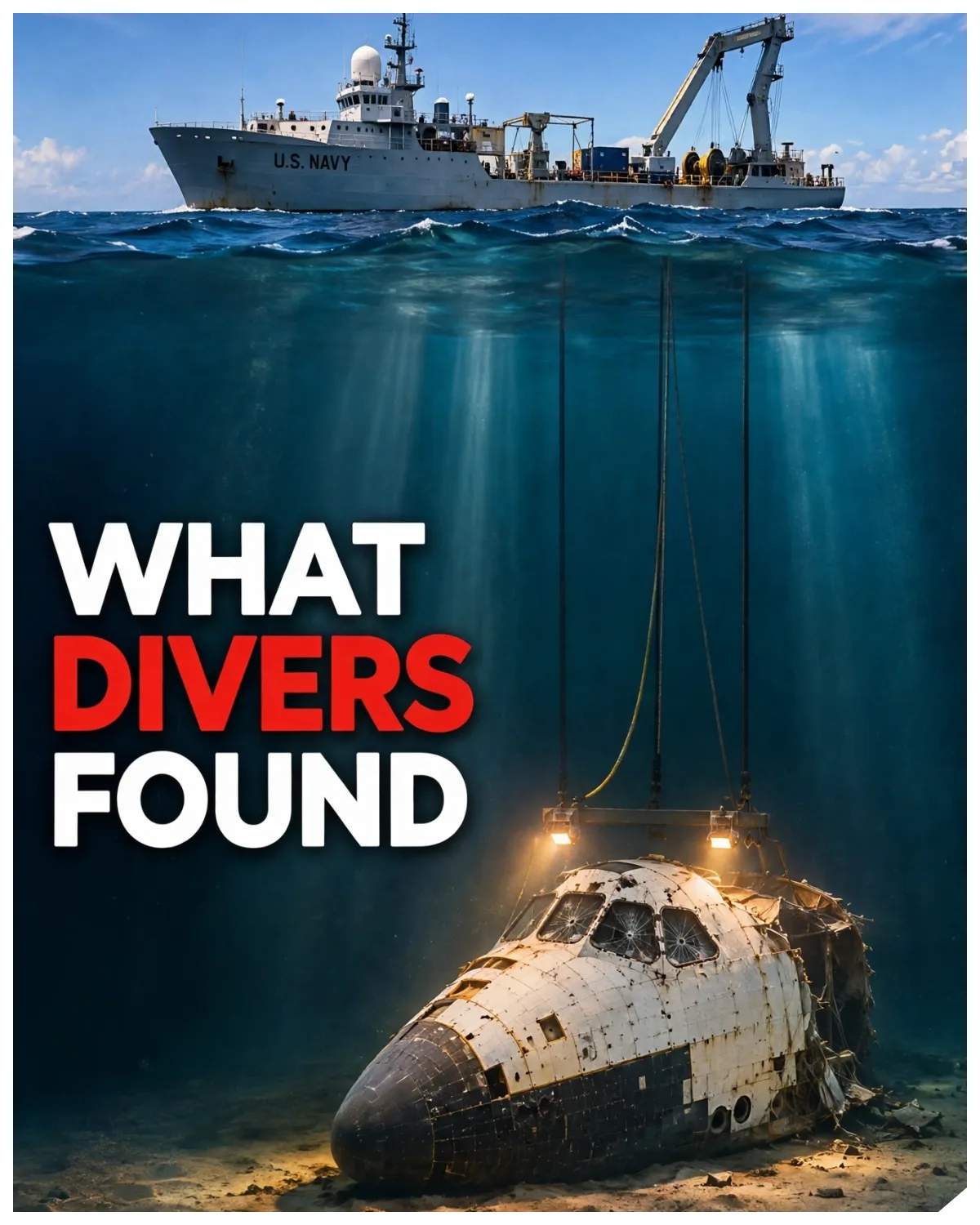
100 ft under the Atlantic, two divers with 6 minutes of air left see a space suit puffed up with air, its legs floating upward, they’ve found Challenger’s crew cabin.
Nobody has told seven families yet whether anyone inside lived through the breakup.
Did they?
And if they did, for how long?
Whatever the Seven left behind is lying in that wreck, and NASA will spend years in court keeping part of it to itself.
Friday, March 7th, 1986, off Cape Canaveral, Florida.
The divers are Terry Bailey and Mike Mallister.
Wind on the surface has stirred up the bottom, and they can see about as far as they can reach.
Seven people rode in that cabin.
Dick Scobby, the commander, who had flown this same orbiter once before.
Mike Smith, the pilot, from Bowurt, North Carolina, on his first flight after nearly 6 years of waiting.
Judy Resnik and Ellison Onuzuka, both on their second trip to space.
Ron McNair, a laser physicist, Greg Jarvis, a satellite engineer, and Christa McAuliffe, a teacher and a mother of two.
Bailey knows shuttle crews launch in cloth flight suits, not space suits, so this one must be a spare.
Packed in the cabin, the two men look at each other.
They have found the cabin.
There’s no air left to look further.
They tie a buoy to the wreck and head up.
And before the day is out, the salvage team knows somewhere in that tangle are four small air packs.
They’ll keep investigators busy until the summer.
Early the next morning, the Navy’s salvage ship preserver sails for the buoy.
She’s 200 ft long with a crane at each end and a recompression chamber on deck for divers who come up too fast.
22 divers live aboard.
They breathe air pumped down from the ship and they carry cameras with them.
They go down and confirm it.
The cabin is there and so is the crew.
But the cabin sat inside a shuttle that blew apart 9 mi up.
How did it get down here in pieces you could still recognize?
Go back 38 days to Tuesday, January 28th, 73 seconds after liftoff.
The big orange fuel tank splits open and Challenger is shoved sideways into air, rushing past at almost Mach 2.
The orbiter comes apart in about a second.
The crew sat in a sealed aluminum shell inside the nose, held in by just four fittings.
It tears loose at one ring of the airframe number 582.
The cabin’s back wall goes with it, and so does the outer skin around it.
The instruments measuring the jolt went dead 2/10 of a second into it, so the rest was worked out from film.
Two separate teams did the sums and landed close together.
At worst, 12 to 20 times the pull of gravity.
For a moment.
Inside 2 seconds, it was below four.
Navy jets pull that much in a hard turn, and Smith had flown them for years.
NASA’s film team later went through the tracking footage frame by frame.
After 10 seconds, the crew cabin was seen again with the front end and top of the cabin visible.
Carried by its own speed, the shell keeps rising for about 25 seconds up to 65,000 ft.
Then it noses over for close to a minute.
It never drops below 48,000 ft.
The whole fall lasts 165 seconds.
It hits the sea nose down, banks steeply to the left at more than 200 mph.
Mach 2 couldn’t break it.
1 second of water does.
So the shell held together all the way down.
Were the seven people in it still alive when it reached the water?
In March, the divers can’t just swim into the cabin.
A bulkhead lies twisted across the way in, and torn metal sticks out everywhere, sharp as knives.
Working in the merc around it is too dangerous.
So, they ask for the wreck itself to be brought up.
Preserver’s cranes lift it out piece by piece.
The ship’s crew stands on deck in silence, and so do the astronauts sent to oversee the recovery.
Over the next four weeks, Preserver’s divers bring the crew home one by one.
Once as a piece of the mid deck rises, the current carries Greg Jarvis away.
Divers will find him five weeks later, 200 yards off.
By April 4th, preservers work on the cabin is done.
About 3/4 of the cabin comes back with the skin around it.
The seats come up too, and the cabin’s tape recorder and four of the crews air packs.
Every seat on the shuttle had one.
A metal bottle of plain breathing air, a hose up to the helmet, and a valve that someone had to open by hand.
It was built for one job, walking out through smoke if a fire broke out on the launchpad.
Seven packs flew that morning.
The divers found four.
They’re tagged and boxed with everything else.
If any of them had been opened, someone was alive after the breakup.
Which ones?
It will be the summer before anyone says.
The job of answering goes to Joseph Kerwin, a Navy doctor who flew on Skyab’s first crew and now heads life sciences at NASA in Houston.
His team goes over the wreck one piece at a time.
The four fittings that held the cabin in the seats, the shell, the floors of both decks, every hole where wires and pipes pass through the wall.
They study the window glass under microscopes, and test it with chemicals.
Jammed in the frame between two of the front windows, they find a piece of debris.
Nobody can tell where it came from or whether it hit in the air or in the water.
Some gear stowed in the lockers looks as if a sudden loss of pressure hit it.
So, they take the same kind of gear and drop the pressure on it in a test chamber.
The result proves nothing.
Then the seats.
Everyone was still in place when the cabin hit the water with someone in it and every set of straps still locked.
Nobody had unbuckled.
Kerwin writes that this is what you’d expect if they blacked out fast [music] and in the next breath that it isn’t proof.
A team from the Armed Forces Institute of Pathology works on the hardest question of all.
They can’t say what killed the crew either.
So, did the cabin leak 9 mi up or did it hold its air?
Nobody could say.
The impact had wiped out the proof either way.
On June 9th, the presidential commission hands in its report.
It pins the accident on a booster seal and it has next to nothing to say about the seven people in the cabin.
In its list of everything the divers raised.
Most pieces get a contact number where the crew compartment’s number should be.
There are four stars.
The cargo rows have stars, too.
So, it may only mean the cabin came up as many contacts.
Still, of every row in that table, it’s the one the families would have looked for first.
[music] On July 28th, NASA hands out Kerwin’s letter.
Its first finding, no one can say for sure what killed the crew.
[music] The same day, NASA puts out a typed transcript of the cabin’s recorder.
It switched itself on 2 minutes before launch.
Its words stop at 73 seconds when the data does.
The sound itself, NASA keeps.
The New York Times sues to hear it.
In 1988, an appeals court panel sides with the paper.
Two years later, the full court sides with NASA, six votes to five, and sends the case back down.
In December 1991, a judge decides for good.
The family’s privacy outweighs the public’s right to the voices.
The tape has never been played in public.
The cabin itself is out of sight, too.
Its pieces lie sealed in the side rooms of an old missile silo at Cape Canaveral.
Here is how Rocket Yard reads the evidence from the lab.
The locked straps say less than they seem to.
In a tumbling cabin with no hatch anyone could reach, there was nothing to unbuckle for.
People who were wide awake would have stayed strapped in, too.
The height tells us more.
Aviation medicine gives a pilot without pressure about 9 to 15 seconds of useful consciousness at 45,000 [music] ft.
This cabin spent close to a minute above 48,000.
If the shell leaked early, the crew had seconds.
[music] But Kerwin found no proof of a leak, and the breakup forces on their own wouldn’t have cracked the windows.
A sealed cabin is just as likely as a leaking one.
If it held, some of the seven could have been awake for most of the fall.
The airpacks will push that reading further.
Long before the courts were done, the families had made their own choice about what to remember.
The entire world knew how the Challenger crew died.
We wanted the world to know how they lived and for what they were risking their lives.
But the family still wanted to know one thing about those air packs.
Somebody had to have opened them.
Who the pilot that day was a man the president had talked [music] about 3 days after the launch at the memorial in Houston.
We remember Michael Smith who earned enough medals as a combat pilot to cover his chest including the Navy Distinguished Flying Cross, three Air Medals and the Vietnamese Cross of Gallantry with Silver Star in gratitude from a nation he fought to keep free.
Mike Smith flew in the right front seat.
His wife had watched the launch from the Cape with their three children.
So, what was inside Challenger’s crew cabin?
Four air packs and three had been turned on.
Not by the water.
The investigators ruled that out.
The one still shut belonged to the commander, Dick Scobby.
One of the three that had been opened was the pilots.
Astronauts who trained in those seats say Mike Smith’s valve was fixed behind him on the back of the pilot seat.
Strapped in and facing forward, he couldn’t reach it.
Two people sat in the row behind him, Ellison Onuzuka and Judy Resnik.
One of them reached forward in a cabin falling from 9 mi up and opened his air.
Which one?
Kerwin never says.
Our reading is Judy Resnik.
She was mission specialist too, the flight engineer, seated just behind the two pilots.
On the way up, that seat’s job is to back them up on their checklists and switches.
A veteran NBC space reporter later named her too.
That’s our conclusion, not the records.
An astronaut who flew the shuttle three times, later wrote down more.
In his account, several switches on the panel at Smith’s right hand had been moved from where they sit for launch.
Each one has a lever lock.
You pull it out before it will move.
Tests showed neither the breakup nor the water could have done it.
Smith, it seems, was trying to get the power back.
And the air left in the opened packs, he wrote, matched about what the fall itself would use.
Kerwin’s letter mentions neither.
Breathing isn’t proof of being awake.
But put together, our reading is that at least two of the seven were awake and working well after the breakup.
Not for a few seconds.
That day in Houston, weeks before anyone knew what the divers would find, the president said goodbye to them by their first names.
Dick, Mike, Judy, L, Ron, Greg, and Christa, your families, and your country.
Mourn your passing.
We bid you goodbye.
We will never forget you.
The cabin couldn’t tell anyone how long the seven stayed awake.
It did keep one thing they chose to do with that time.
Someone behind Mike Smith reached forward and gave him air.
Rocket Yard rebuilds what the cameras missed from the record and the wreckage.
Subscribe if you want to see the next one.