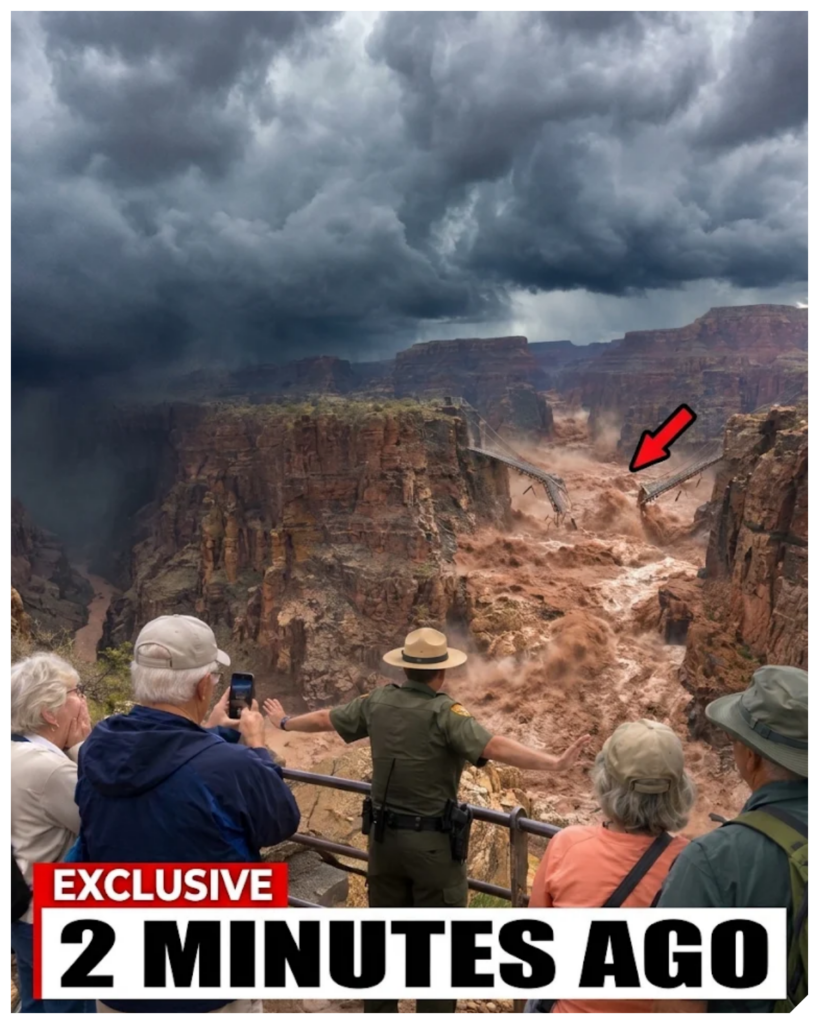
The Grand Canyon stuff is really weird.
Talking about Cad’s Cave and Yes, dude.
That’s the Grand Canyon has long been one of the most mysterious [music] places on Earth, attracting the attention of scientists, explorers, and curious visitors from around the world.
Its towering cliffs and ancient rocks hold nearly 2 billion years of history.
Yet many questions about its past remain unanswered.
Now powerful floods have swept through its narrow valleys, destroying bridges and leaving behind a trail of damage.
These events have brought [music] new attention to a place already known for its ancient ruins and mysterious legends.
But could there be more to these stories than we realize?
Join us as we explore these mysteries and tell us which discovery interests you most.
Don’t forget to share this video and subscribe to support our journey.
The first of these troubling events unfolded in Bright Angel Canyon near Phantom Ranch, where a sudden flood turned one of the Grand Canyon’s most popular hiking areas into a scene of destruction.
As heavy rain poured into the surrounding valleys, water rushed downhill, gathering speed as it passed through the narrow passages.
Within a short time, the rising flood became powerful enough to sweep away a pedestrian bridge, damage hiking trails, and break parts of the water supply system.
Emergency crews worked to evacuate visitors as several routes became unsafe.
When the water finally receded, the damage was clear.
Broken structures, fallen trees, and large piles of rocks covered areas that had once been open to hikers.
The force of the flood showed how quickly water could turn a peaceful landscape into a dangerous place.
But what makes these scenes even more troubling is that flooding has also threatened communities in other parts of America.
From overflowing rivers to streets covered in water, families have faced sudden destruction and uncertainty.
For Christians watching these events, the images may bring to mind something Jesus said [music] nearly 2,000 years ago.
In Matthew 24-37:39, Jesus warned that the days before his return would be like the days of Noah.
People were eating, drinking, and continuing their daily lives, unaware of what was coming until the flood arrived.
Jesus was not simply describing a natural disaster.
His warning focused on how easily people can become distracted by everyday life [music] and fail to prepare spiritually.
Although today’s floods do not prove that biblical prophecy is being fulfilled, they remind us how suddenly everything can change.
And as powerful waters continue to threaten communities, one question deserves our attention.
Are we truly prepared for the day Jesus promised he would return?
As the powerful floods bring new attention to the Grand Canyon, they also remind us of something far more mysterious.
For more than a century, stories have circulated about ancient secrets hidden deep within its massive cliffs.
One of the strangest began with a newspaper report published in 1909.
According to the report, an explorer named G.
Qinc Cade discovered a hidden entrance leading into a vast underground cave system.
Beyond the entrance were long passages carved into the rock, opening into large chambers that appeared to have been built by human hands.
Inside these chambers, ancient statues, metal objects, strange symbols, and writings that no one could easily explain.
Some objects were said to resemble artifacts from ancient Egypt, [music] raising an extraordinary question.
How could traces of a civilization from the other side of the world have ended up deep inside the Grand Canyon?
The story also mentioned the Smithsonian Institution.
As the years passed, rumors spread that the chambers had been sealed and their contents hidden from the public.
Yet no confirmed artifacts or archaeological records have been found to support the account.
But the legend has also drawn attention to a mystery found in the Bible.
In 2 Kings 17-6, scripture tells how the Assyrian Empire conquered the northern kingdom of Israel and carried its people into exile.
The later fate of the 10 lost tribes has remained a subject of questions and speculation for generations.
Some theories suggest that their descendants may have traveled to distant lands, perhaps even reaching North America.
This raises a fascinating question.
Could the legendary chambers hidden within the Grand Canyon have any connection to these lost tribes?
Or was the newspaper report simply a story that grew more mysterious over time?
With no confirmed archaeological evidence to support the claims, the truth behind these supposed chambers remains uncertain.
But while the story of the hidden chambers remains a mystery, another discovery near the Grand Canyon is supported by something far more solid.
Evidence preserved in ancient rocks.
Scientists have found clues suggesting that a massive lake once covered a large area east of the canyon long before the Colorado River followed the path we see today.
This ancient body of water is known as Lake Baochi.
Although the lake disappeared millions of years ago, it left behind layers of sand, mud, and minerals.
By studying these layers, researchers have been able to uncover clues about a landscape that looked very different from the dry valleys and towering cliffs of today.
One of the most important findings came from the study of ancient sediments.
Scientists found evidence suggesting that large rivers carried water and material into the lake basin around 6.6 million years ago.
This raised an important question.
Where did all that water go?
Some researchers believe the lake may have eventually grown so large that its waters spilled over the surrounding land.
As the water escaped, [music] it could have connected separate river systems, helping establish the Colorado River’s path through the region.
However, scientists are still studying this possibility and the exact history remains uncertain.
For Christians, [music] this ancient landscape brings to mind Psalm 104-69, where scripture describes waters covering the mountains [music] before retreating into valleys and remaining within the boundaries established by God.
These verses do not explain how Lake Bahochi formed or disappeared.
Yet, they offer a powerful reminder of the place water holds in God’s creation.
The ancient lake may have disappeared millions of years ago, but the Grand Canyon holds another kind of history, one left behind by people who once called this remarkable place home.
Near Desert View on the South Rim, the remains of a small stone village have survived for nearly 800 years.
This ancient settlement is known as Tusian PBLO.
At first glance, the site appears to be little more than a collection of low stone walls, but these walls once formed the homes and gathering places of an ancient community.
The people who lived here built their rooms from local stone and learned to survive in a dry landscape where water and food were not always easy to find.
Among the ruins, archaeologists identified something especially interesting, a circular room known as a hea.
Unlike the rectangular rooms used for daily activities, [music] this structure served an important purpose in the community’s ceremonial and spiritual life.
For [snorts] generations, the people of this region gathered in such spaces to maintain their traditions and strengthen their connection to their ancestors.
Yet the exact ceremonies once held inside this particular ka remain unknown.
Today Pueblo continues [music] to hold cultural meaning for Native American communities whose ancestors lived in the Grand Canyon region.
For Christians, these ancient ruins also bring to mind Acts 17:26.
In this passage, [music] the Apostle Paul teaches that God established the times and boundaries of the places where people would live.
The remains of Tusaian PBLO offer a glimpse into how one community built its home and preserved its beliefs in a challenging environment.
And although its people left the settlement centuries ago, the circular room still stands as a reminder of a community whose traditions remain meaningful today.
Of all these mysteries, which one interests you the most?
Have you discovered anything more about them?
Share your thoughts below and don’t forget to like and share this video to support our next discoveries.
But long before anyone built a home in the Grand Canyon, mysterious creatures were already leaving their marks on its ancient landscape.
Along the famous Bright [music] Angel Trail, geologist Alan Krill noticed something unusual on a large sandstone boulder that had fallen from a nearby cliff.
Across its surface were strange markings arranged in two separate lines.
They looked almost like footprints, but they were preserved in rock that was hundreds of millions of years old.
Photographs of the markings were later examined by paleontologist Steven Roland.
After studying their shape and arrangement, researchers concluded that they were tracks left by two ancient four-legged animals approximately 313 million years ago.
The footprints were preserved in sandstone belonging to the Manekatcha formation.
At that time, the landscape was very different from the deep canyon visitors see today.
Instead of steep cliffs and winding trails, parts of this region were covered by vast fields of sand dunes.
What made the discovery especially remarkable was the way the tracks crossed the ancient sandy slope.
The animals appeared to have moved across the dune using a walking pattern that revealed details about how their legs worked.
Some aspects of their movement resembled the way certain four-legged animals walk today.
These markings provide some of the earliest known evidence of four-legged animals traveling across ancient sand dunes.
For Christians, the discovery may bring to mind Genesis 1:24:25, where scripture describes God creating living creatures that move across the land.
The footprints do not establish when or how the events described in Genesis took place.
Yet, they offer a remarkable glimpse into the history of animal life on Earth.
After hundreds of millions of years, the animals themselves are gone, but the marks they left behind can still be seen in the stone.
The Grand Canyon’s mysteries are not limited to ancient footprints and forgotten civilizations.
Some visitors believe that even a small rock taken from this remarkable place can bring unexpected trouble into their lives.
Over the years, stories have circulated about tourists who collected stones, handfuls of sand, or pieces of wood as souvenirs.
To them, these objects seemed like harmless reminders of their visit.
But according to some [music] accounts, strange things began happening after they returned home.
Some visitors reportedly experienced sudden illnesses, unexpected accidents, [music] or serious financial problems.
Others described a series of unfortunate events that seemed to begin shortly after they brought the objects home.
Unable to explain their bad luck, [music] they began to wonder whether something they had taken from the canyon was responsible.
As these stories spread, an unusual practice emerged.
Some people reportedly mailed their souvenirs back to the Grand Canyon, hoping to put an end to their troubles.
A few packages were said to include letters of apology with visitors expressing regret for removing something that belonged to the park.
These accounts helped create a lasting legend that certain objects from the Grand Canyon carry a mysterious curse, bringing misfortune to anyone who takes them away.
But is there any truth behind these frightening stories?
There is no scientific evidence that rocks, sand, or other natural objects from the Grand Canyon possess supernatural powers.
Illnesses, accidents, [music] and financial problems can happen for many reasons, and these stories do not establish a connection.
What is certain is that removing natural and cultural materials is prohibited under park rules.
Visitors are encouraged to leave everything where they find it, protecting the canyon for future generations.
Perhaps the real lesson behind these mysterious stories is not about a curse, but about respecting a place whose history is far greater than any souvenir we could carry home.
But perhaps the most mysterious place in the Grand Canyon is not something hidden underground or carried away by visitors.
It is a sacred site that [music] has held deep spiritual meaning for generations.
A place known as Cipapuni.
Near where the little Colorado River meets the Colorado River, a remarkable rock formation rises beside the water.
Its rounded surface is made of travertine, a type of limestone formed as mineralrich water deposits, layers of stone over time.
Yet for the Hopi people, this unusual formation represents something far more important than its appearance.
According to Hopi tradition, Sipuni is connected to the place where their ancestors emerged from a world beneath the earth into the world we know today.
This present world is often described in their traditions as the fourth world.
Their traditional accounts tell of ancestors who passed through earlier worlds before beginning a long journey across the land.
Along the way, they traveled through different regions, established communities, [music] and preserved teachings that would be passed down through generations.
For the Hopi people, Cipuni is therefore not simply an unusual rock formation.
It is deeply connected to their understanding of human origins, ancestral journeys, and their relationship with the land.
But does this mean that a real gateway to another world exists beneath the Grand Canyon?
There is no archaeological or scientific evidence of a literal supernatural passage at this location.
Its significance comes from the living spiritual and cultural traditions of the Hopi people who continue to regard it as sacred.
And perhaps that is what makes Cipuni so fascinating.
While scientists can study how its unusual stone formation developed, the stories surrounding it reveal another side of the Grand Canyon, where ancient landscapes and deeply held beliefs [music] have remained connected for generations.
For generations, the Grand Canyon has been a place of sacred stories and ancient mysteries.
But today, one of its greatest concerns is something far more real.
The future of the river that flows through its heart.
The Colorado River has shaped the Grand Canyon for millions of years.
Yet years of drought, rising temperatures, and heavy water use have placed enormous pressure on this important water system.
Two massive reservoirs, Lake Powell and Lake Meade, have experienced serious declines in water levels.
Along their rocky shores, enormous white bands stretch across the cliffs, marking where the water once stood.
These exposed walls reveal just how much water has disappeared over the years.
Although recent rainfall has raised reservoir levels somewhat, experts warned that the long-term problem remains.
At Lake Powell, Glen Canyon Dam controls the water flowing downstream into the Grand Canyon.
The dam also produces electricity while the wider river system supplies water to cities, farms, and communities [music] across the American Southwest.
But what happens when there is no longer enough water?
Scientists and water managers warned that continued declines could threaten electricity production and make it harder to deliver water downstream.
These problems could eventually affect millions of people across the United States and Mexico.
Officials are studying ways to manage water releases and protect the dam’s operations if reservoir levels fall further.
But the challenge is growing as the region struggles to balance limited water supplies with increasing demand.
The contrast is striking.
Earlier we saw how sudden floods could destroy bridges and trails inside the Grand Canyon.
Now the same region faces a very different danger.
Too little water.
And this raises a troubling question.
If the Colorado River continues to [music] face shortages, what will happen to the Grand Canyon and the millions of people whose lives depend on its waters?
While falling water levels are threatening the Colorado River today, the Grand Canyon’s dry environment has also helped preserve something extraordinary from the distant past.
Hidden inside its caves are the remains of animals that disappeared thousands of years ago, some preserved in remarkable condition.
One of the most fascinating discoveries came from Rampart Cave, where researchers found enormous layers of dried animal dung.
These deposits were left behind by giant Shasta ground sloths that lived in the region between approximately 40,000 [music] and 11,000 years ago.
Unlike the small sloths living in trees today, these ancient creatures walked on the ground and could grow much larger than a human.
Over thousands of years, they repeatedly sheltered inside the cave, leaving behind thick deposits of waste.
Because the cave was extremely dry, much of this material survived.
Scientists were able to examine plant remains preserved inside the dung, revealing what these enormous animals ate [music] and what kinds of vegetation once grew around the Grand Canyon.
But the discoveries did not end there.
In other caves, researchers found skulls and bones belonging to Harrington’s mountain goat, an extinct animal that once lived among the rocky cliffs of the region.
Some cave deposits also preserved dried bats [music] and remains associated with California condors.
What makes these discoveries especially remarkable is their condition.
In certain cases, the dry cave environment protected not only bones, but also pieces of skin and other soft tissues that would normally have disappeared long ago.
These remains offer scientists valuable clues about the animals that once lived here, how they survived, and how the environment changed over thousands of years.
Today, these caves stand as natural archives of a vanished world, preserving traces of creatures that disappeared long before the Grand Canyon became the place we recognize today.
Those ancient caves have preserved the remains of animals that vanished thousands of years ago.
But when darkness falls over the Grand Canyon, some stories suggest that its remote caves and narrow passages may still have unusual visitors.
Imagine standing beside a towering canyon wall after sunset.
The trails are empty, the rocks are growing cold, and the last light is disappearing behind the cliffs.
Suddenly, [music] a strange sound echoes through the darkness.
It resembles footsteps moving across loose stones.
But when you turn around, there is nobody there.
Stories like these have become part of the Grand Canyon’s collection of unusual legends.
Mysterious beings are described as small, mischievous creatures that hide among the rocks and caves.
One name sometimes associated with these supposed beings is pacuz, although reliable historical sources have not established this name as part of a recognized Grand Canyon tradition.
According to the stories, these creatures are not always dangerous.
Instead, [music] they are said to enjoy frightening travelers, making unexpected noises, and disappearing before anyone can see them clearly.
Other accounts describe strange shadows appearing along the canyon walls under the moonlight.
A dark figure might seem to stand near a narrow passage only to vanish when someone looks again.
Some stories even suggest that unexplained sounds follow travelers as they move through isolated areas.
But could something really be hiding among these enormous cliffs?
The Grand Canyon’s landscape offers several natural explanations.
Sound can travel between steep rock walls, creating echoes that make distant noises seem surprisingly close.
Falling stones, wind passing through narrow openings, [music] and animals moving at night can also produce unfamiliar sounds.
Moonlight and deep shadows may create shapes that resemble figures, [music] especially when someone is already feeling nervous in an unfamiliar place.
There is no confirmed scientific evidence that the creatures described in these stories actually exist.
Still, legends about strange beings and unexplained encounters continue to attract people fascinated by the Grand Canyon.
For generations, stories have helped people make sense of places they could not fully understand.
And in a landscape filled with dark caves, towering walls, and isolated valleys, it is easy to imagine how a simple sound in the night could become a story passed down for years.
The question is whether these frightening encounters began with something unusual or simply with the powerful imagination of those who experience them.
Grand Canyon, a journey through ancient history, lost civilizations, and a changing landscape.
The Grand Canyon is often described as a place shaped by water.
But its history is also a story of people learning to live with constant change.
Even its quietest corners [music] carry remarkable stories.
From the highest viewpoints, the canyon seems almost impossible to cross.
Cliffs drop [music] toward the Colorado River, while narrow side valleys disappear between layers of stone.
Yet, people entered this landscape [music] thousands of years before roads, visitor centers, and marked trails existed.
[music] They came to hunt, gather plants, find water, build homes, and maintain connections to places that mattered to their communities.
What visitors see today is therefore more than a spectacular natural landmark.
It is a landscape where human decisions, [music] changing climates, and the movement of water have left evidence that can still be studied.
The challenge is to understand those traces [music] without imagining that every unanswered question hides a secret.
One of the earliest clues is surprisingly small.
[music] In Marble Canyon near the northeastern edge of the park, a broken spear point reveals that a hunter passed through the region about 11,000 years ago.
The person who carried it lived in a North America very different from the one we know.
Large mammals that have since vanished still existed, and hunting required skill, patience, and careful knowledge of the land.
The spear may have been used against animals such as mammoths, although the point itself cannot tell us exactly what its owner hunted.
Deer and big horn sheep were other possible sources of food.
Archaeologists have found relatively few objects from this early period inside the park, which makes such a modest fragment especially valuable.
A broken tool cannot reveal a person’s name or thoughts, but it can confirm that someone stood here long before the canyon became famous.
[music] For those early travelers, the Colorado River was more than a landmark at the bottom of a deep valley.
It offered drinking water and supported plants that could be used for food and other purposes.
Willow, [music] amaranth, mosquite, and salt bush grew in places where moisture made life possible.
People could follow the river, [music] visit nearby valleys, and return to higher ground as conditions changed.
Their movements were probably influenced by the seasons, available resources, and traditions passed between generations.
Later groups also used the canyon in different ways.
As temperatures became warmer and the surrounding land grew drier, some people may have found shelter closer to the river.
These choices show how survival depended on reading the environment.
Instead of treating the canyon as an empty wilderness, we can begin to picture a network of familiar places, each [music] with its own sources of water, plants, and animals.
Over time, the traces of human activity became more varied.
Along the river corridor, archaeologists have found stone rooms, fireplaces, and pits used for preparing food or possibly [music] firing pottery.
These are not merely signs of people passing through on occasional journeys.
Together, they show that some communities spent [music] substantial parts of their lives here.
A room required planning and labor.
A hearth points [music] to meals prepared and shared.
Pottery and tools suggest repeated tasks and skills learned through practice.
Some PBlo and communities farmed along canyon rims and at river deltas, taking advantage of places where growing crops was possible.
[music] The earliest pottery identified in the canyon dates back roughly,500 years.
Such objects help researchers move beyond the image of isolated hunters.
They show people organizing households, using local materials, and adapting their work to the difficult landscape around them.
The human story does not end with the ancient remains.
11 tribes have traditional connections [music] to the Grand Canyon, including the Hopi, Havasupi, Halapai, Navajo, Zuni, and several [music] Pyute communities.
Others include the Yavapai, Apache, and related groups named in park records.
Their relationships with the region are living connections, not simply subjects for museum displays.
Tribal members continue to visit or use the area for cultural purposes, trade, and the collection of traditional materials.
Some locations hold ceremonial importance, while others are tied to knowledge passed down through families.
[music] Recognizing these ties changes how archaeological discoveries should be discussed.
A stone building or carved image is not just an interesting object found in an abandoned landscape.
It may belong to a history that present-day communities understand [music] through language, memory, and tradition.
Scientific [music] investigation becomes more meaningful when these voices are part of the conversation.
[music] That principle became especially important when erosion exposed buried archaeological sites along the river.
Between 2006 and 2009, representatives of traditionally associated tribes [music] worked with park staff and the Museum of Northern Arizona on excavations designed to protect vulnerable remains.
The work was not undertaken simply to collect more objects.
As sediment washed away, long hidden structures and artifacts were left exposed to weather, damage, and other threats.
Many tribal communities generally oppose disturbing ancestral sites.
So, the decision to participate carried real importance.
Their knowledge helped researchers recognize the meaning and possible uses of objects that might otherwise have been misunderstood.
The project demonstrates [music] that archaeology is not only about digging into the past.
It is also about deciding what should be preserved, who should help interpret it, and how discoveries can be handled with respect.
Far beyond the history of human settlement [music] lies another timeline measured in millions rather than thousands of years.
The Grand Canyon’s rock walls expose different chapters of Earth’s geological [music] history.
At the bottom are some of the region’s oldest rocks, formed as much as 1.84 billion years ago.
Higher up, tilted layers record another long period of change.
Above them lie broad bands of sandstone, limestone, and shale that were [music] deposited in very different environments.
Some formed beneath ancient seas.
Others record the work of rivers [music] and shifting sediments.
What now appears as a single steep wall is actually [music] a stack of materials formed under changing conditions.
Their colors and shapes can be admired from a distance.
But each layer also contains evidence.
By examining where one rock type ends and another begins, geologists piece together the sequence of [music] events that created the landscape.
The canyon itself is much younger than many of the rocks it cuts through.
For tens of millions of years, the wider Colorado plateau region experienced uplift, gradually raising the land.
Around 6 million years ago, [music] the Colorado River and its tributaries began cutting deeply through the plateau, exposing the ancient formations beneath.
Water did not complete this work in one sudden event.
Flowing rivers carried material away, while weathering and erosion continued to reshape the cliffs and side valleys.
[music] That process has never truly stopped.
A rockfall can change a trail.
A storm can move sediment.
And a small stream can carry loose material toward the main river.
This distinction matters.
The age of the canyon’s rocks is not the same as the age of the canyon’s present shape.
One records ancient deposition and transformation.
The other records a continuing history of erosion.
Many visitors recognize the pale and reddish layers visible from the rims.
But the canyon also contains [music] darker, older formations below.
Some tilted rocks belong to the Grand Canyon superg groupoup formed around a billion years ago.
Other layers laid down during the Paleozoic era contain marine fossils.
These remains reveal that parts of the region were once connected to environments where sea life could thrive.
The idea can be difficult to imagine [music] while standing above a dry, enormous chasm.
Yet fossils and sedimentary structures make the earlier settings visible to scientists.
At Desert View and the Yavapai Geology Museum, visitors can look across the terrain and begin identifying these different formations.
The striking landscape becomes easier to understand when each layer is treated as evidence of a particular environment rather than as a piece of an unexplained monument.
Water also moves through the canyon in ways that cannot be seen from the rim.
Rain and snow falling across the surrounding plateaus can soak into the ground, traveling [music] slowly through pores, fractures, and faults in the rock.
Some of it eventually emerges far below as springs or small seeps.
The park contains hundreds of these water sources, ranging from seasonal flows to springs that persist through the year.
One especially important example is Roaring Springs, which emerges from limestone far beneath the North Rim.
Its water has supported a pipeline system that serves areas of the park, including the rims and inner [music] canyon.
This hidden connection between rainfall above and water appearing below reveals why the canyon’s geology affects daily life.
[music] The rock is not merely scenery surrounding the water.
Its openings and layers help control where that water goes.
The pipeline connected to Roaring Springs illustrates how fragile access to water can be, even in a place defined by a powerful river.
Built in the 1960s, the system carries water through the inner canyon, passing the Phantom Ranch area on its way toward the South Rim.
Repairs and breaks can interrupt delivery, creating practical difficulties for visitors and park operations.
It is tempting to look down at the Colorado River and assume water must be easy to obtain everywhere nearby.
In reality, moving safe drinking water across steep terrain requires infrastructure and careful maintenance.
A spring emerging from a cliff and a pipe crossing a remote valley are both part of the same story.
Natural conditions make water available while human systems determine whether it reaches the places where people need it.
At the South Rim, the relationship between climate and landscape is visible in the plants beside the trails.
The area receives relatively little rain, and many species survive by conserving moisture.
Pinan, pine, and juniper have small leaves that limit water loss.
Yucka protects its moisture with thick waxy leaves and draws water through its roots.
Trees such as ponderosa pine become more common where the soil holds more nutrients [music] and moisture.
These differences may seem minor beside the immense cliffs, but they reveal how closely life responds to local conditions.
Even a short walk away from the rim [music] can lead into areas where vegetation changes.
The canyon’s plants are therefore useful signs of the environment.
Showing how elevation, soil, sunlight, [music] and access to water shape where different species can grow.
The North Rim offers a striking comparison.
It stands higher than the South Rim at about 8,000 ft and generally receives more precipitation.
Cooler temperatures and thicker forests make the experience noticeably different.
The surrounding Kaibab Plateau [music] contains wooded landscapes as well as areas marked by past fires.
Fire is part of the natural history of these forests, but human efforts to suppress it during the 20th century [music] allowed undergrowth to build up in some places.
When fires later burned with greater intensity, [music] many trees could not survive.
In affected areas, species such aspen and [music] angelman spruce have helped change the forest’s composition.
[music] These details show that the canyon is not one uniform environment.
Its two [music] rims, side valleys, and river corridor form a range of habitats, [music] each responding differently to weather and human activity.
Looking from a viewpoint, the Colorado River may appear as a narrow ribbon far below the cliffs.
Its journey, however, begins much farther away in the mountains of northern Colorado.
Snow melt feeds small streams which grow as other waterways join them.
The river eventually reaches Lake Powell.
The reservoir created by Glen Canyon Dam.
This structure does more than hold back water.
It also traps much of the sediment that [music] the river would otherwise carry downstream.
Water released below the dam is generally clearer and colder than the river’s earlier natural flow.
Those changes matter for native fish that evolved in warmer, more sediment-filled conditions.
A dam can therefore influence an ecosystem far beyond the point where it was built.
It changes the character of the water that enters the Grand Canyon.
Farther downstream, the river reaches the western end of the park and eventually flows toward Lake Meade, the reservoir behind Hoover Dam.
Water from this system supports communities, cities, agriculture, [music] and recreation across parts of the American Southwest.
The river is not only a force that carved a landscape over geological time.
It is also a working source of water for people living far from the canyon itself.
That creates difficult questions about demand and responsibility.
As more water is used across the region, managers must consider [music] what can be delivered and what must remain in the river system.
The canyon reminds us that human [music] life depends on natural processes.
But modern infrastructure can change those processes in ways that require ongoing attention.
These same forces continue to shape the experience of visiting the park today.
Thunderstorms can appear during summer, sending water into narrow drainage [music] channels and creating danger far from the place where rain actually falls.
Steep cliffs demand caution, and a trail that looks manageable from a viewpoint can become exhausting once a hiker descends.
The river is often much farther away than it seems.
Park guidance emphasizes carrying food and water, staying on established trails, and avoiding the attempt to hike down to the river and back in a single day.
Such advice is not separate from the canyon’s history.
It follows from the same realities that ancient inhabitants understood.
Distance, heat, elevation, and limited access to water can determine whether a journey succeeds.
Protecting the canyon also means protecting what cannot be replaced.
Wildlife, ancient structures, fossil bearing rocks, and culturally important places all face pressure when visitors treat the landscape as a collection of souvenirs.
Removing or damaging an object may erase information that researchers and associated communities need to understand its history.
[music] Staying on trails, respecting park rules, and leaving natural and cultural materials where they belong help preserve that evidence.
Preservation is not simply about keeping the scenery [music] attractive.
It allows future visitors to learn from the same places and gives researchers the chance to ask better questions as methods [music] improve.
It also recognizes that certain places have meaning to communities whose [music] connection to the canyon did not end when a ruin was abandoned or an old trail fell out of use.
The longer we study the Grand Canyon, the clearer its central lesson becomes.
Change is written everywhere.
In rocks deposited under vanished seas, [music] in cliffs carved by flowing water, in forests altered by fire, and in settlements shaped [music] by the needs of everyday life.
Yet continuity is present as well.
Springs still emerge from the rock.
Plants still adapt to dry ground.
Tribal communities maintain relationships with places their ancestors knew.
The Colorado River continues downstream even as dams and growing demand influence its flow.
To understand this landscape, we do not need to turn every unanswered question into a supernatural claim.
Its documented history is [music] extraordinary on its own.
From a broken spear point to a billion-year-old formation, each piece of evidence adds detail to a larger picture.
The Grand Canyon remains a place where the past is visible, the present is changing, and the responsibility to protect both belongs to everyone who encounters it.
The Lord’s covenant people.
Throughout the Bible, one of the most important relationships is the relationship between God and his people.
From the earliest generations of humanity, scripture describes a God who does more than give commandments.
He makes promises, establishes responsibilities, and invites individuals and entire nations to live according to his will.
These sacred agreements are called [music] covenants.
They appear in the lives of Adam, Noah, Abraham, Moses, and many others whose stories helped shape the history of faith.
A covenant is different from an ordinary promise between two people.
In a biblical covenant, God establishes the terms and reveals what he expects.
His people are invited to respond [music] through faith, obedience, and commitment.
The covenant may include specific commandments, promises of protection or responsibilities extending beyond one generation.
[music] Its purpose is not simply to establish rules, but to create a lasting relationship in which people understand whom they worship and how they should live.
This idea is central to the teachings of the Church of Jesus Christ of Latter-day [music] Saints.
Members believe that God continues to invite his children into sacred covenants today.
Just as he did in [music] ancient times.
These agreements are understood as part of his plan to help individuals grow spiritually, [music] receive divine guidance, and ultimately return to his presence.
In this understanding, becoming a covenant person means accepting both the blessings [music] God promises and the responsibilities that accompany them.
The Bible provides several examples of how these relationships began.
After the great flood, God established a covenant with Noah and his descendants.
Genesis 9 describes [music] God’s promise that a flood would never again destroy all life on earth.
The rainbow became the visible sign of that promise.
It reminded future generations that God had spoken to humanity and established an enduring commitment.
The story also shows that a covenant may affect people who were not present when the original promise was made.
Another important example appears in the life of Abraham.
According to Genesis, Abraham was called to leave his homeland and travel toward a country that God would show him.
The journey required trust because Abraham could not see every detail of what lay ahead.
He had to make decisions based on the promises he received.
His willingness to follow God became a defining [music] feature of his story, and the covenant established with him would have consequences for generations.
Abraham’s relationship with God was closely connected to obedience.
[music] He rejected the worship of false gods and sought to follow the Lord.
In the Latter-day Saint account found in the book of Abraham, his desire for righteousness and priesthood blessings receives particular attention.
He wanted greater knowledge of God and the opportunity to [music] establish a faithful family.
These ambitions were spiritual rather than merely personal.
Abraham sought a relationship with God that would influence his descendants [music] and benefit others.
God promised Abraham that his descendants would become numerous and that [music] his family would receive extraordinary blessings.
Genesis 17 describes the covenant through which Abraham would become the father of many nations.
God also promised a continuing relationship with Abraham’s descendants.
Within Latter-day Saint teaching, the Abrahamic covenant includes the opportunity to receive the gospel, participate in sacred priesthood ordinances, and carry divine teachings to the nations of the earth.
One of its most significant promises concerns people far beyond Abraham’s immediate family.
[music] Through his descendants, all the families of the earth would be blessed.
This gives the covenant a universal purpose.
Abraham was not called simply so that his household could enjoy special privileges.
His family was also given a responsibility to become a means through which others could receive knowledge of God.
The blessings of the covenant were intended to move outward, reaching people in different lands and generations.
[music] The New Testament later connects Abraham’s covenant to faith in Jesus Christ.
In Galatians 3, the Apostle Paul teaches that those who belong to Christ are Abraham’s descendants in a spiritual sense and heirs according to the promise.
This passage is important because it explains how a covenant associated with an ancient family [music] could come to include believers from many backgrounds.
Membership in the covenant is therefore not presented as a matter of ancestry alone.
Latter-day Saint doctrine develops this understanding through the teaching that people who accept the restored gospel may be counted among Abraham’s covenant descendants.
The book of Abraham describes those who receive the gospel as being associated with Abraham’s lineage.
This inclusion is understood spiritually rather than as a claim that every church member can demonstrate a direct biological connection to the ancient patriarch.
[music] For members of the church, baptism is one of the clearest expressions of entering a covenant relationship with God.
A person who is baptized promises to follow Jesus Christ, repent of sin, [music] and take his name upon themselves.
Baptism marks a public commitment to live as his disciple.
It is not understood simply as a religious ceremony or a sign of belonging to a community.
It represents a sacred promise to continue learning, obeying, [music] and growing in faith.
The Lord’s promised blessings are connected to that commitment.
[music] In Doctrine and Covenants 18:22, salvation is associated with repentance, baptism in the name of Jesus Christ, [music] and enduring faithfully to the end.
This teaching places importance on the entire course of [music] a person’s life.
Making a covenant is a beginning rather than a finish.
The believer [music] must continue choosing how to respond to the teachings of Christ through ordinary decisions, difficult circumstances, and changing responsibilities.
Another expression of this relationship takes place during the sacrament.
Members regularly partake of bread and water in remembrance of the Savior.
The prayers recorded in Doctrine and Covenants 20 describe promises to remember Jesus Christ, take his name upon themselves, and keep his commandments.
In return, believers are promised [music] the companionship of his spirit.
The ceremony is intended to bring the covenant relationship back into focus, especially when everyday concerns have distracted people from their spiritual commitments.
The church also teaches that additional covenants are made [music] through temple ordinances.
These ceremonies are regarded as sacred and are associated with promises concerning eternal life, family relationships, and exaltation.
In Latter-day Saint theology, [music] exaltation refers to the highest form of eternal life in God’s presence.
Temple teachings connect this hope to the redeeming work of Jesus Christ and to faithful participation in the covenants God has established.
These teachings also explain why obedience occupies such an important place in the covenant relationship.
Doctrine and Covenants 82-10 emphasizes that God fulfills his promises when his people follow the conditions he [music] has established.
Disobedience by contrast places the promised blessings in question.
This does not [music] mean that believers can purchase divine favor through perfect behavior.
Rather, within this religious understanding, faithfulness demonstrates that a person intends to honor the sacred agreement they have willingly accepted.
The seriousness of covenants also brings accountability.
Latter-day Saint scripture teaches that those who receive greater spiritual knowledge carry greater [music] responsibility for how they use it.
A person who understands a commandment and deliberately rejects it [music] is not regarded in the same way as someone who has never been taught.
The purpose of this principle is to encourage humility and careful living, not to invite believers to judge other people’s spiritual condition.
The responsibilities associated [music] with the Abrahamic covenant extend into missionary service.
Members of the church believe that sharing the gospel is one way to fulfill the promise [music] that Abraham’s descendants would bless the nations.
Missionaries travel to different countries, learn languages, teach religious principles, and invite interested people to study the message of Jesus Christ.
Other members participate by discussing their faith [music] with friends, helping their communities, and supporting religious education within their families.
This responsibility is also expressed through conduct.
A covenant people should demonstrate their beliefs [music] through honesty, compassion, service, and respect for others.
Their commitments influence how they treat relatives, colleagues, neighbors, and strangers.
Religious promises have little practical [music] meaning if they do not shape the way people behave.
In this sense, the covenant is meant to become visible through a pattern of life rather than through religious language alone.
The church’s teachings describe the fullness of the gospel [music] as the new and everlasting covenant.
The expression may initially seem contradictory.
How can something be both new and everlasting?
Within Latter-day Saint theology, it is everlasting because God established its principles and purposes beyond the limits of any single historical period.
It is called new because the gospel is understood to become newly available when God restores it after a period of loss.
The church teaches that this covenant includes faith in Christ, repentance, [music] baptism, receiving the Holy Ghost, temple ordinances, and continuing obedience.
These elements are connected through the belief that God has provided a path by which his children can prepare to return to him.
Each covenant represents a further commitment to that relationship.
The emphasis is not merely on completing religious ceremonies, but on living according to the promises [music] those ceremonies represent.
Eternal family relationships are another important part of this belief.
The church teaches that marriage performed through proper temple authority can continue beyond death [music] when the associated covenants are faithfully honored.
This teaching gives family relationships an eternal significance.
[music] Parents, children, and spouses are encouraged to treat their earthly responsibilities as part of a much greater spiritual purpose.
Ultimately, the promise of the covenant concerns the possibility of living in God’s presence.
Latter-day Saint teaching describes this [music] hope in terms of eternal life, divine love, knowledge, and glory.
Such blessings are presented as far greater than anything people can fully understand during mortality.
[music] Yet the path toward them is expressed through familiar choices, repenting when wrong, forgiving others, keeping promises, serving those in need, and remaining faithful through adversity.
The central lesson [music] is that being God’s covenant people is both a privilege and a responsibility.
[music] The promises given to Abraham were not intended to produce pride or separation from [music] the rest of humanity.
They pointed toward a divine work meant to bless the [music] world.
For believers today, the challenge is to make those ancient promises meaningful through present actions.
A covenant becomes more than a historical idea when it shapes a person’s character, relationships, and understanding of their purpose before God, the church of Jesus Christ in former times.
To understand why latter-day saints speak about a restoration of the gospel, it is necessary to examine what they believe Jesus Christ established during his earthly ministry.
The New Testament describes more than a collection of people who admired his teachings.
It shows disciples receiving instruction, leaders being appointed, ordinances being performed, and a [music] message being carried beyond the places where Jesus first preached.
These events form the foundation of the church’s understanding of early Christianity.
Jesus began his ministry in a world where religious traditions already shaped everyday life.
He taught in synagogues, spoke to crowds, [music] visited homes, and called individuals to follow him.
His message emphasized repentance, [music] love of God, love of neighbor, forgiveness, and [music] the coming kingdom of God.
But he did not leave his followers to organize themselves entirely according to their own preferences.
[music] He chose apostles and entrusted them with responsibilities that would continue after his death and resurrection.
The calling of the twel apostles was especially significant.
These men traveled with Jesus, [music] witnessed his ministry, and received personal instruction.
They saw him heal the sick, teach large crowds, and respond to religious opposition.
He also sent them to preach and gave them authority to perform particular works.
According to the Latter-day Saint interpretation, [music] this authority was essential because the church was meant to act under divine direction [music] rather than merely under human leadership.
Authority and revelation are therefore two defining features of the ancient church [music] in Latter-day Saint teaching.
Revelation means communication from God that gives guidance, instruction, or understanding.
During his earthly ministry, Jesus taught that his work was directed by the father.
After his resurrection and ascension, the apostles continued seeking heavenly guidance.
The New Testament contains examples of visions, spiritual direction, and decisions that believers understood to reflect God’s will.
One important event involved Peter and the [music] spread of the gospel beyond the Jewish community.
Acts 10 records Peter’s vision and his encounter with Cornelius, a gentile who feared God.
Through these experiences, [music] Peter came to understand that the Christian message was not intended to remain within one nation.
This development helped transform the early movement into a faith that would eventually reach people across the Roman world and far beyond it.
Another example appears in the conversion of Saul, later known as Paul.
According to Acts 9, Saul encountered the risen Jesus while traveling toward Damascus.
The experience changed the direction of his life.
Instead [music] of continuing to persecute Christians, he became one of the most important missionaries of the early church.
His later journeys and letters reveal how Christian communities developed in cities with different languages, cultures, and religious [music] backgrounds.
The apostles could not remain physically present in every congregation.
Local leaders therefore helped teach new believers, organize worship, and address [music] practical problems.
The New Testament refers to elders, bishops, or overseers, deacons, teachers, and other forms of ministry.
[music] Their responsibilities varied according to the needs of different communities.
Latter-day Saint teaching views these offices as evidence that Jesus intended his church to have an organized structure through [music] which the gospel could be taught and administered.
The Apostle Paul offered a powerful description of that structure in Ephesians 2:20, comparing the church to a building founded upon apostles and prophets with Jesus Christ as its chief cornerstone.
The image places Christ at the center while showing that the work of his servants also matters.
Their authority is not independent of him.
Instead, [music] their purpose is to help the church remain connected to his teachings.
The church’s organization was also associated with unity.
In Ephesians 4, Paul describes different forms of [music] ministry that help believers develop faith, knowledge, and spiritual maturity.
Leaders were not meant simply to hold positions of honor.
They were expected to teach, [music] encourage, correct, and serve.
Their work helped people from different backgrounds understand the beliefs and responsibilities they shared.
The replacement of Judas’s Scariot provides another example important to Latter-day Saint interpretations of early church authority.
After Judas’s death, the remaining apostles gathered to select someone who [music] could join them as a witness of the resurrection.
Acts 1 records that Matias was chosen.
The event is understood in Latter-day Saint teaching as evidence that the apostolic office was intended to continue rather than disappear whenever an individual apostle died.
Alongside leadership, the early church practiced specific [music] ordinances.
Baptism was closely connected to repentance and acceptance of Jesus Christ.
The book of Acts describes people receiving baptism after hearing the gospel.
[music] And some passages connect baptism with receiving the gift of the Holy Ghost.
Latter-day [music] Saints understand baptism by immersion and the laying on of hands for the gift of the Holy Ghost as fundamental ordinances established through divine authority.
Jesus himself spoke about the importance of spiritual rebirth.
In John 3, he told Nicodemus that entering the kingdom of God required being born of water and of the spirit.
Different Christian traditions interpret this passage in different ways, but Latter-day Saint teaching connects it directly to baptism [music] and the reception of the Holy Ghost.
The outward ordinance represents a commitment that must be accompanied by inward spiritual change.
Faith and repentance were equally important.
The early apostles did not teach that participation in ceremonies alone was sufficient to transform a person’s life.
Their preaching called people to believe in Jesus Christ, [music] turn away from sin, and develop a new pattern of behavior.
Paul’s letters repeatedly address questions about morality, unity, charity, [music] and responsibility.
These teachings demonstrate that Christianity was intended to influence family relationships, business dealings, worship, and treatment of other people.
The New Testament also describes spiritual gifts among believers.
In 1 Corinthians 12, Paul discusses different gifts associated with the spirit, [music] including healing, prophecy, and discernment.
He emphasizes that these gifts serve the wider community rather than the reputation of an individual.
Their variety reflects the different needs and abilities found among believers.
Latter-day Saints understand such passages as evidence that God can continue to guide and strengthen [music] his church through spiritual gifts.
Another distinctive Latter-day Saint teaching concerns those who died without receiving the gospel during mortal life.
The church interprets passages such as 1 Peter 3 and [music] 4 as indicating that the message of Christ can reach people in the spirit world.
It also connects Paul’s reference to baptism for the dead in 1 Corinthians 15:29 [music] with the practice of performing certain ordinances on behalf of deceased individuals.
These interpretations are not shared by all Christian denominations, but they are important to the church’s understanding of salvation and divine [music] fairness.
The church also teaches that Jesus Christ appeared to people in the ancient Americas after his resurrection.
This account is found in the Book of Mormon, particularly in Third Nephi.
According to that scripture, the risen Savior taught the people, ministered to them, established his church, and instructed them in principles resembling those he had taught in the Holy Land.
The account describes a period of peace [music] and righteousness among the believers following his ministry.
For Latter-day Saints, this narrative broadens their understanding of Christ’s mission.
They believe his concern extended beyond the communities described in the New Testament and that his gospel was intended for all humanity.
The Book of Mormon account is accepted as scripture within their tradition.
Its religious claims, however, should be distinguished from conclusions established through mainstream [music] historical or archaeological scholarship.
The history of the early church also includes conflict.
The New Testament records disagreements over doctrine, leadership, religious [music] customs, and the responsibilities of new converts.
Paul wrote letters correcting behavior and warning against teachings he considered harmful.
Peter, James, John, and other leaders also addressed challenges faced by believers.
These documents reveal a church that was growing, learning, and sometimes struggling to maintain unity.
Persecution added further [music] difficulties.
Christians could face hostility because of their beliefs and refusal to participate in certain religious practices.
Some leaders were imprisoned, mistreated, or killed.
The New [music] Testament records the execution of James, the brother of John, and later Christian traditions described the martyrdom of other apostles.
[music] As the first generation of leaders disappeared, Christian communities faced questions about continuity and authority.
[music] Latter-day Saint theology teaches that a great apostasy followed the deaths of the original apostles.
According to this belief, the complete authority needed to govern Christ’s church and [music] administer its ordinances was eventually lost from the earth.
The church’s teaching materials describe changes in doctrine, worship, and leadership as part of this process.
They view the result as a departure from the organization and authority established by Jesus.
This interpretation should be distinguished from a neutral historical conclusion that all Christianity disappeared.
Christian communities continued to [music] exist, preserve biblical writings, develop theological traditions, and worship throughout the centuries.
Catholic, [music] Orthodox, Protestant, and other Christians understand the continuity of the church differently.
[music] The great apostasy, as described in Latter-day Saint teaching, is specifically a theological claim concerning the loss of priesthood authority and the fullness of the gospel.
The Latter-day Saint account connects this loss with several passages of scripture.
Isaiah 24:5 is interpreted as a warning about people changing ordinances and breaking an everlasting covenant.
Acts 3 20:21 speaks of the restitution of all things while Revelation [music] 14-6 describes an angel carrying the everlasting gospel [music] to the nations.
Members understand these passages as pointing toward a future [music] restoration.
Within this framework, the ancient church serves two purposes.
It provides an example of how Christ directed his followers through revelation, authorized leaders, and sacred ordinances.
It also establishes the pattern that Latter-day Saints believe God would eventually restore.
Understanding that pattern explains why their modern church places [music] such importance on apostles, prophets, baptism, priesthood, authority, and continuing revelation.
The history of early Christianity remains a subject of careful study, and Christian traditions do not agree on every conclusion drawn from it.
Nevertheless, the New Testament presents a clear picture of a community formed around [music] faith in the risen Jesus, strengthened by shared worship and challenged to carry his teachings into the wider world.
For Latter-day Saints, that ancient mission provides the foundation for their belief that [music] Christ would guide his church again through a modern restoration.
The church of Jesus Christ today.
If the ancient church established by Jesus Christ eventually lost its original authority, an [music] important question follows.
Could that authority return?
This question stands at the center of the Latter-day Saint understanding of modern religious history.
Members believe that God did not abandon his children after the period they call the great apostasy.
Instead, they teach that he prepared a time when the fullness of the gospel would be restored and people would again receive divine guidance through living [music] prophets.
According to church teachings, this restoration began during a period of growing religious interest in the United States.
During the early 19th century, Christian denominations offered different explanations of scripture, salvation, and the organization of the church.
Public preaching, religious revival, and debates encouraged many people to examine their beliefs.
[music] For someone sincerely seeking religious truth, the variety of competing teachings could also create confusion.
One young person who experienced this uncertainty was Joseph Smith, who lived in Western New York.
He was deeply interested in religion, but struggled to decide which church he should join.
According to his later account, [music] a passage in the Epistle of James encouraged him to seek wisdom directly from God through prayer.
James 1:5 teaches that those who lack wisdom should ask God who gives generously.
[music] Joseph’s account states that in the spring of 1,820 [music] when he was 14 years old, he entered a wooded area near his home to pray.
He wanted to know which religious denomination he should follow.
What happened next became the foundational event of the Latter-day Saint restoration.
Joseph reported seeing God the Father and Jesus [music] Christ who answered his prayer and instructed him not to join the existing churches.
Latter-day Saints call this event the first vision.
They understand it as the beginning of renewed communication between heaven and earth.
The account also shaped their teachings about the nature of God.
Rather than [music] describing the father and the son as one physical being, church doctrine teaches that they are distinct divine personages united in purpose.
This belief differs from the traditional trinitarian theology held by most Catholic, Orthodox and Protestant Christians.
The first vision is a claim of religious experience preserved in Joseph Smith’s accounts and accepted by church members through faith.
It is not an event that can be independently established by ordinary historical methods.
Historians can examine the written accounts, their dates, and the religious circumstances surrounding them, but conclusions about whether the vision was divine depend on religious belief.
[music] The church teaches that the restoration continued through additional heavenly messengers.
In 1829, according to Joseph Smith’s account, John the Baptist appeared to him and Oliver Cowry and conferred the ironic priesthood.
This priesthood is associated with responsibilities that include baptism and other preparatory ordinances.
Joseph and Oliver subsequently reported receiving [music] the MelkiseDC priesthood through Peter, James, and John, whom they identified as apostles of Jesus Christ.
In Latter-day Saint belief, this restoration of priesthood authority was necessary because sincere faith alone did not provide the authority required to administer all gospel ordinances.
Members [music] distinguish between the personal spiritual experiences available to believers and the particular authority to act officially in God’s name.
They [music] teach that the priesthood makes it possible for ordinances to be performed according to the order established by Christ.
Additional priesthood keys are believed to have been restored through other heavenly messengers, doctrine, and covenants.
110 describes appearances associated with Moses, Elias, and Elijah.
[music] Within church doctrine, these events provided authority connected with gathering Israel, the blessings promised to Abraham, and the sealing of family relationships.
They are understood as part of a developing restoration rather than as a single event completed in one moment.
The next major development concerned the organization of the church itself.
On the 6th of April 1830, Joseph Smith and a small group of followers formally organized the religious community [music] that would become the Church of Jesus Christ of Latter-day Saints.
Joseph was recognized as its first elder and prophet.
The organization began with relatively few members, but its leadership structure expanded as the community grew and missionary work carried its teachings to new regions.
The church takes its name from Jesus Christ because members regard him as its [music] divine head.
Its teachings emphasize that prophets and apostles are servants acting under his direction.
The president of the church is sustained as a prophet, seer and revelator.
He is assisted by counselors who formed the first presidency while the quorum of the twel apostles carries responsibilities for teaching the gospel and overseeing the church’s work across the world.
Other leaders serve in different capacities.
[music] 70s support worldwide church administration and ministry while bishops, elders, and additional priesthood officers carry out responsibilities within local congregations.
[music] The purpose of this organization according to church teaching is to provide order, support religious ordinances, and help members receive instruction in their everyday lives.
As membership expanded, local units became an important part of church life.
Congregations are generally called wards and smaller congregations are called branches.
A bishop presides over a ward with the assistance of two counselors.
Several wards may form a stake.
Led [music] by a stake president and his counselors.
In places where church membership is developing, branches may be organized into districts.
These local congregations provide the setting for weekly worship, religious education, service projects, [music] and family activities.
Members gather to partake of the sacrament, [music] study scripture, and encourage one another.
Much of the ordinary work is carried out by members serving in voluntary callings.
Such responsibilities may involve teaching children, supporting [music] families in need, organizing worship services, or helping individuals develop their faith.
Another central element of the restoration is the Book of Mormon.
Joseph Smith taught that he translated an ancient record [music] through the gift and power of God.
The resulting book was first published in 1830 and became an additional volume of scripture for the emerging church.
Members regard it as another testament of Jesus Christ and study it alongside the Bible.
The church also accepts the doctrine and covenants and the pearl of [music] great price as scripture.
These texts contain revelations, historical accounts, and teachings associated with the restoration.
Together with the Bible and Book of Mormon, they form the church’s standard works.
The acceptance of additional scripture [music] distinguishes Latter-day Saint belief from many other Christian traditions which do not recognize these texts as divine revelation.
The church teaches that several important religious principles were restored [music] through Joseph Smith and subsequent prophets.
These include teachings about the premortal existence of God’s spirit children, [music] the eternal potential of human beings, the relationship between personal accountability and salvation, and the possibility of continuing [music] family relationships after death.
Members understand these teachings as part of a larger explanation of where humanity came from, why people live on Earth, and what may happen after death.
One distinctive teaching concerns the age at which children become accountable for their choices.
The church practices baptism beginning at 8 years old rather than infant baptism.
Members believe that young children are innocent before God and do not require baptism for Adam’s transgression.
This understanding [music] is connected to their doctrine that individuals are responsible for their own sins rather than being personally punished for the actions of the first human beings.
The church also teaches that the life to come includes three kingdoms of glory.
Celestial, terrestrial, [music] and celestial.
These represent different eternal conditions associated with God’s judgment [music] and the opportunities provided through Jesus Christ.
The celestial kingdom is understood as the highest [music] degree of glory where faithful individuals may receive the fullness of promised blessings.
Temple worship holds particular importance within this understanding of eternity.
Latter-day Saints build temples for sacred ordinances that are distinct from ordinary Sunday worship.