
In 1913, German engineers stood at the edge of a square pit in the ruins of Babylon.
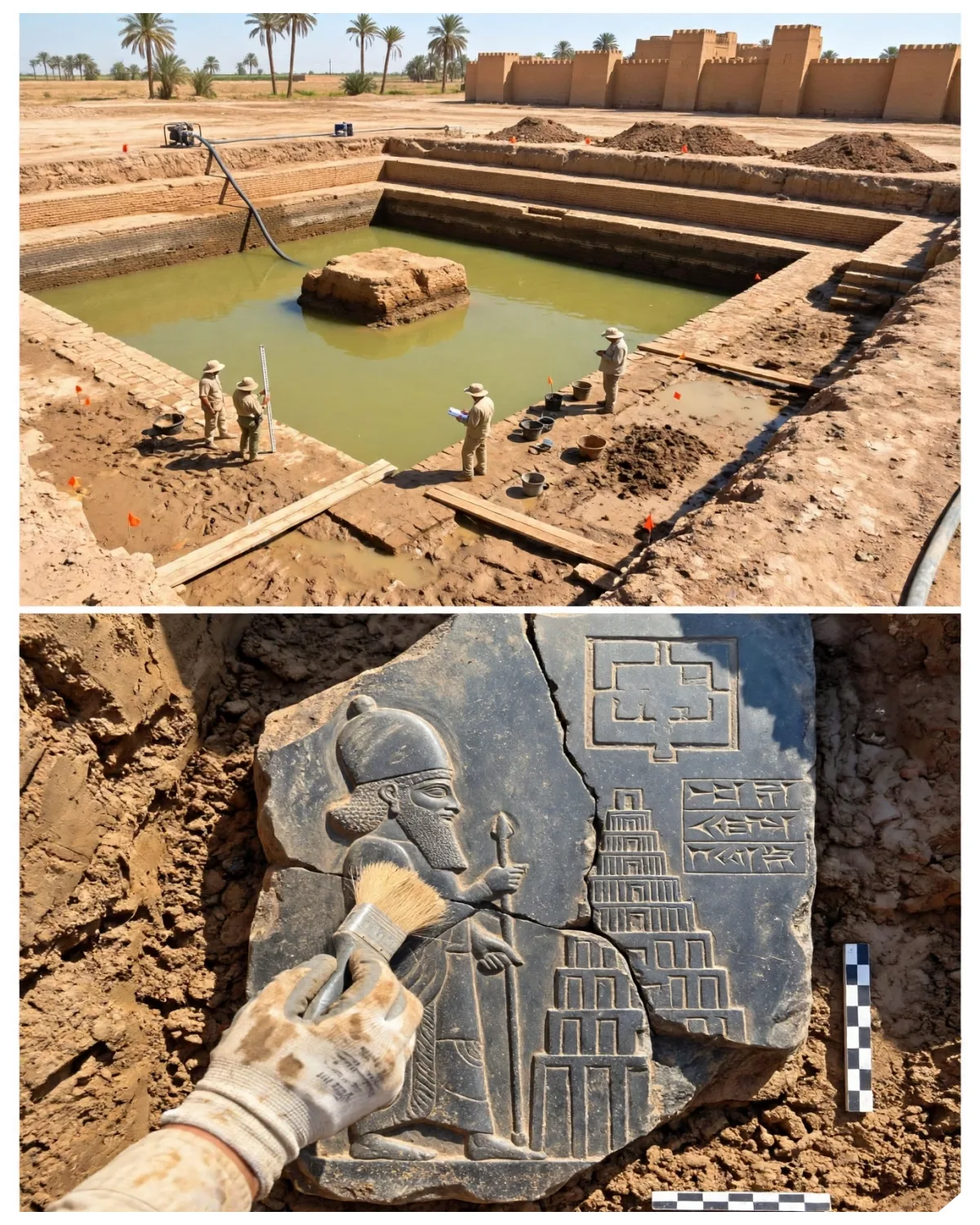
Their pumps were roaring.
They were pulling water out of the earth where the most famous tower in history should have stood.
There was no tower.
There was a hole full of water.
But the hole had edges.
And when they measured them, each side came to almost exactly 300 ft.
A clay tablet copied more than 2,000 years earlier had given the same number.
The tower had not simply vanished.
Somebody had taken it apart brick by brick [music] and more than once.
Four things were waiting inside.
A square of water, a tower hidden inside the tower, a message a king sealed into the wall, and the oldest picture of the tower ever found.
That last one left Iraq after smugglers told the border guards it was a fake.
To understand what was waiting in that pit, you have to know what was supposed to be standing over it.
Babylon sat on the Euphrates River about 55 mi south of modern Baghdad.
By the 6th century B.CE, it was one of the largest cities on Earth.
Its walls were so wide that people said chariots could pass each other on top.
Its gates were faced with glazed blue brick and at its center rose a single building that could be seen from miles across the flat plain.
The Babylonians called it etani.
In Sumerian the name means house of the foundation of heaven and earth.
It was a ziggurat, a stepped tower of brick built in stages, one above another.
It stood beside the great temple of Marduk, the chief god of the city.
To the people of Babylon, this was the point where the world was anchored.
Here is the problem.
For [snorts] more than 2,000 years, almost nobody who wrote about this tower had actually seen it.
The most famous description came from the Greek historian Heroditus in the 5th century B.C.E.
He wrote of a solid tower with eight levels stacked one on another, a ramp wound around the outside all the way to the top.
Halfway up, there were seats where climbers could rest.
At the summit, he placed a temple with a great couch and a golden table.
It is a vivid picture and a problem.
Heroditus never claimed he had climbed it himself.
Parts of his account do not match anything else we know.
He may have been repeating what others told him.
Then there is the book of Genesis.
Its account of a tower in the land of Shenar mentions builders using baked brick instead of stone and bumenumen for mortar.
That detail matters because baked brick and bumen are exactly what Babylon was built from.
So the tower had a name.
It had descriptions.
What it did not have was a location anyone could agree on.
For centuries, travelers went looking and pointed at the wrong ruins.
Until the 17th century, many Europeans believed the Tower of Babel was a ziggurat at a place called Akar Kuf near Baghdad.
That tower was real, but it was built by a completely different king for a completely different city.
Medieval Arab writers made a different mistake.
They confused the tower with the ruined royal palace of Babylon.
Visitors in the 16th century were told the same story by local guides.
Everyone had heard of the tower.
Nobody could find it.
And while the scholars argued, someone else was already digging.
In 1886, people from the villages around Babylon were sinking wells and working the ground for palm gardens.
Their shovels hit something hard.
Baked bricks, huge ones, many thousands of them.
Good fired brick was valuable in a land with almost no stone.
So they did what people in that region had done for centuries.
They pulled the bricks out and carried them away to build with.
They had no idea they were quarrying the foundations of the most famous tower in history.
And the tower still had one more secret buried in that ground.
A carved picture of itself.
It would not be found by any professor.
It would turn up a century later in the hands of two fishermen.
Before that, the scholars finally arrived.
On the 26th of March 1899, a German architect named Robert Culaway began excavating Babylon.
His team would stay for 18 years.
They uncovered the city walls, the palaces, the great processional street, the blue gate of Ishtar, but the tower kept beating them.
The place where it should have stood was low ground.
And low ground in Babylon meant water.
Every time they dug down, groundwater seeped into the trench and filled it.
It was not until 1913 that they finally attacked the problem properly.
Engineers brought in pumps.
The architect, Friedrich Vetszel, surveyed what was left.
Slowly, the water came down and the outline of the foundation appeared.
It was a square.
Each side measured about 91 1/2 m, roughly 300 ft.
And that number had already been written down on a clay tablet barely the size of a man’s hand by someone who had been dead for more than 2,000 years.
The tablet is small enough to close your fingers around.
It is covered on both sides in rows of tiny wedge-shaped marks, [music] and it is one of the most important documents ever written about the Tower of Babel.
It was copied in the city of Uruk in the year 229 B.CE.
But the scribe who pressed these signs into the clay was not writing anything new.
He was copying an older text.
Some scholars think the original may go back as far as the late 8th or early 7th century B.C.E.
Long before the tower was finished.
Today, the tablet sits in the Louv in Paris.
[music] Scholars call it the Asagula tablet.
It was first translated in 1876 by the English scholar George Smith.
And for decades, almost nobody could check whether a word of it was true.
Here is what it says.
The text is written like a set of mathematical problems.
It gives the measurements of the temple of Marduk and then turns to the tower.
Its base is 3 * 60 units long and 3 * 60 units wide.
The Babylonians counted in 60s.
That base comes out at 180 cubits on each side.
A Babylonian cubit was about half a meter.
So the base measures roughly 90 m, about 300 ft.
Now remember the pit.
When the Germans finally pumped the water out in 1913, they measured that foundation at about 91 12 m on each side.
The ground and the tablet agreed.
A scribe working more than 2,000 years earlier had recorded the footprint of the tower almost to the meter.
The tablet does not stop at the base.
It describes seven stages.
It gives the length and the width and the height of every single one.
The numbers are not random.
Again and again, they fall into neat multiples of three and five.
It reads less like a building report and more like a design.
And at the very top, it describes a temple.
According to the tablet, the summit held a cluster of rooms.
Each was set aside for a different god in the Babylonian belief system.
There were rooms for Marduk and his wife Sarpanum, for Nabu and his consort Tashmetu, for Aah, for Nusu.
One room was shared by Anu and Enlil.
And there was one more chamber.
The tablet calls it the house of the bed.
Inside it stood a bed and a throne.
Then comes the strangest line of all.
On the back of the tablet, the scribe added a [music] warning.
It says that the one who knows may show the one who knows.
The one who does not know must not see it.
These measurements were not meant for ordinary eyes.
So, the tablet had been right about the base, which raises an obvious question.
Was it right about everything else?
This is where the story gets uncomfortable.
Add up the heights of those seven stages and the temple on top, and the tower reaches about 90 m into the sky, as tall as it was wide.
A perfect cube of brick and air rising 300 f feet above the plane.
Many experts do not believe it ever stood that high.
When modern researchers rebuild the tower on paper using the stairways and the surviving foundations, the numbers keep coming out lower.
One widely used reconstruction gives a total height of around 60 m.
Still tall enough to dominate the city, but a long way short of a perfect cube.
Some scholars now suspect the tablet was never describing the tower as it actually stood.
It may have been describing the ideal, a sacred blueprint, the tower as the priests believed it ought to be.
The measurements line up a little too neatly to be a simple survey.
But that still leaves one question nobody could answer.
The base was real.
So what exactly had been built on top of it?
Because when Wetzel and his team looked closer at the foundation, they noticed something that did not fit.
Inside that 300 ft square was a solid core of sundried mud brick.
And the core was far too small, about 200 ft across, sitting in the middle of the giant footprint like a smaller building.
Something else was inside the tower.
To understand what that smaller core was, you have to go back to the year 689 B.CE.
De because that year somebody tried to wipe this tower off the face of the earth.
His name was Sinakaribb.
He was king of Assyria.
Babylon had rebelled against him again and again.
And this time he decided to end the problem for good.
His own inscriptions describe what happened next.
His army stormed the city.
The temples were smashed and the great tower of Babylon was torn down.
Sinakaribb boasted that he had destroyed the ziggurat built of brick and earth.
Here is the strange part.
Within a single decade, the tower was rising again.
Sinakarb was murdered by his own sons.
His successor, Esser Haden, took a very different view of Babylon.
[music] He ordered the city rebuilt and he left an inscription describing the tower.
He gave its base as a rope and a half.
To a Babylonian builder, that meant about 180 cubits, roughly 90 m on each side.
Remember that number.
It is the same footprint the Germans pumped dry in 1913.
The same footprint recorded on the clay tablet.
So, the giant tower existed under Esser Haden.
But what happened to the one Sinakaribb smashed?
Was it cleared away or was it still there?
For almost 50 years, nobody dug deep enough to find out.
Then in 1962, a German architect named Hanzorg Schmid returned to Babylon.
He did something the first excavators had never done.
He cut into the core itself.
Brick by brick, he traced every wall and every joint inside that solid mass.
The early excavators had seen two things.
A mudbrick core in the middle and an outer shell of baked brick around it.
Schmid found three.
At the very center was the oldest structure, a tower of sundried mud brick roughly 65 m square at its base, about 213 ft.
It was badly damaged.
Schmid believed this was the tower Sinakaribb had torn down.
Wrapped around it was a second tower, a thick new casing of mud brick that pushed the base out to about 73 m, roughly 240 ft.
And it had been tied into the old core with timber beams.
The builders had not cleared the ruin away.
They had locked it inside.
Then came the third, the outermost shell, a wall of baked brick about 50 ft thick that pushed the base all the way out to that famous 300 ft square, fired brick set in bumen.
To make room for it, the builders had cut the older towers back below ground level.
They left a shelf of hardpacked mud brick that helped carry the weight of the new shell.
So this was what was waiting inside the Tower of Babel.
Not an empty chamber, another tower.
And inside that one, another tower again.
Babylon had never built a single tower on this spot.
It had built a tower around a tower around a tower.
Each king wrapped the ruin of the last one in a bigger skin.
But this is where the experts start to disagree.
And the disagreement matters.
Andrew George is one of the leading authorities on Babylonian texts in the world.
He went back to the inscriptions and found that they do not fit Schmid’s story neatly.
Essen’s text already gives the full 90 m base.
So the biggest version of the tower must have existed by his time.
Esson also wrote that he built in baked brick, not mud brick.
That clashes with the idea that the middle tower of mud was his.
George’s conclusion is startling.
The 73 m tower may be older than Sinakaribb and the great 90 m design itself may be far older than anyone assumed based on the measuring units it uses.
He suggests the original builder might have reigned anywhere from the 14th to the 9th century BCE.
In other words, the tower Nebuchadnezzar is famous for finishing may have been an old giant even before Assyria knocked it down.
Nobody knows who laid that first core.
The name of that king is still buried in the mud.
But the outer shell is different.
Its builders were not shy.
One of them left his name and his story sealed into the wall itself.
In the 1880s, a clay cylinder was pulled from a niche in the long side of the tower.
It was hollow and it was covered from end to end in uniform.
The man who wrote it was Nabo Palassar, the founder of a new Babylonian dynasty.
He was the king who finally broke the power of Assyria.
And one of the first things he turned to was the tower.
The scribes carved the signs in an old-fashioned style, copying the writing of Babylon’s golden age more than a thousand years earlier.
This was a king who wanted to sound ancient.
Here is what he found when he came to the site.
In his own words, “The tower had become very weak.
It had been allowed to collapse.
Decades after Sinakaribb, it was still a broken giant.”
Nabo Palaso wrote that his god Marduk had commanded him to rebuild it, to set its foundation firmly on the breast of the underworld and to make its summit rival the heavens.
What he describes next is a building site on a staggering scale.
He had hoes and spades and brick molds made of ivory and ebony and rare wood.
He put them in the hands of a vast workforce drawn from across his land.
They made mud bricks without number.
And they molded baked bricks, he says, like countless drops of rain.
The Aratu Canal carried bitumen to bind them.
Surveyors and master builders laid out the plan.
Omens were taken.
The ground was ritually purified by exorcists.
And then the foundations were laid, but not before something went into them.
Nabopolasar placed gold in the foundations and silver and precious stones from the mountains and the sea.
Beneath the brick work, he spread fine oil and fragrant aromatics.
A fortune buried where no one would ever see it.
And then the king did something extraordinary.
He made statues of himself carrying a basket of earth and set them on the foundation.
Then he bowed.
He rolled up his royal robe and he carried mud bricks and mud on his own head.
He did not stop there.
He called his firstborn son and made him carry mud mixed with wine and oil and crushed aromatics.
His younger son took up a hoe and a spade.
The king placed a basket of gold and silver on him.
That firstborn son was named Nebuchadnezzar.
Think about that.
The boy who carried scented mud to the foundation of this tower would grow up to become the most famous king Babylon ever had.
And he would need to because his father never finished the job.
Nabopolaser raised the four outer walls about 30 cubits, roughly 50 ft, using baked brick and bumenumen.
And there the work stopped.
In the words of his son, the upper part had not been raised.
When Nebuchadnezzar took the throne, he picked up where his father left off, and he made it bigger.
His inscriptions describe workers drawn from the upper sea to the lower sea, from the Mediterranean to the Persian Gulf, men from the old cities of the south, Ur, Uruk, Larsa, Eridu, Nepur, men from Assyria, and kings and governors from the lands west of the Euphrates.
Those western rulers brought cedar from the mountains of Lebanon all the way to Babylon.
The timber was plated in bronze.
The bricks kept coming.
Some modern estimates run to tens of millions of them.
Course by course, the tower rose.
And at the top, Nebuchadnezzar built a holy shrine with a richly decorated bedroom inside, just as the clay tablet described.
Another of his inscriptions speaks of bricks glazed in shining blue.
Picture it at the end of his reign.
[music] a mountain of brick rising in stages above the flat plain crowned with blue glaze that caught the sun.
And this was the tower that a very particular group of people saw every day in 597 B.CE.
And again in 586 B.CE.
Nebuchadnezzar’s armies took Jerusalem.
Thousands of people from Judah were brought to Babylon as exiles.
They lived in its shadow for decades.
Many scholars believe the account of a tower in Genesis was shaped by exactly this building.
It seemed built to stand forever.
Within two centuries, it was coming down.
And the people tearing it apart claimed they only wanted to rebuild it.
In 539 B.CE, Babylon fell to Cyrus of Persia.
There was no great sack.
The city simply changed hands and the tower kept standing.
Almost a century later, the Greek writer Herodotus described it as a working monument.
Eight levels, a ramp, a temple at the top.
Whatever the flaws in his account, he clearly believed the tower was still there.
So, what happened to it?
For a long time, the answer seemed simple.
Blame Xerxes.
Xerxes was the Persian king remembered for invading Greece.
In 484 B.CE, CE Babylon rose against him.
Both revolts were crushed.
Herodotus says that afterwards Xerxes carried off a great statue from the temple of Marduk.
Centuries later, the Roman era historian Aryan went further.
He claimed Xerxes had destroyed the tower itself.
It is a neat story.
A furious king punishes a rebel city by tearing down its greatest monument.
Here is the problem.
Babylonian records from the fifth and fourth centuries B.C.E.
Show rituals still being carried out in the sacred precinct.
Life around the tower went on.
Some historians now argue that the Xerxes story was exaggerated.
Greek and Roman writers had every reason to paint Persian kings as destroyers of temples, but the ground tells its own story, and it is not entirely on the side of Xerxes.
When Hudzorg Schmid excavated the core in 1962, he found clear signs of deliberate damage.
Someone had demolished the great stairways on the south side.
The baked brick shell next to them had been broken open.
The mud brick heart of the tower was left exposed to the weather.
Somebody had attacked the tower on purpose.
Andrew George accepts that this damage probably happened in the Persian era, [music] but he warns that the ancient writers who blamed Xerxes were hardly neutral witnesses.
Who struck the first blow is still an open question.
What happened next is not.
In 331 B.CE, Alexander the Great rode into Babylon.
He had just defeated the Persian king and he was fascinated by the city.
He wanted to make it one of the capitals of his new empire.
Ancient writers say he ordered the ruined temples of Babylon restored.
Then he went east.
When he came back years later, he found that very little had been done.
So Alexander made a radical decision.
Rather than patch the old ruin, he would clear it completely and start again from the ground.
According to the ancient sources, he put 10,000 men to work [music] for about 2 months.
In the spring of 323 B.CE, they hauled away the remains of the tower.
They carried the rubble across the city and [music] dumped it in a great heap.
And then on the 11th of June, 323 B.CE, Alexander died in Babylon.
The new tower was never built.
The old one was already half gone.
Here the evidence takes a strange turn.
Andrew George points out that the classical writers may have handed Alexander credit for work that actually took much longer.
Kuneaoform records from Babylon describe workers clearing debris from the temple of Marduk for decades from about 327 B.CE to around 281 B.CE.
The tower may have been dismantled slowly over a generation.
The rubble went somewhere.
Some was dumped about half a mile to the northeast, just inside the city wall.
Over time, it formed an artificial hill.
The Greeks later built a theater against its slope.
Then comes one of the oddest moments in the whole story.
A Babylonian chronicle records a visit by the Greek crown prince Antiochus.
He came to make an offering on what was left of the tower.
And during the ceremony, he stumbled.
Whatever happened next, he ordered his elephant drivers to destroy the last remains.
The tower that Sinakaribb had smashed and Nabopolasser had raised was finished off by a stumble and a team of war elephants.
After that, the leveled core became a building site.
A large building went up on top of it in the Parthion era.
Later builders used the remains as foundations.
The tower was gone, but one picture of it survived.
It was carved for the king who had finished it and it would surface far from any excavation in a little village of fishermen.
Jungjuma is a small village on the southern edge of ancient Babylon.
Sometime in the early 1990s, two fishermen from that village were walking through the ruins.
They came to an old trench, a long cut in the earth that German archaeologists had opened almost a century earlier.
It ran north from the deep pit where the temple of Marduk once stood, about 20 m from that temple, close to where the tower had risen.
In that trench lay two pieces of black stone.
Perhaps they had fallen out of the trench wall.
The fisherman picked them up.
We know this because one of them later told the story to the Swedish archaeologist Olaf Person.
The men asked that their names be kept private.
Person is honest about the limits here.
There are no photographs of the find, no other witnesses, but he found their account believable, and they had no obvious reason to invent it.
What happened next is darker.
Iraq in the early 1990s was under Saddam Hussein.
According to Person, the stones were taken out of the country by people linked to the security services at the border.
They had a simple story ready.
These were not antiquities.
They were modern imitations, fakes.
The pieces soon appeared on the antiquities market in 1995 and again in 1999.
They were bought by a private collector in Norway named Martin Shoyen.
And then a story was attached to them.
The collection said the stone had been found in 1917 during the final days of the German excavation.
Person calls that faulty information, probably invented by the dealers.
So, what exactly had the fisherman found?
Joined together, the two fragments make a slab of black stone about 18 1/2 in tall.
On its face is a man in profile.
He wears the tall rounded hat of a Babylonian king.
In one hand, he holds a staff.
In the other, he holds an object that may be a building tool or a rolledup plan.
Next to him stands a tower stepped, rising in stages.
Above it is carved the floor plan of the shrine at its summit.
And beside the tower, three short lines of ununiform give its name, Emani, the ziggurat of Babylon.
In 2011, Andrew George published the stone in full.
He confirmed that the inscription belongs to Nebuchadnezzar II.
It is only the fourth certain image of that king ever found.
The other three are carved into cliffs in Lebanon and have been battered by the weather for 26 centuries.
And the text below the picture is the king speaking.
He says that to complete this tower, he mobilized all countries everywhere, every ruler who had risen to power over the peoples of the world.
He says he finished it to the top with baked brick.
This is the tower in the hands of the man who completed it.
The oldest known picture of the Tower of Babel made while it still stood.
Patterson went further.
He measured the carving and worked through the proportions.
His reading suggests a tower of six stepped terraces with a sanctuary on top about 91 12 m on each side at the base.
The pit in the ground, the clay tablet in Paris, the king’s own carving.
Three witnesses separated by thousands of years.
And all three agree on the size of the base, on how many stages, and how high.
They still argue.
But the steel had one more journey to make.
In 2021, at the request of Iraq, Norwegian police seized it along with other objects.
A year later, a Norwegian court ruled that Iraq had not proven where the stone came from.
It went back to the collection.
Then, Person shared his research, including where the fisherman said they found it.
After reading it, the collector made a decision.
In December 2023, the steel was handed back to Iraq as a gift.
It is meant to be conserved and displayed in the Iraq Museum in Baghdad.
The picture of the tower has gone home.
The tower itself has not.
Today, only the mud brick core survives, about 200 ft square and just a few meters high.
Where the great baked brick shell once stood, there is mostly water.
Go back to that square of water.
The engineers thought they had found the place where a tower once stood.
They had found something stranger.
Not one tower, but several.
Each king wrapped the ruin of the last inside a bigger shell.
And the final one was not destroyed in a single blow.
It was taken apart for a rebuild that never came.
Four things were waiting inside.
A square of water, a tower hidden inside the tower, a message a king sealed into the wall, and a picture of the tower carried out of Iraq as a fake.
Yet, the biggest questions are still open.
How high did it really stand?
[music] And who laid that first core of mud?
Only about a fifth of Babylon has ever been excavated.
So, which would you want answered first?
Its true height or the name of its first builder?
Tell me below.